


Consumers' Response to an On-Shelf Nutrition Labelling System in Supermarkets: Evidence to Inform Policy and Practice
- PMID: 28895220
- PMCID: PMC5594320
- DOI: 10.1111/1468-0009.12277
Consumers' Response to an On-Shelf Nutrition Labelling System in Supermarkets: Evidence to Inform Policy and Practice
Abstract
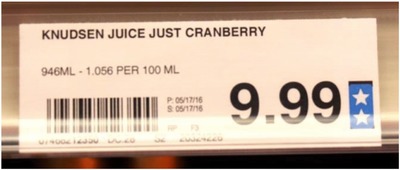
Policy Points: On-shelf nutrition labelling systems in supermarkets, such as the Guiding Stars system, are intended to provide consumers with simple, standardized nutrition information to support more informed and healthier food choices. Policies that support the provision of simplified nutrition labelling systems may encourage consumers to make positive shifts in food-purchasing behaviors. The shifts in consumer food-purchasing patterns observed in our study after the introduction of the Guiding Stars system in supermarkets translated into measurable nutritional benefits, including more items purchased with slightly less trans fat and sugar and more fiber and omega-3 fatty acids. This study is one of the first to report the positive impact of an on-shelf nutrition labelling system on supermarket sales and revenues-key information that was specifically requested by the US National Academies, as such labelling interventions may be more sustainable if they lead to higher revenues.
Context: Providing a nutrition rating system on the front of food packages or on retail shelf tags has been proposed as a policy strategy for supporting healthier food choices. Guiding Stars is an on-shelf nutrition labelling system that scores foods in a supermarket based on nutritional quality; scores are then translated into ratings of 0 to 3 stars. It is consistent with evidence-informed recommendations for well-designed labels, except for not labelling 0-star products. The largest supermarket retailer in Canada rolled out the Guiding Stars system in supermarkets across Ontario, Canada. The aim of our study was to examine the extent to which consumers respond to an on-shelf nutrition labelling system in supermarkets to inform current and future nutrition labelling policies and practices.
Methods: Capitalizing on a natural experiment, we conducted a quasi-experimental study across 3 supermarket banners (or "chains") in Ontario, one of which implemented the Guiding Stars system in 2012. We used aggregated supermarket transaction data to test the effect of Guiding Stars on the nutritional quality of food purchases in intervention supermarkets relative to control supermarkets. We also conducted exit surveys among 783 randomly selected shoppers from intervention and control supermarkets to assess consumer awareness, understanding, trust, and self-reported use of the labelling system.
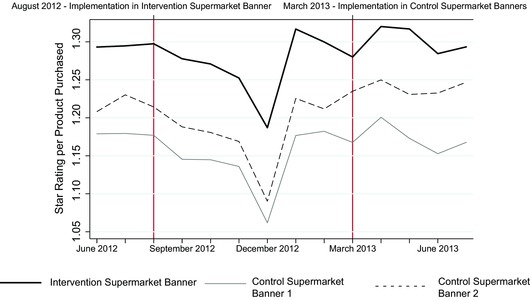
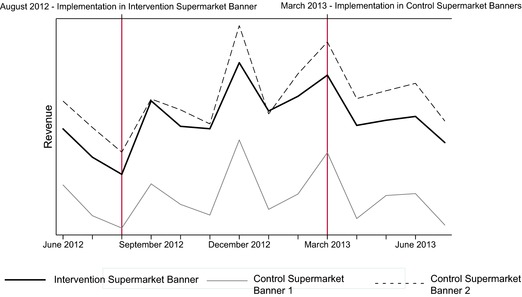
Findings: Relative to control supermarkets, shoppers in intervention supermarkets made small but significant shifts toward purchasing foods with higher nutritional ratings; however, shifts varied in direction and magnitude across food categories. These shifts translated into foods being purchased with slightly less trans fat and sugar and more fiber and omega-3 fatty acids. We also found increases in the number of products per transaction, price per product purchased, and total revenues. Results of the exit surveys indicate a modest proportion of consumers were aware of, understood, and trusted Guiding Stars in intervention supermarkets, and a small proportion of consumers reported using this system when making purchasing decisions. However, 47% of shoppers exposed to Guiding Stars were confused when asked to interpret the meaning of a 0-star product that does not display a rating on the shelf tag.
Conclusions: This study demonstrates support for policies promoting on-shelf nutrition labels designed according to evidence-informed principles, but policymakers should move forward with caution when investing in such systems until research has confirmed optimal label design, clarified the mechanisms through which dietary intake is improved, and assessed associations with nutrition-related health outcomes.
Keywords: food environment; food labelling; nutrition policy; population health intervention research.
© 2017 Milbank Memorial Fund.
Figures
References
-
- Global burden of disease country profiles—Canada . Institute for Health Metrics and Evaluation website. http://www.healthdata.org/canada. Accessed June 20, 2017.
-
- Global burden of disease country profiles—United States . Institute for Health Metrics and Evaluation website. http://www.healthdata.org/united‐states. Accessed October 27, 2016.
-
- Global burden of disease country profiles—Australia . Institute for Health Metrics and Evaluation website. http://www.healthdata.org/australia. Accessed October 27, 2016.
-
- World Health Organization . Global strategy on diet, physical activity, and health. http://www.who.int/dietphysicalactivity/strategy/eb11344/strategy_englis.... Published 2002. Accessed October 27, 2016.
Publication types
MeSH terms
Grants and funding
LinkOut - more resources
Full Text Sources
Other Literature Sources
Medical
