


Trends and age, period and cohort effects for marijuana use prevalence in the 1984-2015 US National Alcohol Surveys
- PMID: 28895239
- PMCID: PMC5807111
- DOI: 10.1111/add.14031
Trends and age, period and cohort effects for marijuana use prevalence in the 1984-2015 US National Alcohol Surveys
Abstract
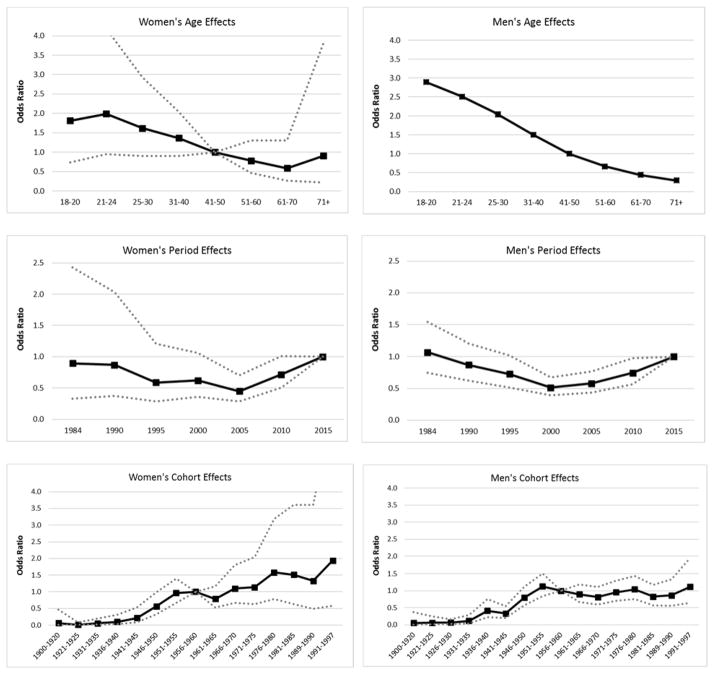
Background and aims: Epidemiological trends show marijuana use in the United States to have increased in recent years. Previous research has identified cohort effects as contributing to the rising prevalence, in particular birth cohorts born after 1945. However, given recent policy efforts to regulate marijuana use at the state level, period effects could also play a contributory role. This study aimed to examine whether cohort or period effects play a larger role in explaining trends in marijuana use.
Design: Using data from seven National Alcohol Surveys, we estimated age-period-cohort decomposition models for marijuana use, controlling for socio-demographic measures.
Setting: United States.
Participants: US general population aged 18 and older from 1984 to 2015.
Measurements: Any past-year marijuana use.
Findings: Results indicated that period effects were the main driver of rising marijuana use prevalence. Models including indicators of medical and recreational marijuana policies did not find any significant positive impacts.
Conclusions: The steep rise in marijuana use in the United States since 2005 occurred across the population and is attributable to general period effects not linked specifically to the liberalization of marijuana policies in some states.
Keywords: Age; age-period-cohort; legalization; marijuana; marijuana policy; trends.
© 2017 Society for the Study of Addiction.
Conflict of interest statement
Conflict of interest and financial disclosure: no conflicts to disclose
Figures
Comment in
-
Commentary on Kerr et al. (2018): Marijuana, drug use, and mental health in the United States-a tale of two generations.Addiction. 2018 Mar;113(3):482-483. doi: 10.1111/add.14047. Addiction. 2018. PMID: 29423983 Free PMC article.
References
-
- Kerr WC, Greenfield TK, Bond J, Ye Y, Rehm J. Age-period-cohort influences on trends in past year marijuana use in the U.S. from the 1984, 1990, 1995, and 2000 National Alcohol Surveys. Drug Alcohol Depend. 2007;86(2–3):132–8. - PubMed
Publication types
MeSH terms
Grants and funding
LinkOut - more resources
Full Text Sources
Other Literature Sources
Medical
Miscellaneous
