


Self-care and health-related quality of life in chronic heart failure: A longitudinal analysis
- PMID: 28895482
- PMCID: PMC5624300
- DOI: 10.1177/1474515117702021
Self-care and health-related quality of life in chronic heart failure: A longitudinal analysis
Abstract
Background: Self-care is assumed to benefit health outcomes in patients with chronic heart failure (HF), but the evidence is conflicting for health-related quality of life (HRQOL). The aim of this study was to examine the association of (changes in) self-care with HRQOL while adjusting for psychological distress.
Methods: In total, 459 patients (mean age = 66.1 ± 10.5 years, 73% male) with chronic HF completed questionnaires at baseline and at 6, 12 and 18 months of follow-up. Self-care and HF-specific HRQOL were quantified with the European Heart Failure Self-care Behaviour scale and the Minnesota Living with Heart Failure Questionnaire.
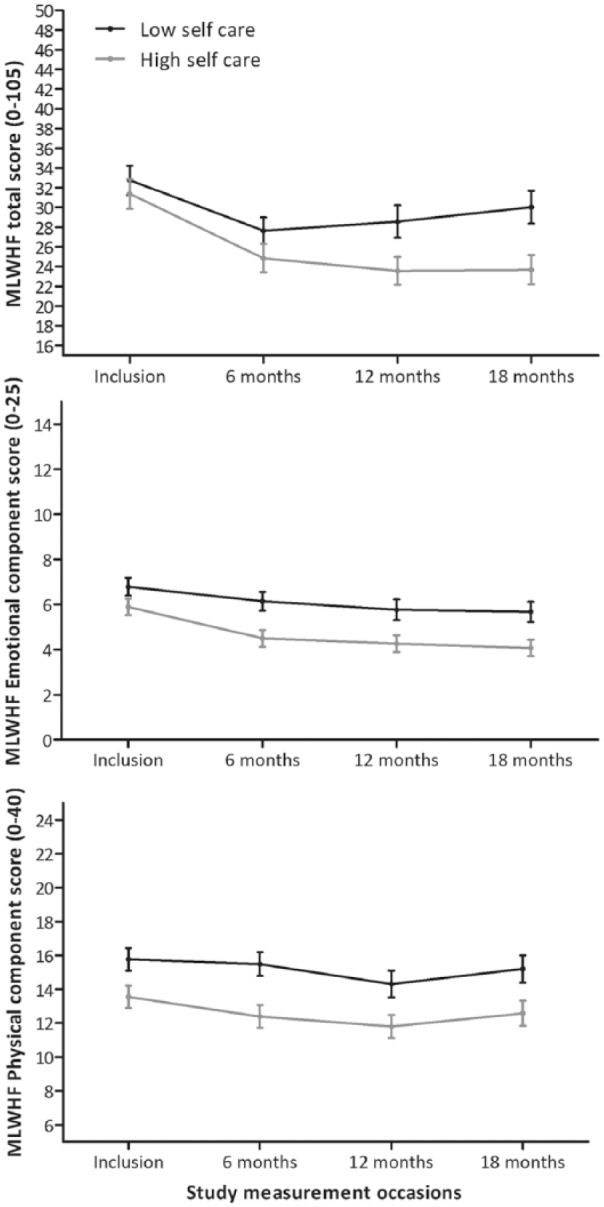
Results: Using general linear models, multivariable between-subject (estimate = -0.14, p = 0.005) and no within-subject effects of self-care were found for better HRQOL over time. Associations between self-care and HRQOL were fully explained by depression (estimate = 1.77, p < 0.001). Anxiety (estimate = 4.49, p < 0.001) and Type D personality (estimate = 13.3, p < 0.001) were associated with poor HRQOL, but only partially accounted for the relationship between self-care and emotional HRQOL.
Conclusions: Self-care was prospectively associated with better disease-specific HRQOL in patients with HF, which was fully accounted for by depression, and partially accounted for by anxiety and Type D personality. Changes in self-care within a person did not affect HRQOL. Psychological distress should be considered in future efforts to address self-care and HRQOL.
Keywords: Anxiety; Type D personality; depression; heart failure; psychological; quality of life; self-care; stress.
Conflict of interest statement
Figures
References
-
- Dickstein K, Cohen-Solal A, Filippatos G, et al. ESC Guidelines for the diagnosis and treatment of acute and chronic heart failure 2008: The Task Force for the Diagnosis and Treatment of Acute and Chronic Heart Failure 2008 of the European Society of Cardiology. Developed in collaboration with the Heart Failure Association of the ESC (HFA) and endorsed by the European Society of Intensive Care Medicine (ESICM). Eur Heart J 2008; 29(19): 2388–2442. - PubMed
-
- Cook C, Cole G, Asaria P, et al. The annual global economic burden of heart failure. Int J Cardiol 2014; 171(3): 368–376. - PubMed
-
- Lesman-Leegte I, Jaarsma T, Coyne JC, et al. Quality of life and depressive symptoms in the elderly: A comparison between patients with heart failure and age- and gender-matched community controls. J Card Fail 2009; 15(1): 17–23. - PubMed
MeSH terms
LinkOut - more resources
Full Text Sources
Other Literature Sources
Medical
Research Materials
Miscellaneous
