


"Autoimmune(-Like)" Drug and Herb Induced Liver Injury: New Insights into Molecular Pathogenesis
- PMID: 28895915
- PMCID: PMC5618603
- DOI: 10.3390/ijms18091954
"Autoimmune(-Like)" Drug and Herb Induced Liver Injury: New Insights into Molecular Pathogenesis
Abstract
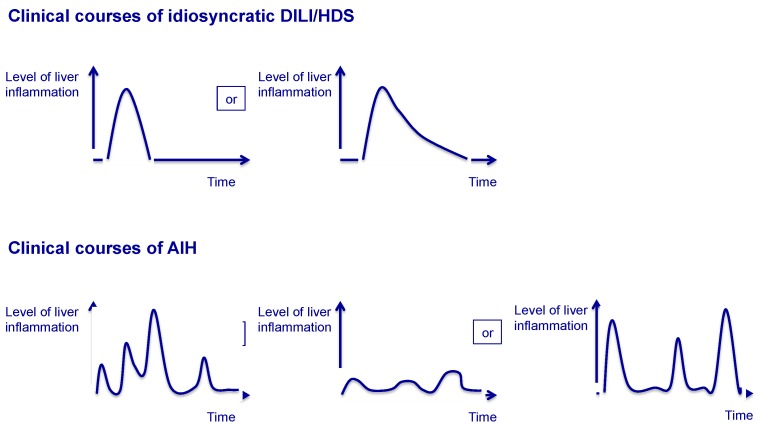
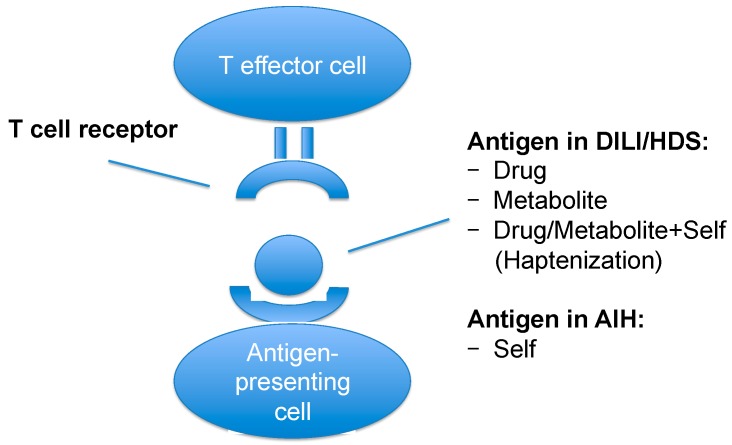
Idiosyncratic drug-induced liver injury (DILI) and hepatic injury due to herbal and dietary supplements (HDS) can adapt clinical characteristics of autoimmune hepatitis (AIH), such as the appearance of autoantibodies and infiltration of the liver by immune competent cells. To describe these cases of DILI/HDS, the poorly-defined term "autoimmune(-like)" DILI/HDS came up. It is uncertain if these cases represent a subgroup of DILI/HDS with distinct pathomechanistic and prognostic features different from "classical" DILI/HDS. Besides, due to the overlap of clinical characteristics of "immune-mediated" DILI/HDS and AIH, both entities are not easy to differentiate. However, the demarcation is important, especially with regard to treatment: AIH requires long-term, mostly lifelong immunosuppression, whereas DILI/HDS does not. Only through exact diagnostic evaluation, exclusion of differential diagnoses and prolonged follow-up can the correct diagnosis reliably be made. Molecular mechanisms have not been analysed for the subgroup of "autoimmune(-like)" DILI/HDS yet. However, several pathogenetic checkpoints of DILI/HDS in general and AIH are shared. An analysis of these shared mechanisms might hint at relevant molecular processes of "autoimmune(-like)" DILI/HDS.
Keywords: autoimmune hepatitis; autoimmune-like drug induced liver injury; drug-induced liver injury; herbal and dietary supplements; herbs; idiosyncratic.
Conflict of interest statement
The authors declare no conflict of interest.
Figures
References
-
- Kleiner D.E., Chalasani N.P., Lee W.M., Fontana R.J., Bonkovsky H.L., Watkins P.B., Hayashi P.H., Davern T.J., Navarro V., Reddy R., et al. Hepatic histological findings in suspected drug-induced liver injury: Systematic evaluation and clinical associations. Hepatology. 2014;59:661–670. doi: 10.1002/hep.26709. - DOI - PMC - PubMed
-
- Chalasani N., Bonkovsky H.L., Fontana R., Lee W., Stolz A., Talwalkar J., Reddy K.R., Watkins P.B., Navarro V., Barnhart H., et al. Features and Outcomes of 899 Patients with Drug-Induced Liver Injury: The DILIN Prospective Study. Gastroenterology. 2015;148:1340–1352. doi: 10.1053/j.gastro.2015.03.006. - DOI - PMC - PubMed
Publication types
MeSH terms
Substances
LinkOut - more resources
Full Text Sources
Other Literature Sources
Medical
