


Burden of chronic urticaria relative to psoriasis in five European countries
- PMID: 28898460
- PMCID: PMC6084337
- DOI: 10.1111/jdv.14584
Burden of chronic urticaria relative to psoriasis in five European countries
Abstract
Background: Quantification of burden of chronic spontaneous urticaria (CSU) vs. psoriasis (PsO) is limited.
Objective: To evaluate the burden associated with CSU vs. PsO of all severities (overall PsO), mild and moderate/severe PsO.
Methods: This retrospective cross-sectional analysis compared data from adult patients with chronic urticaria (CU), used as a proxy for CSU, and PsO from the National Health and Wellness Survey in France, Germany, Italy, Spain and the United Kingdom. Outcomes included mental and physical component summary scores (MCS and PCS) calculated from the Short Form (SF)-36v2 or SF-12v2, SF-6D health utility scores, self-reported psychological complaints (anxiety, depression and sleep difficulties), work productivity and activity impairment, and self-reported healthcare resource utilization. Bivariate and multivariate analyses for each outcome and comparative groups were conducted.
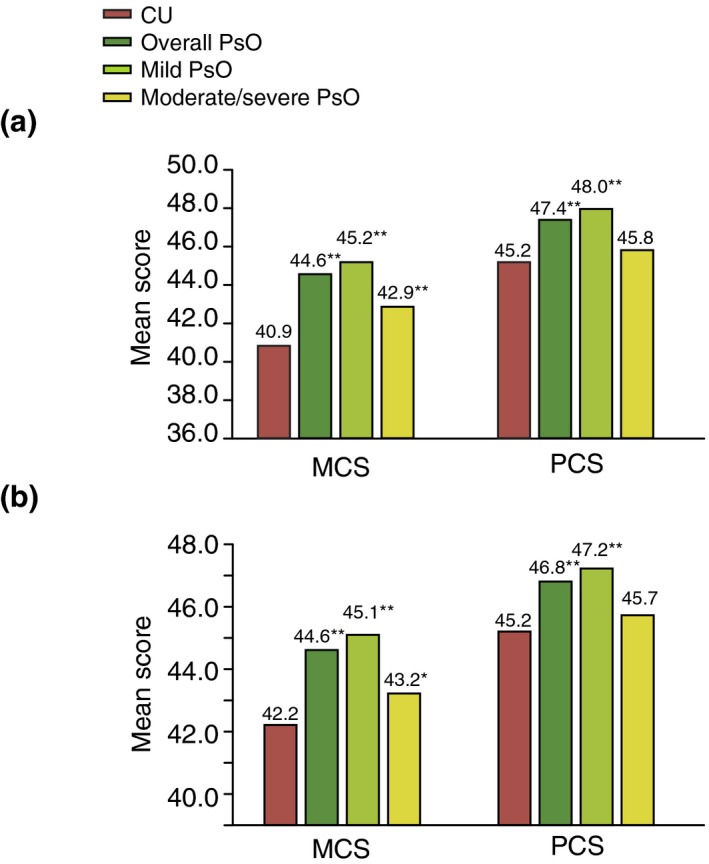
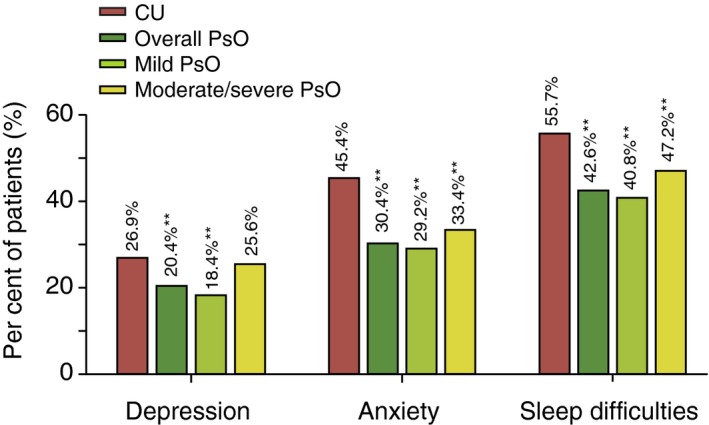
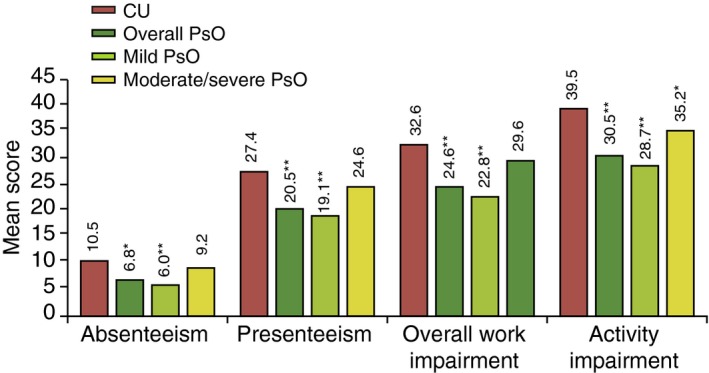
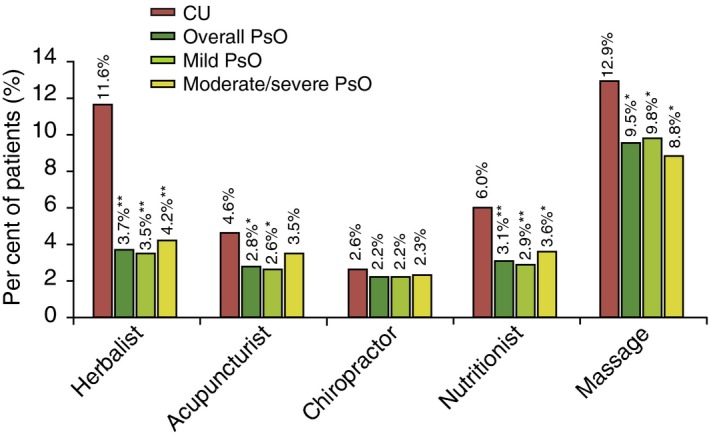
Results: This analysis included 769 CU and 7857 PsO (26.9% moderate/severe) patients. Following adjustment for covariates, CU patients showed a greater health-related quality of life (HRQoL) impairment vs. overall PsO (MCS: -2.4, PCS: -1.6, SF-6D: -0.03; all P < 0.001). CU patients showed a higher risk of anxiety, depression and sleep difficulties [odds ratio (OR): 1.63, 1.34 and 1.56, respectively; all P < 0.01] and greater healthcare resource use vs. overall PsO. The overall activity impairment was significantly greater in CU patients than in overall PsO patients (P = 0.001), while the impact on work was not significantly different. The results vs. moderate/severe PsO group showed no significant differences on all outcomes.
Conclusion: Burden of illness in CU is higher than PsO of all severities but similar to that observed in moderate/severe PsO. Both diseases have a similar negative impact on work productivity.
© 2017 European Academy of Dermatology and Venereology.
Figures
References
-
- Hay RJ, Johns NE, Williams HC et al The global burden of skin disease in 2010: an analysis of the prevalence and impact of skin conditions. J Invest Dermatol 2014; 134: 1527–1534. - PubMed
-
- Zuberbier T, Asero R, Bindslev‐Jensen C et al EAACI/GA(2)LEN/EDF/WAO guideline: definition, classification and diagnosis of urticaria. Allergy 2009; 64: 1417–1426. - PubMed
-
- Zuberbier T, Aberer W, Asero R et al The EAACI/GA(2) LEN/EDF/WAO Guideline for the definition, classification, diagnosis, and management of urticaria: the 2013 revision and update. Allergy 2014; 69: 868–887. - PubMed
-
- Maurer M, Weller K, Bindslev‐Jensen C et al Unmet clinical needs in chronic spontaneous urticaria. A GA(2)LEN task force report. Allergy 2011; 66: 317–330. - PubMed
-
- Lewis V, Finlay AY. 10 years experience of the Dermatology Life Quality Index (DLQI). J Investig Dermatol Symp Proc 2004; 9: 169–180. - PubMed
MeSH terms
LinkOut - more resources
Full Text Sources
Other Literature Sources
Medical
