Review
. 2018 Mar;46(2):158-168.
doi: 10.1111/ceo.13064. Epub 2017 Oct 12.

Structural and functional imaging of aqueous humour outflow: a review

Affiliations
Review

Structural and functional imaging of aqueous humour outflow: a review

Alex S Huang et al. Clin Exp Ophthalmol. 2018 Mar.

Abstract

Maintaining healthy aqueous humour outflow (AHO) is important for intraocular cellular health and stable vision. Impairment of AHO can lead to increased intraocular pressure, optic nerve damage and concomitant glaucoma. An improved understanding of AHO will lead to improved glaucoma surgeries that enhance native AHO as well as facilitate the development of AHO-targeted pharmaceuticals. Recent AHO imaging has evolved to live human assessment and has focused on the structural evaluation of AHO pathways and the functional documentation of fluid flow. Structural AHO evaluation is predominantly driven by optical coherence tomography, and functional evaluation of flow is performed using various methods, including aqueous angiography. Advances in structural and functional evaluation of AHO are reviewed with discussion of strengths, weaknesses and potential future directions.

Keywords: aqueous humour; fluorescein angiography; glaucoma; imaging systems.


Figures

Figure 1
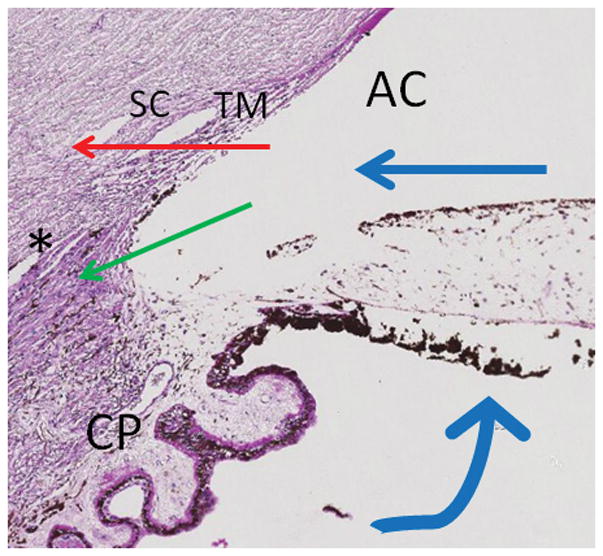
Figure 1. Aqueous Humor Outflow (AHO)
Aqueous humor is produced at ciliary processes (CP) and flows from the sulcus space into the anterior chamber (AC). At that point, there are two outflow pathways. The conventional (trabecular) pathway (red arrow) moves past the trabecular meshwork (TM) into Schlemm’s Canal (SC) ultimately leading to venous system and the right side of the heart. The unconventional (uveoscleral) pathway (green arrow) enters into the ciliary body band at the angle into ciliary body clefts (asterisk).
Figure 2
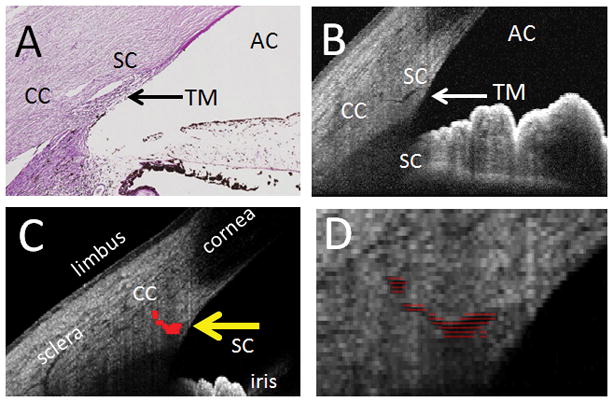
Figure 2. AHO Assessment by OCT and Automated Segmentation
A) Histological anatomy of the human anterior segment angle (PAS stain) showing the anterior chamber (AC), trabecular meshwork (TM), Schlemm’s Canal (SC), and a collector channel (CC). B) OCT B-scan of the human anterior segment angle with similar structures seen. C) Automated segmentation of SC (yellow arrow) and first order CC. D) Expanded view of the segmentation from panel C.
Figure 3
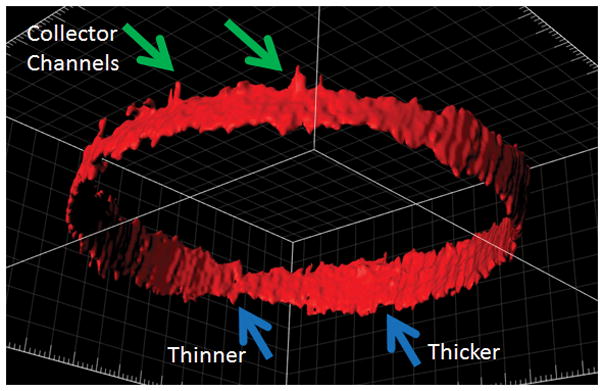
Figure 3. Circumferential (360-degree) Reconstruction of Live Human Outflow Pathways
Anterior-segment OCT was performed circumferential around the limbus of the right eye of a healthy male. A three-dimensional AHO cast was created based on automated segmentation of Schlemm’s Canal (SC; blue arrows) and first order collector channels (green arrows). Areas of thicker and thinner SC are seen.
Figure 4
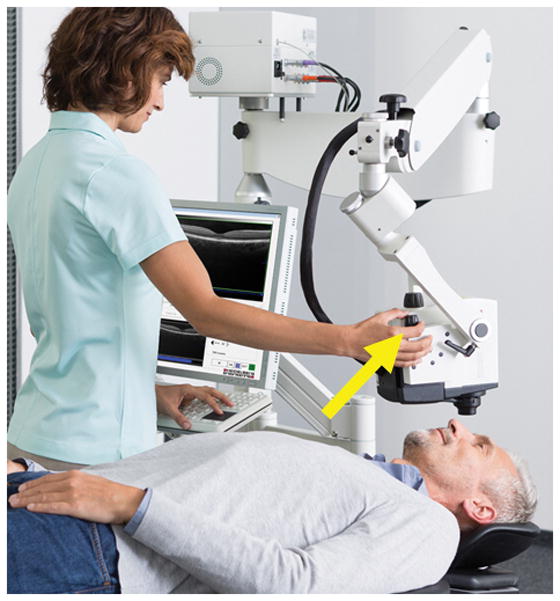
Figure 4. Heidelberg Engineering FLEX Module
The FLEX module is a fully-functional Spectralis HRA+OCT that is installed on a modified surgical boom arm as opposed to a table top. A 500-pound base provides stability. Multiple pivot joints allow imaging in nearly any body position. A micromanipulator (yellow arrow) allows for precise z-axis adjustments. Initial unmodified image provided courtesy of Heidelberg Engineering.
Figure 5
Figure 5. Aqueous Angiography During Cataract Surgery
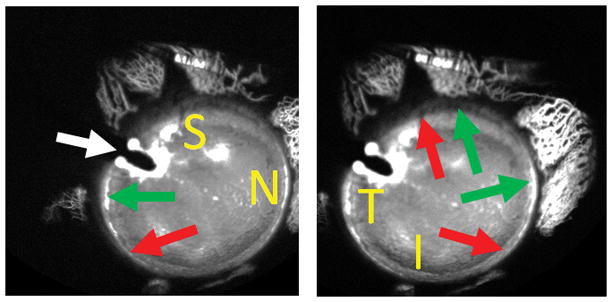
Aqueous angiography was performed in the right eye of a 73-year-old female during cataract surgery with 2% fluorescein diluted in balanced salt solution. The anterior chamber maintainer entered superior-temporal (white arrow) to allow space inferior-temporal for placement of an eventual phacoemulsification main wound. The subject moved her eye slightly to the right (A) and left (B) to allow viewing of different regions (S = superior, N = nasal, T = temporal, and I = inferior). Peri-limbal, there were segmental regions with (green arrows) and without (red arrow) angiographic aqueous humor outflow.
Figure 6
Figure 6. Dynamic Angiographic Aqueous Humor Outflow Seen by Aqueous Angiography
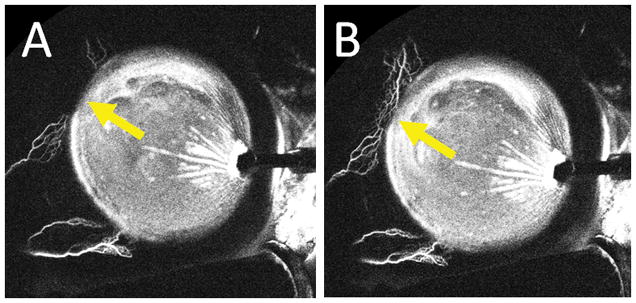
Aqueous angiography was performed in the left eye of a 61-year-old female during cataract surgery with 0.4% indocyanine green diluted in balanced salt solution. The right side of the images is temporal and the left side is nasal. The anterior chamber maintainer inserted into the eye temporally. A) 176 seconds after tracer introduction and B) 182 seconds after tracer introduction. Yellow arrows show increasing angiographic signal superior-nasal over 6 seconds.

References

    1. Macknight AD, McLaughlin CW, Peart D, et al. Formation of the aqueous humor. Clin Exp Pharmacol Physiol. 2000;27(1–2):100–6. - PubMed
    1. Brubaker RF. Goldmann’s equation and clinical measures of aqueous dynamics. Exp Eye Res. 2004;78(3):633–7. - PubMed
    1. Johnson M. What controls aqueous humour outflow resistance? Exp Eye Res. 2006;82(4):545–57. - PMC - PubMed
    1. Ascher KW. The Aqueous Veins. In: Ritch R, Caronia RM, editors. Classic Papers in Glaucoma. Netherlands: Kugler Publications; 2000.
    1. Swaminathan SS, Oh DJ, Kang MH, Rhee DJ. Aqueous outflow: segmental and distal flow. J Cataract Refract Surg. 2014;40(8):1263–72. - PMC - PubMed

Publication types

MeSH terms