


A Multi-institutional Comparison of SBRT and IMRT for Definitive Reirradiation of Recurrent or Second Primary Head and Neck Cancer
- PMID: 28899556
- PMCID: PMC7418052
- DOI: 10.1016/j.ijrobp.2017.04.017
A Multi-institutional Comparison of SBRT and IMRT for Definitive Reirradiation of Recurrent or Second Primary Head and Neck Cancer
Abstract
Purpose: Two modern methods of reirradiation, intensity modulated radiation therapy (IMRT) and stereotactic body radiation therapy (SBRT), are established for patients with recurrent or second primary squamous cell carcinoma of the head and neck (rSCCHN). We performed a retrospective multi-institutional analysis to compare methods.
Methods and materials: Data from patients with unresectable rSCCHN previously irradiated to ≥40 Gy who underwent reirradiation with IMRT or SBRT were collected from 8 institutions. First, the prognostic value of our IMRT-based recursive partitioning analysis (RPA) separating those patients with unresectable tumors with an intertreatment interval >2 years or those with ≤2 years and without feeding tube or tracheostomy dependence (class II) from other patients with unresected tumors (class III) was investigated among SBRT patients. Overall survival (OS) and locoregional failure were then compared between IMRT and SBRT by use of 2 methods to control for baseline differences: Cox regression weighted by the inverse probability of treatment and subset analysis by RPA classification.
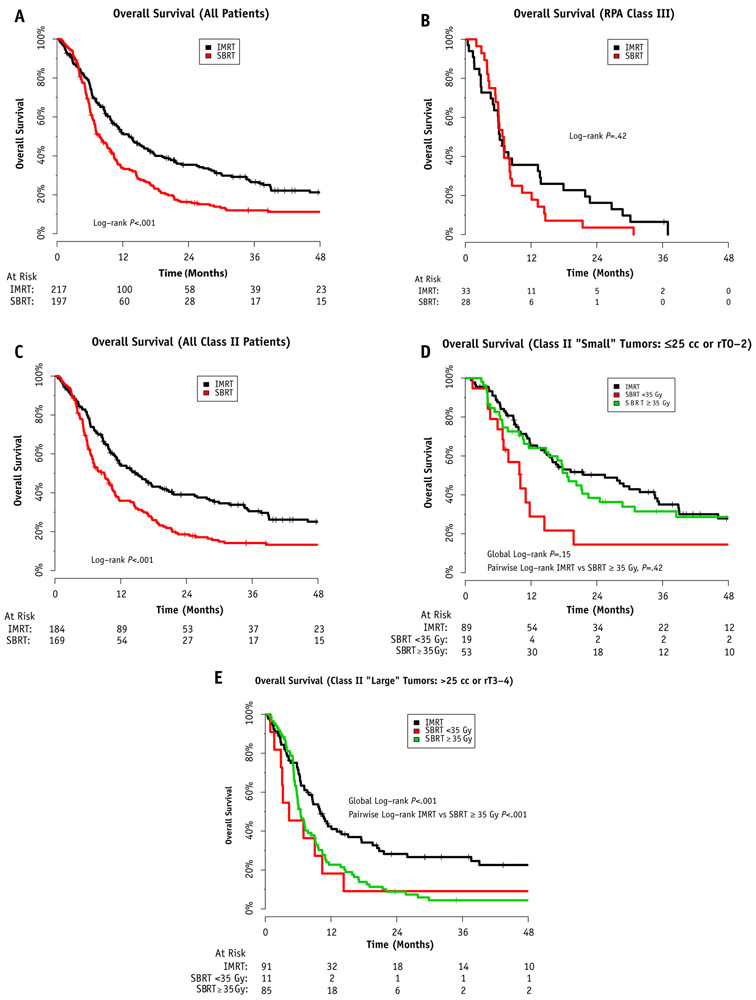
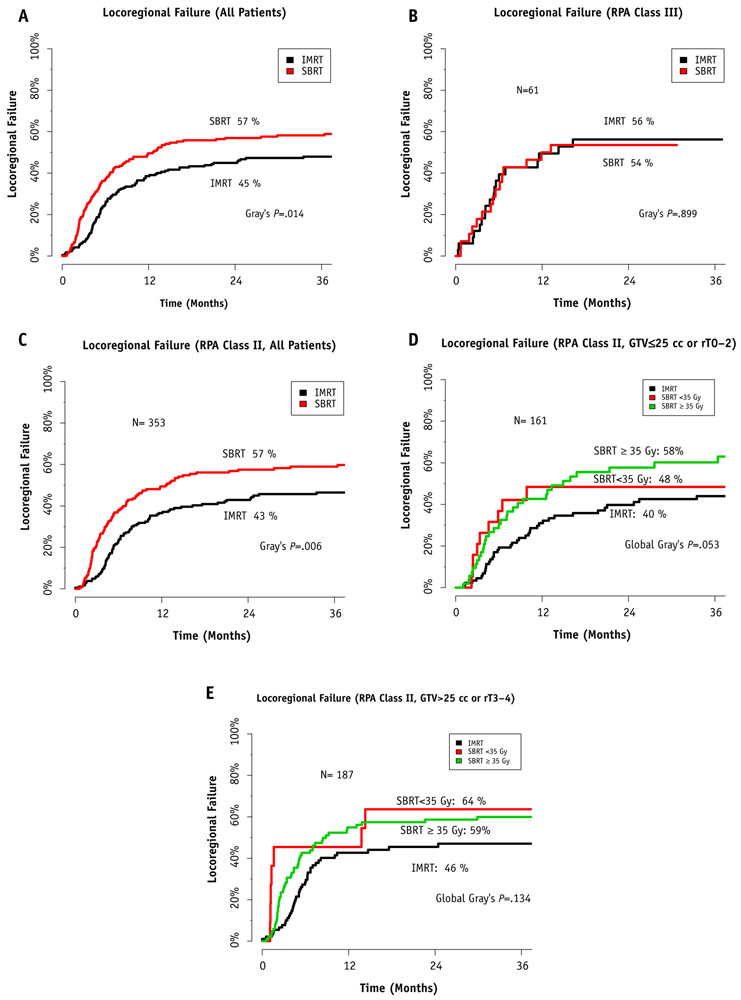
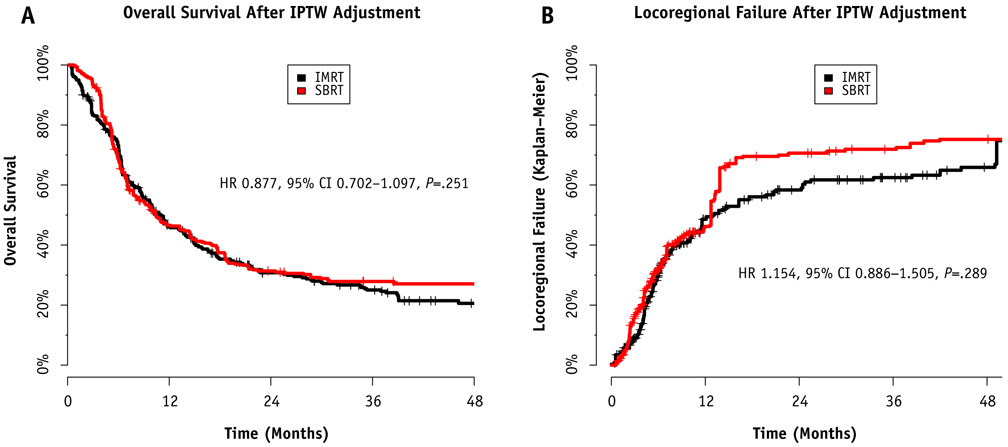
Results: The study included 414 patients with unresectable rSCCHN: 217 with IMRT and 197 with SBRT. The unadjusted 2-year OS rate was 35.4% for IMRT and 16.3% for SBRT (P<.01). Among SBRT patients, RPA classification retained an independent association with OS. On Cox regression weighted by the inverse probability of treatment, no significant differences in OS or locoregional failure between IMRT and SBRT were demonstrated. Analysis by RPA class showed similar OS between IMRT and SBRT for class III patients. In all class II patients, IMRT was associated with improved OS (P<.001). Further subset analysis demonstrated comparable OS when ≥35 Gy was delivered with SBRT to small tumor volumes. Acute grade ≥4 toxicity was greater in the IMRT group than in the SBRT group (5.1% vs 0.5%, P<.01), with no significant difference in late toxicity.
Conclusions: Reirradiation both with SBRT and with IMRT appear relatively safe with favorable toxicity compared with historical studies. Outcomes vary by RPA class, which informs clinical trial design. Survival is poor in class III patients, and alternative strategies are needed.
Copyright © 2017 Elsevier Inc. All rights reserved.
Conflict of interest statement
Conflict of interest: none.
Figures

Comment in
-
Reirradiation for Head and Neck Cancer: The Who and the How.Int J Radiat Oncol Biol Phys. 2018 Mar 1;100(3):618-620. doi: 10.1016/j.ijrobp.2017.12.279. Int J Radiat Oncol Biol Phys. 2018. PMID: 29413275 No abstract available.
References
-
- Spencer SA, Harris J, Wheeler RH, et al. Final report of RTOG 9610, a multi-institutional trial of re-irradiation and chemotherapy for unresectable recurrent squamous cell carcinoma of the head and neck. Head Neck 2008;30:281–288. - PubMed
-
- Langer CJ, Harris J, Horwitz EM, et al. Phase II study of low-dose paclitaxel and cisplatin in combination with split-course concomitant twice-daily re-irradiation in recurrent squamous cell carcinoma of the head and neck: Results of Radiation Therapy Oncology Group protocol 9911. J Clin Oncol 2007;25:4800–4805. - PubMed
-
- Vermorken JB, Mesia R, Rivera F, et al. Platinum-based chemotherapy plus cetuximab in head and neck cancer. N Engl J Med 2008;359: 1116–1127. - PubMed
-
- Sulman EP, Schwartz DL, Le TT, et al. IMRT re-irradiation of head and neck cancer-disease control and morbidity outcomes. Int J Radiat Oncol Biol Phys 2009;73:399–409. - PubMed
-
- Lee N, Chan K, Bekelman JE, et al. Salvage re-irradiation for recurrent head and neck cancer. Int J Radiat Oncol Biol Phys 2007;68: 731–740. - PubMed
Publication types
MeSH terms
Grants and funding
LinkOut - more resources
Full Text Sources
Other Literature Sources
Medical
