


Regulation of the cell cycle and centrosome biology by deubiquitylases
- PMID: 28900014
- PMCID: PMC5652225
- DOI: 10.1042/BST20170087
Regulation of the cell cycle and centrosome biology by deubiquitylases
Abstract
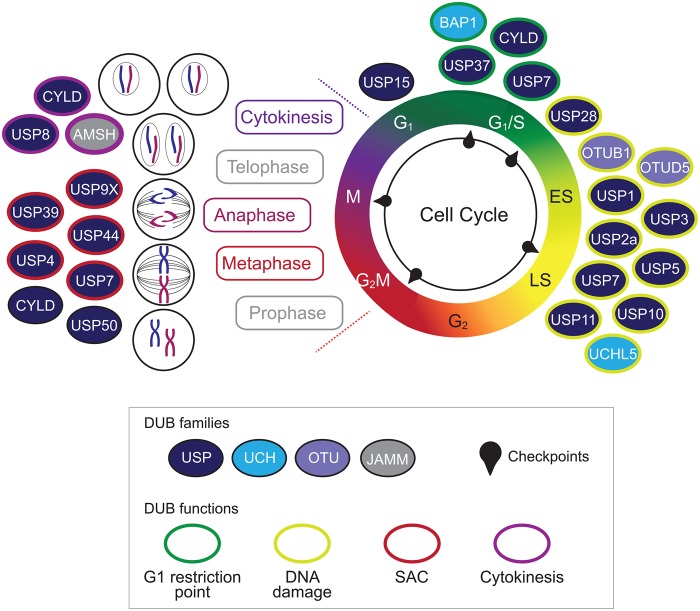
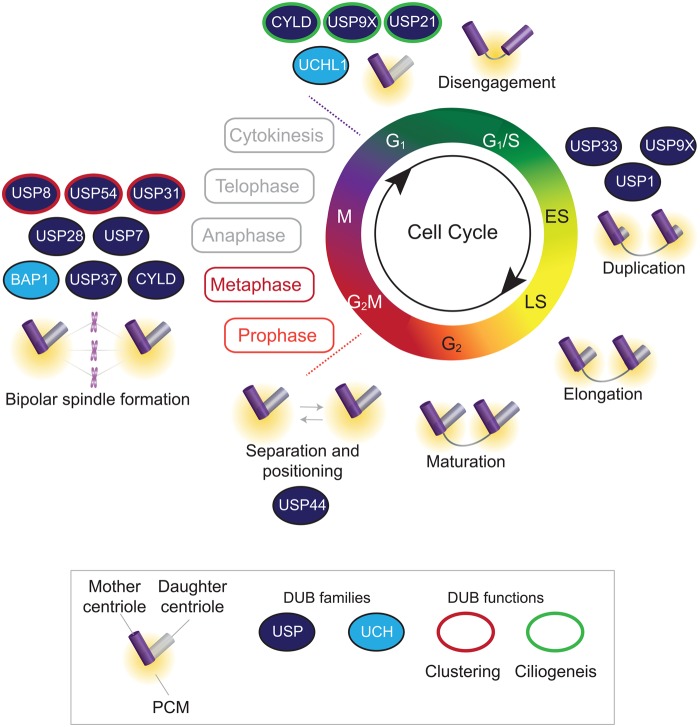
Post-translational modification of proteins by ubiquitylation is increasingly recognised as a highly complex code that contributes to the regulation of diverse cellular processes. In humans, a family of almost 100 deubiquitylase enzymes (DUBs) are assigned to six subfamilies and many of these DUBs can remove ubiquitin from proteins to reverse signals. Roles for individual DUBs have been delineated within specific cellular processes, including many that are dysregulated in diseases, particularly cancer. As potentially druggable enzymes, disease-associated DUBs are of increasing interest as pharmaceutical targets. The biology, structure and regulation of DUBs have been extensively reviewed elsewhere, so here we focus specifically on roles of DUBs in regulating cell cycle processes in mammalian cells. Over a quarter of all DUBs, representing four different families, have been shown to play roles either in the unidirectional progression of the cell cycle through specific checkpoints, or in the DNA damage response and repair pathways. We catalogue these roles and discuss specific examples. Centrosomes are the major microtubule nucleating centres within a cell and play a key role in forming the bipolar mitotic spindle required to accurately divide genetic material between daughter cells during cell division. To enable this mitotic role, centrosomes undergo a complex replication cycle that is intimately linked to the cell division cycle. Here, we also catalogue and discuss DUBs that have been linked to centrosome replication or function, including centrosome clustering, a mitotic survival strategy unique to cancer cells with supernumerary centrosomes.
Keywords: cancer; cell cycle; centrosomes; post-translational modification; ubiquitins.
© 2017 The Author(s).
Conflict of interest statement
The Authors declare that there are no competing interests associated with the manuscript.
Figures
References
Publication types
MeSH terms
Substances
LinkOut - more resources
Full Text Sources
Other Literature Sources
Research Materials
