


Five-year microbiological monitoring of wards and operating theatres in southern Italy
- PMID: 28900357
- PMCID: PMC5584086
Five-year microbiological monitoring of wards and operating theatres in southern Italy
Abstract
Introduction: Nosocomial infections are one of the greatest problems in public health. Several studies have highlighted the role played by the hospital environment as a possible source of transmission of nosocomial pathogens.
Methods: A five-year monitoring of bacterial contamination on healthcare workers hands, surfaces most closely in contact with inpatient wards, operating theatres and "at rest" and "in use" operating theatre air samples. For the samples, we used sterile swabs, contact slides, manual API, and automated VITEK systems for identification.
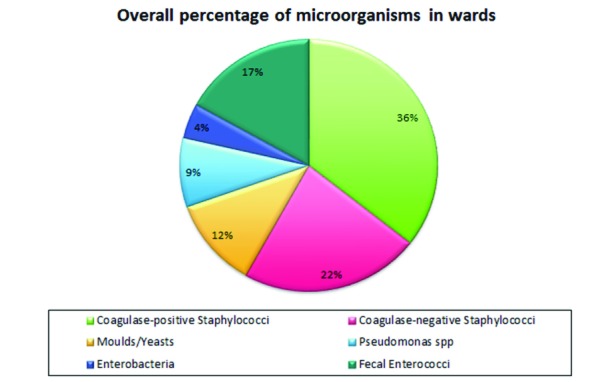
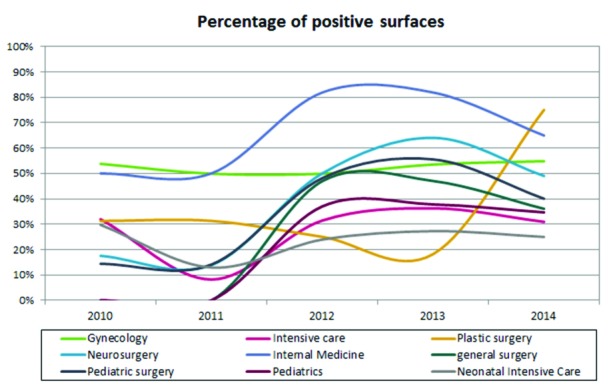
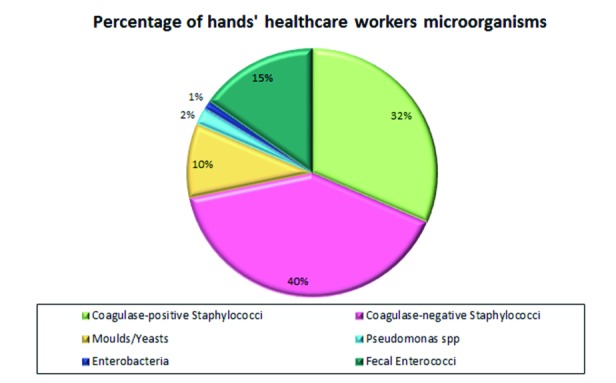
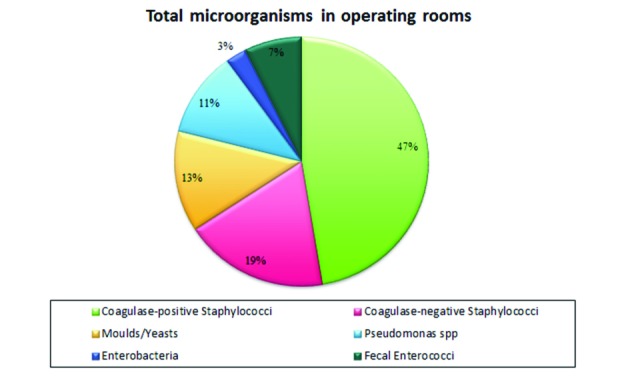
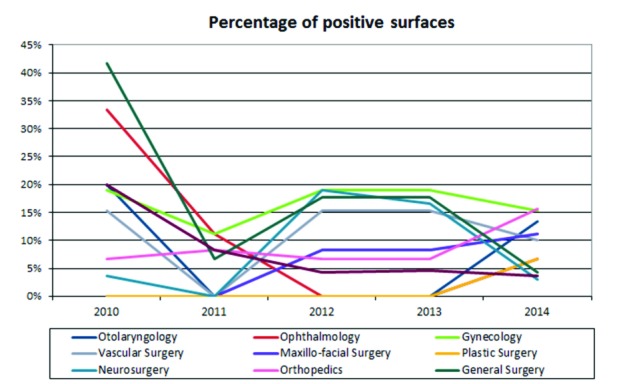
Results: In the five-year period, a total of 9396 samples were collected and analysed. In ward patients, 4398 samplings were carried out with 4.7%, 9.4%, 7%, 10.8% and 7.9% positive results respectively from 2010 to 2014. For hands, 648 samplings were carried out, with a positivity of 40.74%. In operating theatres, 4188 samples were taken, with a positivity of 11.9%. Regarding air in empty and full theatres, 1962 samplings were carried out with a positivity rate equal to 31.9%. The monitoring showed a low rate of contamination with a progressive decrease in the fiveyear period on operating theatres surfaces and hands, while there was an increase in the surgical site wards and in the air of operating rooms.
Conclusions: Our investigation has revealed the presence of pathogens on the assessed surfaces and the need for environmental monitoring, which can be a valuable tool for reducing contamination.
Keywords: HCAI; Microbiological surveillance; Operating rooms; Wards.
Conflict of interest statement
the authors declare that there are no conflicts of interest.
Figures
References
-
- Magill SS, Edwards JR, Bamberg W, Beldavs ZG, Dumyati G, Kainer MA, Lynfield R, Maloney M, McAllister-Hollod L, Nadle J, et al. Emerging Infections Program Healthcare-Associated Infections and Antimicrobial Use Prevalence Survey Team, author. Multistate pointprevalence survey of health care-associated infections. N Engl J Med. 2014;370:1198–1208. doi: 10.1056/NEJMoa1306801. - PMC - PubMed
-
- Weber DJ, Anderson D, Rutala WA. The role of the surface environment in healthcare-associated infections. Curr Opin Infect Dis. 2013;26(4):338–344. - PubMed
-
- Otter J, Yezli S, French GL. The role played by contaminated surfaces in the transmission of nosocomial pathogens. Infect Control Hosp Epidemiol. 2011;32(7):687–699. doi: 10.1086/660363. - PubMed
-
- Dancer SJ. The role of environmental cleaning in the control of hospital-acquired infection. J Hosp Infect. 2009;73:378–385. doi: 10.1016/j.jhin.2009.03.030. - PubMed
-
- Boyce JM. Environmental contamination makes an important contribution to hospital infection. J Hosp Infect. 2007;65:50–54. - PubMed
MeSH terms
LinkOut - more resources
Full Text Sources