


Fertility treatment for the transgender community: a public opinion study
- PMID: 28900753
- PMCID: PMC5699998
- DOI: 10.1007/s10815-017-1035-y
Fertility treatment for the transgender community: a public opinion study
Abstract
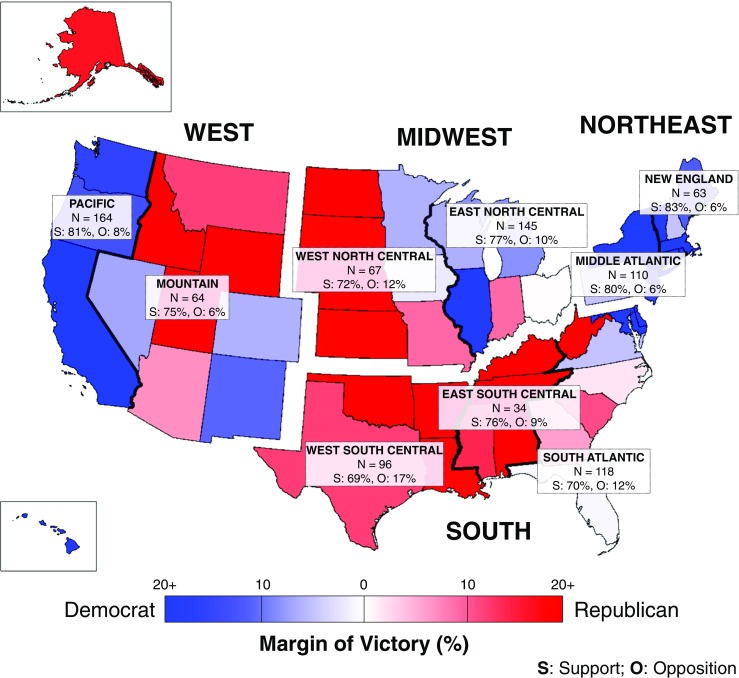
Purpose: The purposes of this study were to evaluate public opinion regarding fertility treatment and gamete cryopreservation for transgender individuals and identify how support varies by demographic characteristics.
Methods: This is a cross-sectional web-based survey study completed by a representative sample of 1111 US residents aged 18-75 years. Logistic regression was used to calculate odd ratios (ORs) and 95% confidence intervals (CIs) of support for/opposition to fertility treatments for transgender people by demographic characteristics, adjusting a priori for age, gender, race, and having a biological child.
Results: Of 1336 people recruited, 1111 (83.2%) agreed to participate, and 986 (88.7%) completed the survey. Most respondents (76.2%) agreed that "Doctors should be able to help transgender people have biological children." Atheists/agnostics were more likely to be in support (88.5%) than Christian-Protestants (72.4%; OR = 3.10, CI = 1.37-7.02), as were younger respondents, sexual minorities, those divorced/widowed, Democrats, and non-parents. Respondents who did not know a gay person (10.0%; OR = 0.20, CI = 0.09-0.42) or only knew a gay person without children (41.4%; OR = 0.29, CI = 0.17-0.50) were more often opposed than those who knew a gay parent (48.7%). No differences in gender, geography, education, or income were observed. A smaller majority of respondents supported doctors helping transgender minors preserve gametes before transitioning (60.6%) or helping transgender men carry pregnancies (60.1%).
Conclusions: Most respondents who support assisted and third-party reproduction also support such interventions to help transgender people have children.
Keywords: Assisted reproduction; Fertility preservation; Trans health; Transgender; Transitioning.
Conflict of interest statement
Conflicts of interest
E.G. receives royalties from UpToDate, Springer, and BioMed Central and receives research funding from Serono unrelated to this work. R.A. is a consultant for the New England Cryogenic Center. The remaining authors report no conflicts of interest.
Ethical approval
All procedures performed in studies involving human participants were in accordance with the ethical standards of the institutional and/or national research committee and with the 1964 Helsinki declaration and its later amendments or comparable ethical standards.
Informed consent
Informed consent was obtained from all individual participants included in the study.
Figures
References
-
- De Sutter P, Kira K, Verschoor A, Hotimsky A. The desire to have children and the preservation of fertility in transsexual women: a survey. Int J Transgenderism. 2002;6(3):215–221.
MeSH terms
LinkOut - more resources
Full Text Sources
Other Literature Sources
