


Return of spontaneous circulation and long-term survival according to feedback provided by automated external defibrillators
- PMID: 28901546
- PMCID: PMC5698742
- DOI: 10.1111/aas.12992
Return of spontaneous circulation and long-term survival according to feedback provided by automated external defibrillators
Abstract
Background: We aimed to investigate the effect of automated external defibrillator (AED) feedback mechanisms on survival in out-of-hospital cardiac arrest (OHCA) victims. In addition, we investigated converting rates in patients with shockable rhythms according to AED shock waveforms and energy levels.
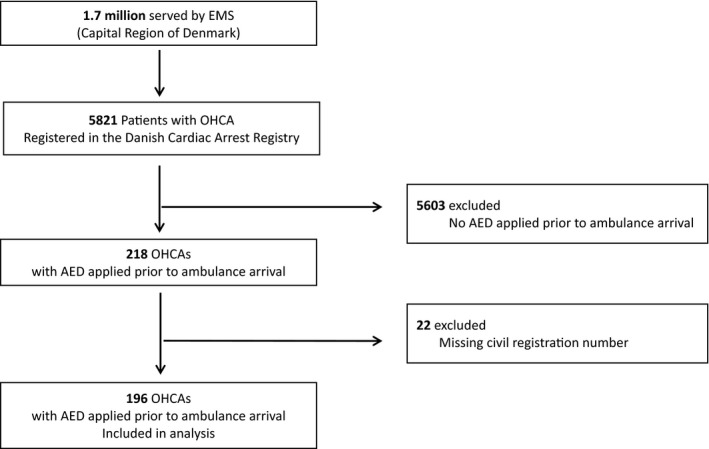
Methods: We collected data on OHCA occurring between 2011 and 2014 in the Capital Region of Denmark where an AED was applied prior to ambulance arrival. Patient data were obtained from the Danish Cardiac Arrest Registry and medical records. AED data were retrieved from the Emergency Medical Dispatch Centre (EMDC) and information on feedback mechanisms, energy waveform and energy level was downloaded from the applied AEDs.
Results: A total of 196 OHCAs had an AED applied prior to ambulance arrival; 62 of these (32%) provided audio visual (AV) feedback while no feedback was provided in 134 (68%). We found no difference in return of spontaneous circulation (ROSC) at hospital arrival according to AV-feedback; 34 (55%, 95% confidence interval (CI) [13-67]) vs. 72 (54%, 95% CI [45-62]), P = 1 (odds ratio (OR) 1.1, 95% CI [0.6-1.9]) or 30-day survival; 24 (39%, 95% CI [28-51]) vs. 53 (40%, 95% CI [32-49]), P = 0.88 (OR 1.1 (95% CI [0.6-2.0])). Moreover, we found no difference in converting rates among patients with initial shockable rhythm receiving one or more shocks according to AED energy waveform and energy level.
Conclusions: No difference in survival after OHCA according to AED feedback mechanisms, nor any difference in converting rates according to AED waveform or energy levels was detected.
© 2017 The Authors. Acta Anaesthesiologica Scandinavica published by John Wiley & Sons Ltd on behalf of Acta Anaesthesiologica Scandinavica Foundation.
Figures
References
-
- Berdowski J, Berg RA, Tijssen JGP, Koster RW. Global incidences of out‐of‐hospital cardiac arrest and survival rates: systematic review of 67 prospective studies. Resuscitation 2010; 81: 1479–87. - PubMed
-
- Atwood C, Eisenberg MS, Herlitz J, Rea TD. Incidence of EMS‐treated out‐of‐hospital cardiac arrest in Europe. Resuscitation 2005; 67: 75–80. - PubMed
-
- Gräsner JT, Herlitz J, Koster RW, Rosell‐Ortiz F, Stamatakis L, Bossaert L. Quality management in resuscitation–towards a European cardiac arrest registry (EuReCa). Resuscitation 2011; 82: 989–94. - PubMed
-
- Gräsner J‐T, Bossaert L. Epidemiology and management of cardiac arrest: what registries are revealing. Best Pract Res Clin Anaesthesiol 2013; 27: 293–306. - PubMed
-
- Perkins GD, Handley AJ, Koster RW, Castrén M, Smyth MA, Olasveengen T, Monsieurs KG, Raffay V, Gräsner J‐T, Wenzel V, Ristagno G, Soar J. Adult basic life support and automated external defibrillation section Collaborators. European Resuscitation Council Guidelines for Resuscitation 2015: Section 2. Adult basic life support and automated external defibrillation. Resuscitation 2015; 95: 81–99. - PubMed
MeSH terms
LinkOut - more resources
Full Text Sources
Other Literature Sources
