


Comment
doi: 10.1038/nature24139.
Epub 2017 Sep 13.
Neuroscience: Mum's bacteria linked to baby's behaviour
Affiliations
- PMID: 28902837
- PMCID: PMC7082098
- DOI: 10.1038/nature24139
Item in Clipboard
Comment
Neuroscience: Mum's bacteria linked to baby's behaviour
Nature.
.
Erratum in
-
Correction.Nature. 2017 Oct 11;550(7675):198. doi: 10.1038/550198a. Nature. 2017. PMID: 29022580 No abstract available.
Abstract
Infection during pregnancy increases the risk of neurodevelopmental disorders, such as autism, in offspring. Mouse studies now reveal a link between gut bacteria and atypical brain-circuit connections.
Figures
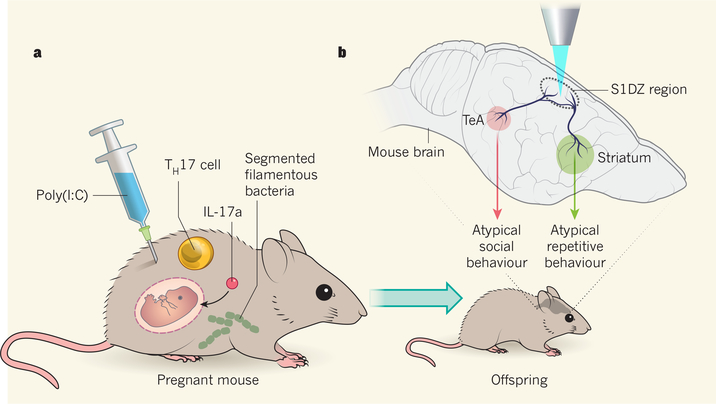
Viral exposure during pregnancy can sometimes result in offspring that have neurodevelopmental disorders,. This phenomenon is linked to a maternal immune response associated with TH17 cells and the signalling molecule IL-17a. a, Kim et al. and Yim et al. investigated this process using a model in which pregnant mice are injected with a molecule called poly(I:C) that is structurally similar to the double-stranded RNA characteristic of viral infection. The authors demonstrated that the presence of a type of gut microbe called segmented filamentous bacteria is required for the animals’ offspring to show atypical behaviours. b, Applying a technique known as optogenetics, in which light of a certain wavelength (shown here in blue) is used to activate or inhibit neurons genetically engineered to express light-sensitive ion channels, the authors reveal that activation of the S1DZ region of the cortex is associated with atypical offspring behaviour. They found that neurons in the S1DZ connect to neurons in a brain region called the temporal association area (TeA) that influence social behaviours, and to neurons in the striatum that affect repetitive behaviours.
Comment on
-
Reversing behavioural abnormalities in mice exposed to maternal inflammation.Nature. 2017 Sep 28;549(7673):482-487. doi: 10.1038/nature23909. Epub 2017 Sep 13. Nature. 2017. PMID: 28902835 Free PMC article.
-
Maternal gut bacteria promote neurodevelopmental abnormalities in mouse offspring.Nature. 2017 Sep 28;549(7673):528-532. doi: 10.1038/nature23910. Epub 2017 Sep 13. Nature. 2017. PMID: 28902840 Free PMC article.
References
Publication types
MeSH terms
Grants and funding
LinkOut - more resources
Full Text Sources
Other Literature Sources
Medical
