


A checklist is associated with increased quality of reporting preclinical biomedical research: A systematic review
- PMID: 28902887
- PMCID: PMC5597130
- DOI: 10.1371/journal.pone.0183591
A checklist is associated with increased quality of reporting preclinical biomedical research: A systematic review
Abstract
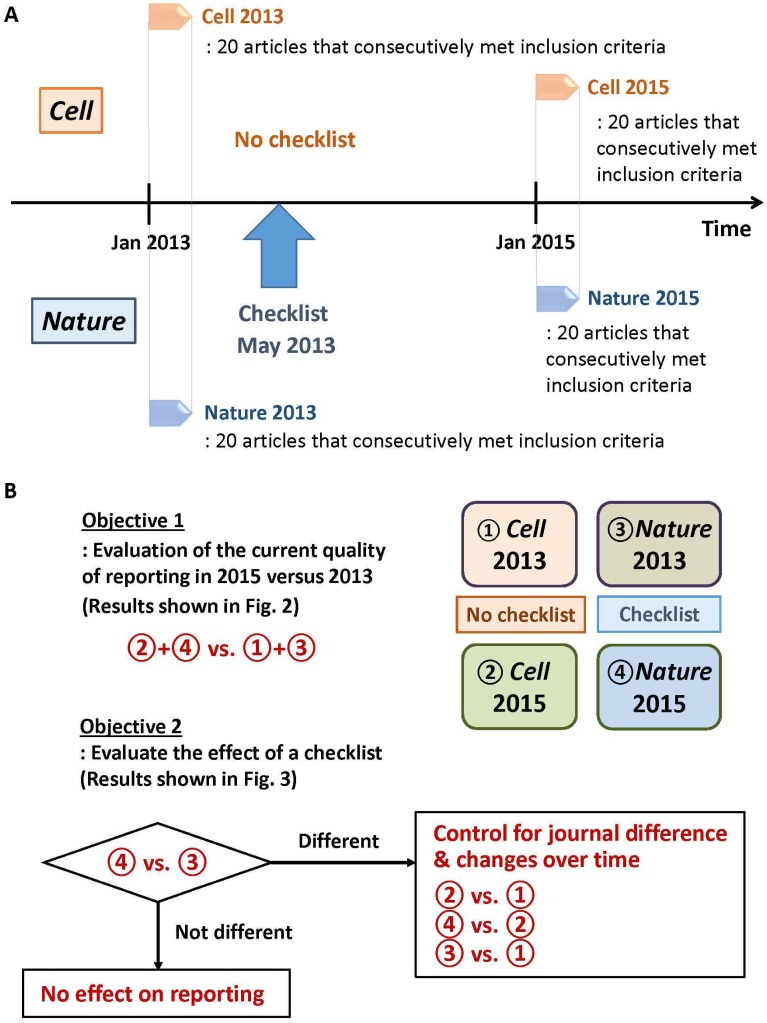
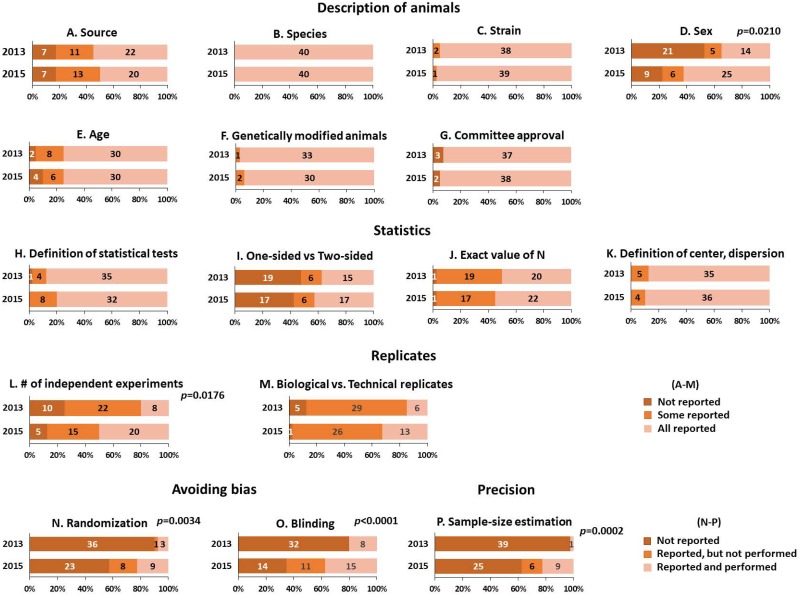
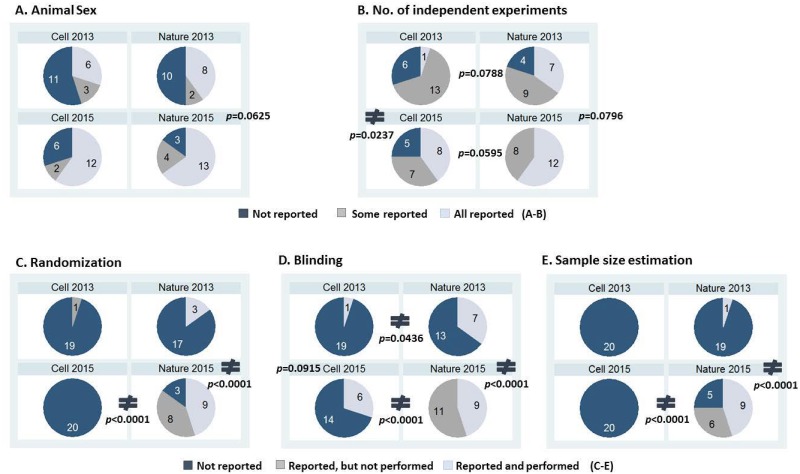
Irreproducibility of preclinical biomedical research has gained recent attention. It is suggested that requiring authors to complete a checklist at the time of manuscript submission would improve the quality and transparency of scientific reporting, and ultimately enhance reproducibility. Whether a checklist enhances quality and transparency in reporting preclinical animal studies, however, has not been empirically studied. Here we searched two highly cited life science journals, one that requires a checklist at submission (Nature) and one that does not (Cell), to identify in vivo animal studies. After screening 943 articles, a total of 80 articles were identified in 2013 (pre-checklist) and 2015 (post-checklist), and included for the detailed evaluation of reporting methodological and analytical information. We compared the quality of reporting preclinical animal studies between the two journals, accounting for differences between journals and changes over time in reporting. We find that reporting of randomization, blinding, and sample-size estimation significantly improved when comparing Nature to Cell from 2013 to 2015, likely due to implementation of a checklist. Specifically, improvement in reporting of the three methodological information was at least three times greater when a mandatory checklist was implemented than when it was not. Reporting the sex of animals and the number of independent experiments performed also improved from 2013 to 2015, likely from factors not related to a checklist. Our study demonstrates that completing a checklist at manuscript submission is associated with improved reporting of key methodological information in preclinical animal studies.
Conflict of interest statement
Figures
References
-
- Contopoulos-Ioannidis DG, Ntzani E, Ioannidis JP. Translation of highly promising basic science research into clinical applications. Am J Med. 2003;114(6):477–84. . - PubMed
-
- Prinz F, Schlange T, Asadullah K. Believe it or not: how much can we rely on published data on potential drug targets? Nat Rev Drug Discov. 2011;10(9):712 doi: 10.1038/nrd3439-c1 . - DOI - PubMed
-
- Begley CG, Ellis LM. Drug development: Raise standards for preclinical cancer research. Nature. 2012;483(7391):531–3. doi: 10.1038/483531a . - DOI - PubMed
-
- Casadevall A, Fang FC. Reproducible science. Infect Immun. 2010;78(12):4972–5. doi: 10.1128/IAI.00908-10 ; - DOI - PMC - PubMed
-
- Peng RD. Reproducible research and Biostatistics. Biostatistics. 2009;10(3):405–8. doi: 10.1093/biostatistics/kxp014 . - DOI - PubMed
Publication types
MeSH terms
Grants and funding
LinkOut - more resources
Full Text Sources
Other Literature Sources
