


Mental Health Services Use Trends in Canadian Veterans: A Population-Based Retrospective Cohort Study in Ontario
- PMID: 28903578
- PMCID: PMC5971406
- DOI: 10.1177/0706743717730826
Mental Health Services Use Trends in Canadian Veterans: A Population-Based Retrospective Cohort Study in Ontario
Abstract
Objective: A substantial evidence base in the peer-reviewed literature exists investigating mental illness in the military, but relatively less is documented about mental illness in veterans. This study uses provincial, administrative data to study the use of mental health services by Canadian veterans in Ontario.
Method: This was a retrospective cohort study of Canadian Armed Forces and Royal Canadian Mounted Police veterans who were released between 1990 and 2013 and resided in Ontario. Mental health-related primary care physician, psychiatrist, emergency department (ED) visits, and psychiatric hospitalisations were counted. Repeated measures were presented in 5-year intervals, stratified by age at release.
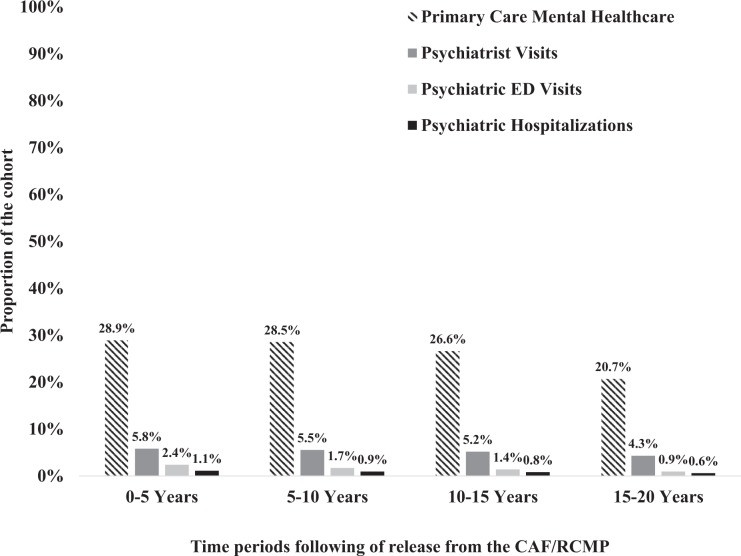
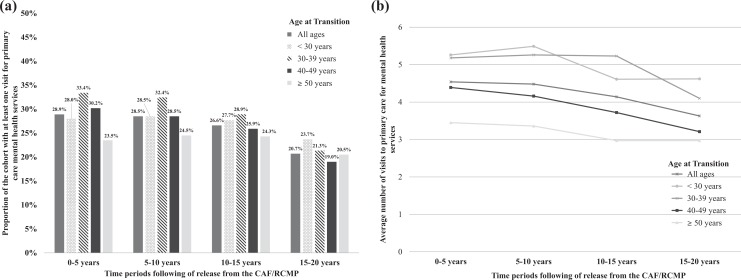
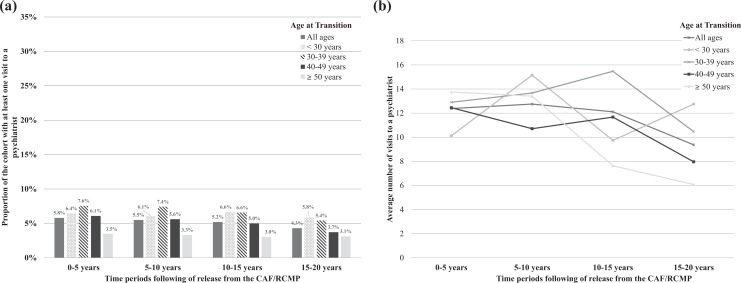
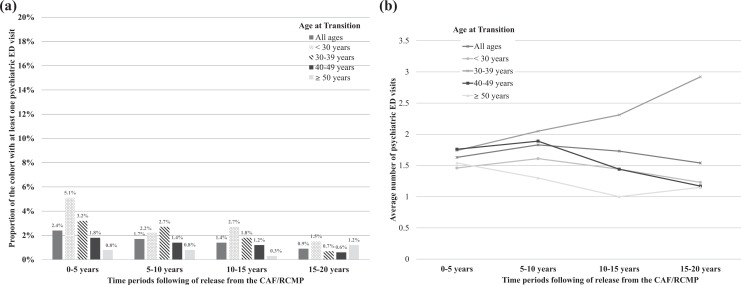
Results: The cohort included 23,818 veterans. In the first 5 years following entry into the health care system, 28.9% of veterans had ≥1 mental health-related primary care physician visit, 5.8% visited a psychiatrist at least once, and 2.4% received acute mental health services at an ED. The use of mental health services was consistent over time. Almost 8% of veterans aged 30 to 39 years saw a psychiatrist in the first 5 years after release, compared to 3.5% of veterans aged ≥50 years at release. The youngest veterans at release (<30 years) were the most frequent users of ED services for a mental health-related reason (5.1% had at least 1 ED visit).
Conclusion: Understanding how veterans use the health care system for mental health problems is an important step to ensuring needs are met during the transition to civilian life.
Objectif:: Il y a une recherche substantielle fondée sur des données probantessur la maladie mentale chez les militaires, mais elle est relativement peu documentée dans la littérature révisée par les pairs quand il s’agit de maladie mentale chez les anciens combattants. Cette étude utilise des données provinciales, administratives pour étudier l’utilisation des services de santé mentale par les anciens combattants de l’Ontario.
Méthodologie:: C’était une étude de cohorte rétrospective des anciens combattants des Forces armées canadiennes (FAC) et de la Gendarmerie royale du Canada (GRC) qui ont été libérés entre 1990 et 2013 et résidaient en Ontario. Les visites liées à la santé mentale à un médecin des soins de première ligne, à un psychiatre ou à un service d’urgence (SU) ainsi que les hospitalisations psychiatriques ont été comptées. Les mesures répétées ont été présentées à cinq ans d’intervalle, stratifiées selon l’âge à la libération.
Résultats:: La cohorte comprenait 23818 anciens combattants. Dans les cinq premières années suivant l’entrée dans le système de santé, 28,9% des anciens combattants avaient ≥ 1 visite liée à la santé mentale à un médecin des soins de première ligne, 5,8% avaient vu un psychiatre au moins une fois, et 2,4% avaient reçu des soins actifs de santé mentale à un service d’urgence. L’utilisation des services de santé mentale était constante avec le temps. Presque 8% des anciens combattants de 30 à 39 ans ont vu un psychiatre dans les 5 premières années après la libération, comparé à 3,5% des anciens combattants de ≥ 50 ans à la libération. Les anciens combattants les plus jeunes à la libération (< 30 ans) étaient les utilisateurs les plus fréquents des services d’urgence pour une raison liée à la santé mentale (5,1% avaient au moins une visite au SU).
Conclusion:: Comprendre comment les anciens combattants utilisent le système de santé pour des problèmes de santé mentale est une étape importante pour faire en sorte de répondre à leurs besoins durant la transition à la vie civile.
Keywords: health services; mental disorders; military personnel; veteran; veteran health.
Conflict of interest statement
Figures
Similar articles
-
Canadian Veteran chronic disease prevalence and health services use in the five years following release: a matched retrospective cohort study using routinely collected data.BMC Public Health. 2022 Sep 5;22(1):1678. doi: 10.1186/s12889-022-14053-4. BMC Public Health. 2022. PMID: 36064372 Free PMC article.
-
A descriptive analysis of medical health services utilization of Veterans living in Ontario: a retrospective cohort study using administrative healthcare data.BMC Health Serv Res. 2016 Aug 4;16(a):351. doi: 10.1186/s12913-016-1596-y. BMC Health Serv Res. 2016. PMID: 27488736 Free PMC article.
-
A Retrospective Cohort Analysis of Mental Health-Related Emergency Department Visits Among Veterans and Non-Veterans Residing in Ontario, Canada: Une analyse de cohorte rétrospective des visites au service d'urgence liées à la santé mentale parmi les vétérans et non-vétérans résidant en Ontario, Canada.Can J Psychiatry. 2024 May;69(5):347-357. doi: 10.1177/07067437231223328. Epub 2024 Jan 5. Can J Psychiatry. 2024. PMID: 38179680 Free PMC article.
-
Transition Needs Among Veterans Living With Chronic Pain: A Systematic Review.Mil Med. 2024 Feb 27;189(3-4):556-565. doi: 10.1093/milmed/usad363. Mil Med. 2024. PMID: 37675856
-
The psychiatric case register: noble past, challenging present, but exciting future.Br J Psychiatry. 2009 Sep;195(3):191-3. doi: 10.1192/bjp.bp.109.068452. Br J Psychiatry. 2009. PMID: 19721105 Review.
Cited by
-
Mental health services use among Canadian Armed Forces members and Veterans: Data from the 2018 Canadian Armed Forces members and Veterans mental health follow-up survey (CAFMVHS).Front Health Serv. 2022 Aug 22;2:954914. doi: 10.3389/frhs.2022.954914. eCollection 2022. Front Health Serv. 2022. PMID: 36925872 Free PMC article.
-
Do Investments in Mental Health Systems Result in Greater Use of Mental Health Services? National Trends in Mental Health Service Use (MHSU) in the Canadian Military and Comparable Canadian Civilians, 2002-2013.Can J Psychiatry. 2018 Sep;63(9):602-609. doi: 10.1177/0706743718760291. Epub 2018 Feb 13. Can J Psychiatry. 2018. PMID: 29439596 Free PMC article.
-
Adherence of the #Here4U App - Military Version to Criteria for the Development of Rigorous Mental Health Apps.JMIR Form Res. 2020 Jun 17;4(6):e18890. doi: 10.2196/18890. JMIR Form Res. 2020. PMID: 32554374 Free PMC article.
-
Caring for Canadian military families.Can Fam Physician. 2019 Jan;65(1):9-11. Can Fam Physician. 2019. PMID: 30674507 Free PMC article. No abstract available.
-
Canadian Veteran chronic disease prevalence and health services use in the five years following release: a matched retrospective cohort study using routinely collected data.BMC Public Health. 2022 Sep 5;22(1):1678. doi: 10.1186/s12889-022-14053-4. BMC Public Health. 2022. PMID: 36064372 Free PMC article.
References
-
- Thompson JM, Van Til L, Poirier A, et al. Health and well-being of Canadian Armed Forces veterans: findings from the 2013 life after service survey In: Canada RDVA, editor. Charlottetown. Prince Edward Island: Veterans Affairs Canada; 2014.
Publication types
MeSH terms
LinkOut - more resources
Full Text Sources
Other Literature Sources
Miscellaneous
