


Nonclinical and clinical pharmacology evidence for cardiovascular safety of saxagliptin
- PMID: 28903775
- PMCID: PMC5598064
- DOI: 10.1186/s12933-017-0595-6
Nonclinical and clinical pharmacology evidence for cardiovascular safety of saxagliptin
Abstract
Background: In the Saxagliptin Assessment of Vascular Outcomes Recorded in Patients with Diabetes Mellitus (SAVOR) trial in patients with type 2 diabetes mellitus (T2D) at high risk of cardiovascular (CV) disease, saxagliptin did not increase the risk for major CV adverse events. However, there was an unexpected imbalance in events of hospitalization for heart failure (hHF), one of six components of the secondary CV composite endpoint, with a greater number of events observed with saxagliptin. Here, we examined findings from nonclinical safety and clinical pharmacology studies of saxagliptin with the aim of identifying any potential signals of myocardial injury.
Methods: In vitro and in vivo (rat, dog, monkey) safety pharmacology and toxicology studies evaluating the potential effects of saxagliptin and its major active metabolite, 5-hydroxy saxagliptin, on the CV system are reviewed. In addition, results from saxagliptin clinical studies are discussed: one randomized, 2-period, double-blind, placebo-controlled single-ascending-dose study (up to 100 mg); one randomized, double-blind, placebo-controlled, sequential, multiple-ascending-high-dose study (up to 400 mg/day for 14 days); and one randomized, double-blind, 4-period, 4-treatment, cross-over thorough QTc study (up to 40 mg/day for 4 days) in healthy volunteers; as well as one randomized, placebo-controlled, sequential multiple-ascending-dose study in patients with T2D (up to 50 mg/day for 14 days).
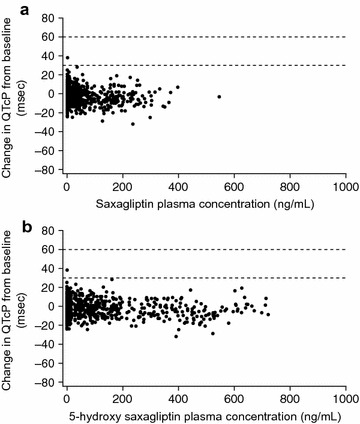
Results: Neither saxagliptin nor 5-hydroxy saxagliptin affected ligand binding to receptors and ion channels (e.g. potassium channels) or action potential duration in in vitro studies. In animal toxicology studies, no changes in the cardiac conduction system, blood pressure, heart rate, contractility, heart weight, or heart histopathology were observed. In healthy participants and patients with T2D, there were no findings suggestive of myocyte injury or fluid overload. Serum chemistry abnormalities indicative of cardiac injury, nonspecific muscle damage, or fluid homeostasis changes were infrequent and balanced across treatment groups. There were no QTc changes associated with saxagliptin. No treatment-emergent adverse events suggestive of heart failure or myocardial damage were reported.
Conclusions: The saxagliptin nonclinical and clinical pharmacology programs did not identify evidence of myocardial injury and/or CV harm that may have predicted or may explain the unexpected imbalance in the rate of hHF observed in SAVOR.
Keywords: Diabetes mellitus; Heart failure; Pharmacology; Saxagliptin.
Figures
References
-
- Augeri DJ, Robl JA, Betebenner DA, Magnin DR, Khanna A, Robertson JG, et al. Discovery and preclinical profile of saxagliptin (BMS-477118): a highly potent, long-acting, orally active dipeptidyl peptidase IV inhibitor for the treatment of type 2 diabetes. J Med Chem. 2005;48:5025–5037. doi: 10.1021/jm050261p. - DOI - PubMed
-
- Wang A, Dorso C, Kopcho L, Locke G, Langish R, Harstad E, et al. Potency, selectivity and prolonged binding of saxagliptin to DPP4: maintenance of DPP4 inhibition by saxagliptin in vitro and ex vivo when compared to a rapidly-dissociating DPP4 inhibitor. BMC Pharmacol. 2012;12:2. doi: 10.1186/1471-2210-12-2. - DOI - PMC - PubMed
-
- Onglyza® US prescribing information. 2017. https://www.azpicentral.com/onglyza/pi_onglyza.pdf#page=1. Accessed 4 Sep 2017.
-
- Food and Drug Administration. Guidance for industry: diabetes mellitus—evaluating cardiovascular risk in new antidiabetic therapies to treat type 2 diabetes. Silver Spring, MD: Center for Drug Evaluation and Research. 2008. http://www.fda.gov/downloads/Drugs/GuidanceComplianceRegulatoryInformati.... Accessed 13 Apr 2017.
Publication types
MeSH terms
Substances
LinkOut - more resources
Full Text Sources
Other Literature Sources
Medical
