Assessing Microvascular Function in Humans from a Chronic Disease Perspective
- PMID: 28904002
- PMCID: PMC5698072
- DOI: 10.1681/ASN.2017020157
Assessing Microvascular Function in Humans from a Chronic Disease Perspective
Abstract
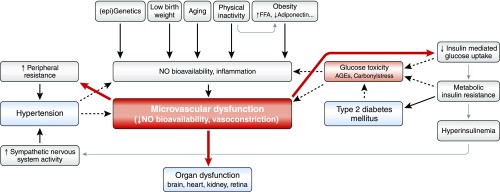
Microvascular dysfunction (MVD) is considered a crucial pathway in the development and progression of cardiometabolic and renal disease and is associated with increased cardiovascular mortality. MVD often coexists with or even precedes macrovascular disease, possibly due to shared mechanisms of vascular damage, such as inflammatory processes and oxidative stress. One of the first events in MVD is endothelial dysfunction. With the use of different physiologic or pharmacologic stimuli, endothelium-dependent (micro)vascular reactivity can be studied. This reactivity depends on the balance between various mediators, including nitric oxide, endothelin, and prostanoids, among others. The measurement of microvascular (endothelial) function is important to understand the pathophysiologic mechanisms that contribute to MVD and the role of MVD in the development and progression of cardiometabolic/renal disease. Here, we review a selection of direct, noninvasive techniques for measuring human microcirculation, with a focus on methods, interpretation, and limitations from the perspective of chronic cardiometabolic and renal disease.
Keywords: Cardiometabolic disease; Microvascular dysfunction; Pathophysiology; Renal disease; endothelium.
Copyright © 2017 by the American Society of Nephrology.
Figures


References
-
- Stehouwer CD, Smulders YM: Microalbuminuria and risk for cardiovascular disease: Analysis of potential mechanisms. J Am Soc Nephrol 17: 2106–2111, 2006 - PubMed
-
- Stehouwer CD: Is measurement of endothelial dysfunction clinically useful? Eur J Clin Invest 29: 459–461, 1999 - PubMed
-
- Chew SK, Xie J, Wang JJ: Retinal arteriolar diameter and the prevalence and incidence of hypertension: A systematic review and meta-analysis of their association. Curr Hypertens Rep 14: 144–151, 2012 - PubMed
-
- Wong TY, Klein R, Sharrett AR, Duncan BB, Couper DJ, Tielsch JM, Klein BE, Hubbard LD: Retinal arteriolar narrowing and risk of coronary heart disease in men and women. The sAtherosclerosis Risk in Communities study. JAMA 287: 1153–1159, 2002 - PubMed
-
- Wong TY, Klein R, Couper DJ, Cooper LS, Shahar E, Hubbard LD, Wofford MR, Sharrett AR: Retinal microvascular abnormalities and incident stroke: The Atherosclerosis Risk in Communities study. Lancet 358: 1134–1140, 2001 - PubMed
Publication types
MeSH terms
Substances
LinkOut - more resources
Full Text Sources
Other Literature Sources
Medical