


Genomic Characterization of Urethritis-Associated Neisseria meningitidis Shows that a Wide Range of N. meningitidis Strains Can Cause Urethritis
- PMID: 28904187
- PMCID: PMC5703804
- DOI: 10.1128/JCM.01018-17
Genomic Characterization of Urethritis-Associated Neisseria meningitidis Shows that a Wide Range of N. meningitidis Strains Can Cause Urethritis
Abstract
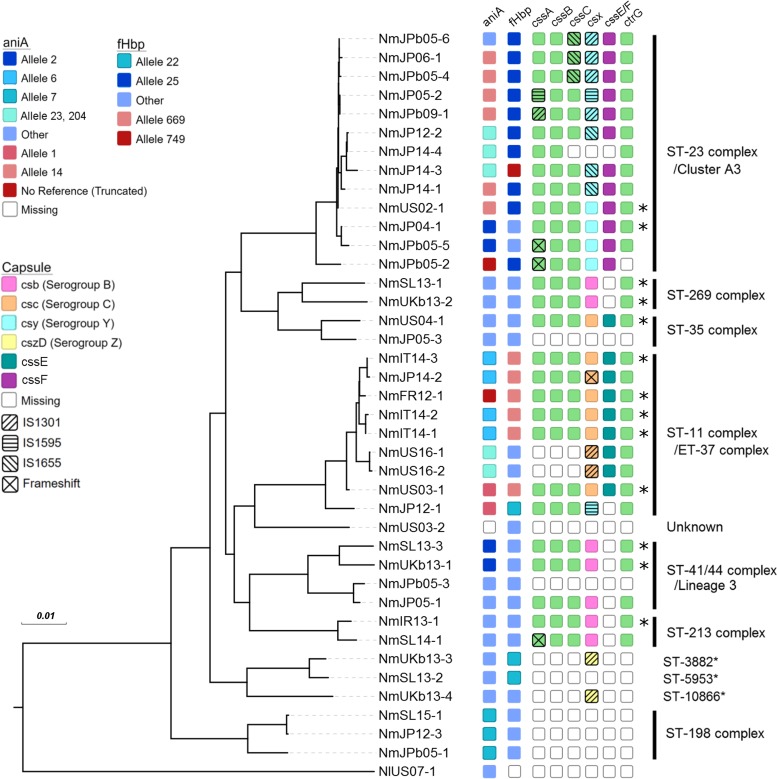
Neisseria meningitidis, typically a resident of the oro- or nasopharynx and the causative agent of meningococcal meningitis and meningococcemia, is capable of invading and colonizing the urogenital tract. This can result in urethritis, akin to the syndrome caused by its sister species, N. gonorrhoeae, the etiologic agent of gonorrhea. Recently, meningococcal strains associated with outbreaks of urethritis were reported to share genetic characteristics with the gonococcus, raising the question of the extent to which these strains contain features that promote adaptation to the genitourinary niche, making them gonococcus-like and distinguishing them from other N. meningitidis strains. Here, we analyzed the genomes of 39 diverse N. meningitidis isolates associated with urethritis, collected independently over a decade and across three continents. In particular, we characterized the diversity of the nitrite reductase gene (aniA), the factor H-binding protein gene (fHbp), and the capsule biosynthetic locus, all of which are loci previously suggested to be associated with urogenital colonization. We observed notable diversity, including frameshift variants, in aniA and fHbp and the presence of intact, disrupted, and absent capsule biosynthetic genes, indicating that urogenital colonization and urethritis caused by N. meningitidis are possible across a range of meningococcal genotypes. Previously identified allelic patterns in urethritis-associated N. meningitidis strains may reflect genetic diversity in the underlying meningococcal population rather than novel adaptation to the urogenital tract.
Keywords: Neisseria gonorrhoeae; Neisseria meningitidis; bacterial genomics; urethritis.
Copyright © 2017 American Society for Microbiology.
Figures
References
-
- Harrison OB, Cole K, Peters J, Cresswell F, Dean G, Eyre DW, Paul J, Maiden MC. 2017. Genomic analysis of urogenital and rectal Neisseria meningitidis isolates reveals encapsulated hyperinvasive meningococci and coincident multidrug-resistant gonococci. Sex Transm Infect 93:445–451. doi:10.1136/sextrans-2016-052781. - DOI - PMC - PubMed
-
- Bazan JA, Peterson AS, Kirkcaldy RD, Briere EC, Maierhofer C, Turner AN, Licon DB, Parker N, Dennison A, Ervin M, Johnson L, Weberman B, Hackert P, Wang X, Kretz CB, Abrams AJ, Trees DL, Del Rio C, Stephens DS, Tzeng Y-L, DiOrio M, Roberts MW. 2016. Notes from the field: increase in Neisseria meningitidis-associated urethritis among men at two sentinel clinics—Columbus, Ohio, and Oakland County, Michigan, 2015. MMWR Morbid Mortal Wkly Rep 65:550–552. doi:10.15585/mmwr.mm6521a5. - DOI - PMC - PubMed
MeSH terms
Substances
Grants and funding
LinkOut - more resources
Full Text Sources
Other Literature Sources
Molecular Biology Databases
