. 2017 Sep 13;7(1):11488.
doi: 10.1038/s41598-017-10200-9.

Acute interaction between hydrocortisone and insulin alters the plasma metabolome in humans

Affiliations

Acute interaction between hydrocortisone and insulin alters the plasma metabolome in humans

Mohammad A Alwashih et al. Sci Rep. .

Abstract

With the aim of identifying biomarkers of glucocorticoid action and their relationship with biomarkers of insulin action, metabolomic profiling was carried out in plasma samples from twenty healthy men who were administered either a low or medium dose insulin infusion (n = 10 each group). In addition, all subjects were given metyrapone (to inhibit adrenal cortisol secretion) + /- hydrocortisone (HC) in a randomised crossover design to produce low, medium and high glucocorticoid levels. The clearest effects of insulin were to reduce plasma levels of the branched chain amino acids (BCAs) leucine/isoleucine and their deaminated metabolites, and lowered free fatty acids and acylcarnitines. The highest dose of hydrocortisone increased plasma BCAs in both insulin groups but increased free fatty acids only in the high insulin group, however hydrocortisone did not affect the levels of acyl carnitines in either group. The clearest interaction between HC and insulin was that hydrocortisone produced an elevation in levels of BCAs and their metabolites which were lowered by insulin. The direct modulation of BCAs by glucocorticoids and insulin may provide the basis for improved in vivo monitoring of glucocorticoid and insulin action.


Conflict of interest statement

The authors declare that they have no competing interests.

Figures

Figure 1
Figure 1
2D PCA score plot for QC (pooled) samples in healthy individuals. The plot shows the clustering of pooled samples (plum-QC) compared to the rest of plasma samples (grey-No class).
Figure 2
Figure 2
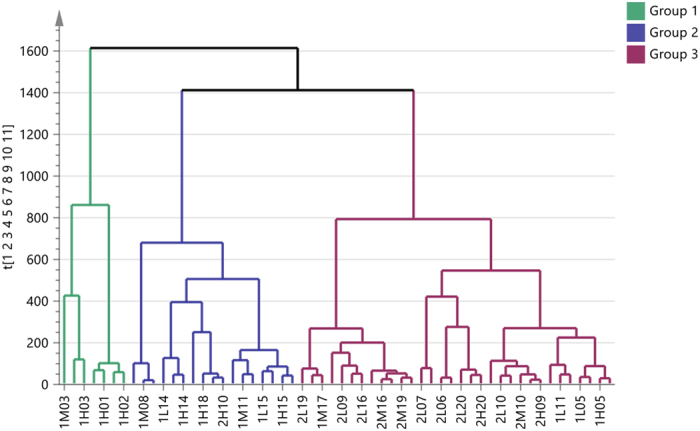
Hierarchical Clustering Analysis (HCA). The dendrogram above shows observations clustered into three groups. X-axis represents the samples and y-axis shows the similarity index. The higher the variability index the larger the between group variability and the lower the similarity index, the smaller the between group variability. The plot divides samples into three groups; group 1 (green), group 2 (blue) and group 3 (plum).
Figure 3
Figure 3
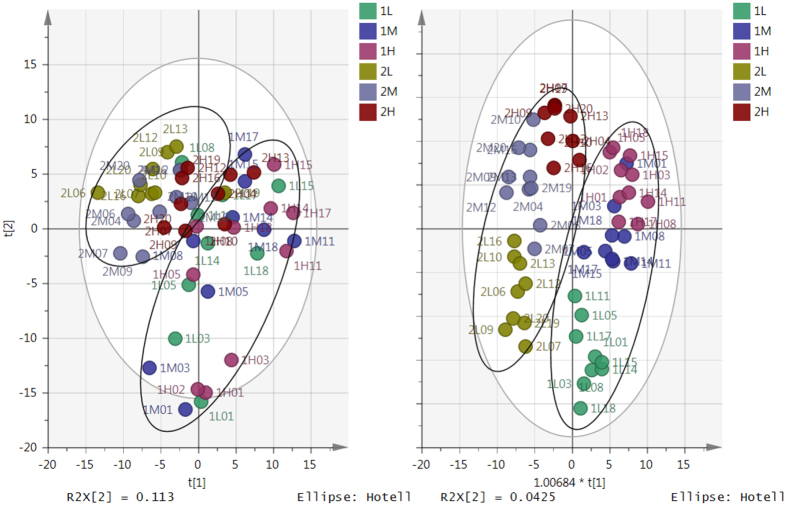
(A, left) PCA vs (B, right) OPLS-DA score plots for healthy individuals receiving different doses of HC and insulin. PCA score plot (A) includes 2 groups of subjects (n = 30 samples/10 subjects/group). Group 1 denotes samples with low insulin dose (n = 30), group 2 denotes samples with high insulin dose (n = 30). Subjects in each group have 3 different levels of HC treatment; L = low HC, M = medium HC and H = high HC dose. OPLS-DA score plot (B) includes the same group of subjects. Subjects in the same oval shapes were given the same insulin dose. In the OPLS-DA, model separation is between low and high HC doses in each insulin group but the domain of the medium HC dose overlaps with that of high HC dose in both insulin groups, while in the high insulin group also overlaps with the low GC dose.
Figure 4
Figure 4
OPLS-DA score plot for healthy individuals having either high or low insulin dose. The OPLS-DA score plot shows two groups of samples (n = 29 samples per group) based on readings of 29 significant metabolites in plasma of healthy individuals. Subjects with low insulin dose (green) and subjects with high insulin dose (blue). The model consists of one predictive x-score component; component t[1] and one orthogonal x-score components to[1]. t[1] explains 56.9% of the predictive variation in x, to[1] explains 22% of the orthogonal variation in x, R2X (cum) = 0.789, R2Y (cum) = 1, R2 (cum) = 0.841, Accuracy of prediction Q2 (cum) = 0.796.
Figure 5
Figure 5
OPLS-DA score plot for the effect of insulin on 10 selected metabolites. The OPLS-DA score plot based on 10 most significant metabolites showing two groups: samples with low insulin dose (green) and samples with high insulin dose (blue). The model consists of one predictive x-score component; component t[1] and one orthogonal x-score components to[1]. t[1] explains 82% of the predictive variation in x, to[1] explains 11.2% of the orthogonal variation in x, R2X (cum) = 1, R2Y (cum) = 1, R2 (cum) = 0.706. Accuracy of prediction Q2 (cum) = 0.665.
Figure 6
Figure 6
OPLS-DA score plot for the effect of HC dose on 10 significant putative metabolites with highest AUC values in plasma of healthy individuals. The plot shows two groups: subjects with low HC dose (grey-blue) and subjects with high HC dose (red). The model consists of one predictive x-score component; component t[1] and one orthogonal x-score components to[1]. t[1] explains 50% of the predictive variation in x, to[1] explains 15.8% of the orthogonal variation in x, R2X (cum) = 0.65.9, R2Y (cum) = 1, R2 (cum) = 0.74 and accuracy of prediction Q2 (cum) = 0.693.

References

    1. Andrews RC, Walker BR. Glucocorticoids and insulin resistance: old hormones, new targets. Clinical Science. 1999;96:513–523. doi: 10.1042/cs0960513. - DOI - PubMed
    1. Macfarlane DP, Forbes S, Walker BR. Glucocorticoids and fatty acid metabolism in humans: fuelling fat redistribution in the metabolic syndrome. J Endocrinol. 2008;197:189–204. doi: 10.1677/JOE-08-0054. - DOI - PubMed
    1. Walker BR. Glucocorticoids and cardiovascular disease. Eur J Endocrinol. 2007;157:545–559. doi: 10.1530/EJE-07-0455. - DOI - PubMed
    1. Seckl JR, Olsson T. Glucocorticoid hypersecretion and the age-impaired hippocampus: cause or effect? J Endocrinol. 1995;145:201–211. doi: 10.1677/joe.0.1450201. - DOI - PubMed
    1. Sapolsky RM, Romero LM, Munck AU. How do glucocorticoids influence stress responses? Integrating permissive, suppressive, stimulatory, and preparative actions. Endocr Rev. 2000;21:55–89. - PubMed

Publication types