


Association of Massive Transfusion for Resuscitation in Gastrointestinal Bleeding with Transfusion-related Acute Lung Injury
- PMID: 28904480
- PMCID: PMC5588485
- DOI: 10.4103/ijccm.IJCCM_380_16
Association of Massive Transfusion for Resuscitation in Gastrointestinal Bleeding with Transfusion-related Acute Lung Injury
Abstract
Background and aims: This study aimed to understand the use of massive transfusion (MT) for gastrointestinal bleeding (GIB).
Patients and methods: We performed a retrospective analysis of patients admitted to our medical Intensive Care Unit (ICU) with GIB for the type of bleeding, quantity of blood products transfused, and risk of transfusion-related acute lung injury (TRALI) and death. MT was defined as transfusion of 10 or more units of red blood cell (RBC) within a 24-h period in a 1-unit RBC: 1-unit fresh frozen plasma: and 1-unit platelet ratio. TRALI was defined as development of acute lung injury (ALI), within 6 h of transfusion, with new bilateral pulmonary infiltrates, absence of circulatory overload, or other explanation for ALI.
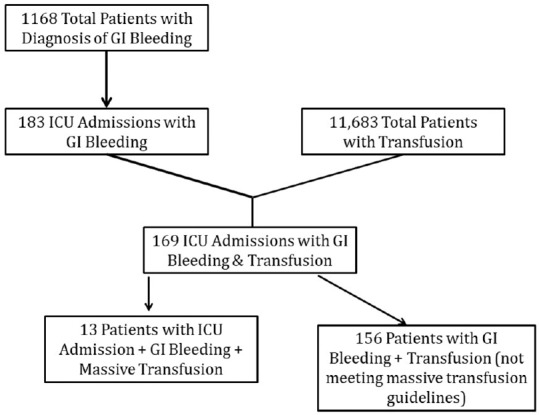
Results: In a 43-month interval, 169 patients were admitted to the ICU with GIB and received blood products, of whom 13 received MT. Ten patients developed TRALI, of whom 7 (70%) had received MT. MT was associated with an increased risk of TRALI (odds ratio [OR]: 17.9, 95% confidence interval [CI]: 2.9-111.2, P = 0.002) after adjusting for age, sex, body mass index, baseline vitals, and laboratory data. Death was predicted by MT (OR: 5.6, 95% CI: 1.6-19.7, P = 0.007), TRALI (OR: 2.3, 95% CI: 1.1-4.6, P = 0.02), and Acute Physiologic Chronic Health Evaluation II score (OR: 1.17 per unit increase, 95% CI: 1.09-1.26, P < 0.001) after adjusting for age and sex.
Conclusions: MT for GIB is associated with an increased risk of TRALI and death. Prospective studies assessing the use of MT in this population are needed to understand and improve outcomes.
Keywords: Blood transfusion; Intensive Care Unit; gastrointestinal bleeding; massive transfusion; outcomes; resuscitation.
Conflict of interest statement
There are no conflicts of interest.
Figures
References
-
- Sihler KC, Napolitano LM. Complications of massive transfusion. Chest. 2010;137:209–20. - PubMed
-
- Kleinman S, Caulfield T, Chan P, Davenport R, McFarland J, McPhedran S, et al. Toward an understanding of transfusion-related acute lung injury: Statement of a consensus panel. Transfusion. 2004;44:1774–89. - PubMed
-
- Toy P, Popovsky MA, Abraham E, Ambruso DR, Holness LG, Kopko PM, et al. Transfusion-related acute lung injury: Definition and review. Crit Care Med. 2005;33:721–6. - PubMed
LinkOut - more resources
Full Text Sources
Other Literature Sources