. 2017 Sep 7:10:210.
doi: 10.1186/s13068-017-0896-8. eCollection 2017.

Bacillus coagulans MA-13: a promising thermophilic and cellulolytic strain for the production of lactic acid from lignocellulosic hydrolysate

Affiliations

Bacillus coagulans MA-13: a promising thermophilic and cellulolytic strain for the production of lactic acid from lignocellulosic hydrolysate

Martina Aulitto et al. Biotechnol Biofuels. .

Abstract

Background: The transition from a petroleum-based economy towards more sustainable bioprocesses for the production of fuels and chemicals (circular economy) is necessary to alleviate the impact of anthropic activities on the global ecosystem. Lignocellulosic biomass-derived sugars are suitable alternative feedstocks that can be fermented or biochemically converted to value-added products. An example is lactic acid, which is an essential chemical for the production of polylactic acid, a biodegradable bioplastic. However, lactic acid is still mainly produced by Lactobacillus species via fermentation of starch-containing materials, the use of which competes with the supply of food and feed.

Results: A thermophilic and cellulolytic lactic acid producer was isolated from bean processing waste and was identified as a new strain of Bacillus coagulans, named MA-13. This bacterium fermented lignocellulose-derived sugars to lactic acid at 55 °C and pH 5.5. Moreover, it was found to be a robust strain able to tolerate high concentrations of hydrolysate obtained from wheat straw pre-treated by acid-catalysed (pre-)hydrolysis and steam explosion, especially when cultivated in controlled bioreactor conditions. Indeed, unlike what was observed in microscale cultivations (complete growth inhibition at hydrolysate concentrations above 50%), B. coagulans MA-13 was able to grow and ferment in 95% hydrolysate-containing bioreactor fermentations. This bacterium was also found to secrete soluble thermophilic cellulases, which could be produced at low temperature (37 °C), still retaining an optimal operational activity at 50 °C.

Conclusions: The above-mentioned features make B. coagulans MA-13 an appealing starting point for future development of a consolidated bioprocess for production of lactic acid from lignocellulosic biomass, after further strain development by genetic and evolutionary engineering. Its optimal temperature and pH of growth match with the operational conditions of fungal enzymes hitherto employed for the depolymerisation of lignocellulosic biomasses to fermentable sugars. Moreover, the robustness of B. coagulans MA-13 is a desirable trait, given the presence of microbial growth inhibitors in the pre-treated biomass hydrolysate.

Keywords: Bacillus coagulans; Cellulolytic enzymes; Enzymes secretion; Fermentation; Lactic acid; Robustness; Thermophilic; Wheat straw hydrolysate.


Figures
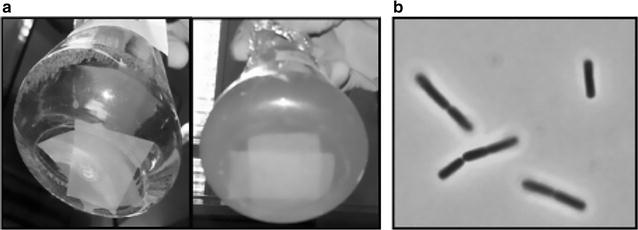
Fig. 1
Fig. 1
Isolation of the cellulolytic strain MA-13. a Bacillus coagulans MA-13 culture after overnight growth in FP-SM (right side) and negative control without cells (left side). b Light microscope observation of B. coagulans MA-13 cells when cultivated in CMC-SM (Additional file 1: Table S1)
Fig. 2
Fig. 2
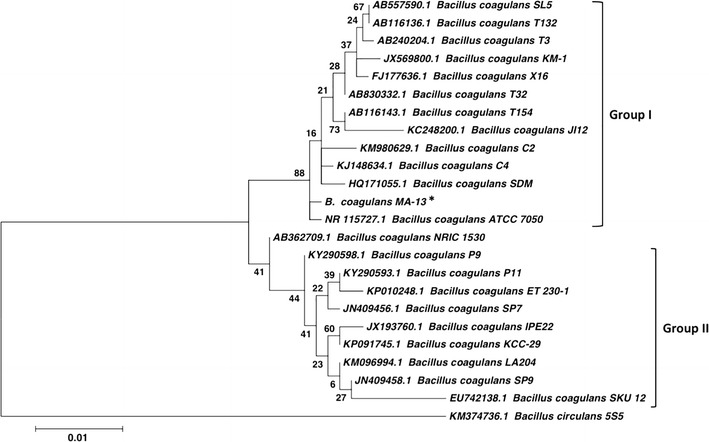
Phylogenetic relationship between MA-13 and other B. coagulans strains based on 16S rRNA sequences. The evolutionary history was inferred by using the Maximum Likelihood method based on the Tamura–Nei model [35]. The tree with the highest log likelihood (−1664.1025) is shown. The percentage of trees in which the associated taxa clustered together is shown next to the branches. Initial tree(s) for the heuristic search were obtained by applying the Neighbour-Joining method to a matrix of pairwise distances estimated using the Maximum Composite Likelihood approach. The tree is drawn to scale, with branch lengths measured in the number of substitutions per site (0.01). The analysis involved 24 nucleotide sequences. All positions containing gaps and missing data were eliminated. There was a total of 745 positions in the final dataset. Evolutionary analyses were conducted in MEGA6, using the 16S sequence from Bacillus circulans 5S5 as an outgroup to root the tree. For all strains, the GenBank accession number is reported
Fig. 3
Fig. 3
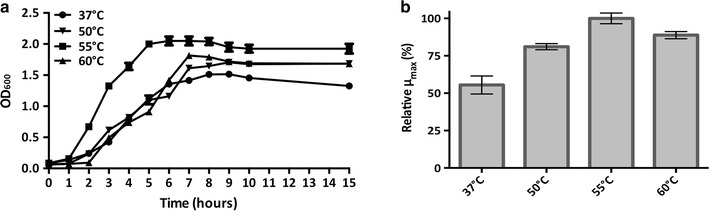
Assessment of the optimal temperature of growth. a Average growth curves (n = 3) at different temperatures in CMC-SM (Additional file 1: Table S1). b Bar plots of the maximum specific growth rates (μ max) expressed as percentage (%) relative to the optimal condition (55 °C). Error bars show the deviation between triplicate experiments
Fig. 4
Fig. 4
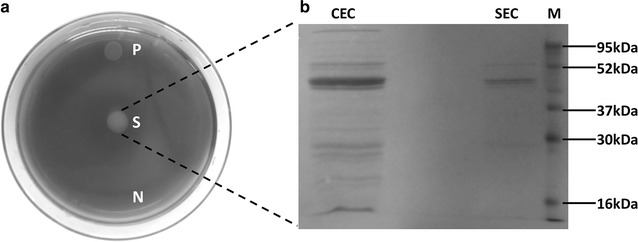
Detection of secreted endoglucanase enzymes. a CMC-hydrolysis spot assay. Positive control (P): cellulase from Trichoderma reesei ATCC 26921 (5 μg of total proteins; determined by Bradford assay). Negative control (N): 90% (w/v) (NH4)2SO4 solution. Concentrated supernatant (S): B. coagulans cell-free supernatant concentrated by adding 90% (w/v) (NH4)2SO4 (5 μg of total proteins; determined by Bradford assay). b SDS-PAGE of Azo-CMCase positive fractions obtained by cation-exchange (CEC) and size-exclusion chromatography (SEC). Molecular mass markers (M)
Fig. 5
Fig. 5
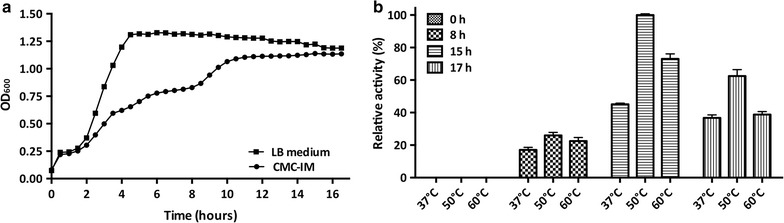
Time course secretion of endoglucanase enzymes. a Average growth curves (n = 3) at 37 °C in CMC-IM (Additional file 1: Table S1) and LB medium (negative control of secretion). b Bar plots of Azo-CMCase activity tested at three different temperatures. Values are expressed as percentage (%) relative to the maximum value (i.e. at 15 h at 50 °C). Error bars show the deviation between triplicate experiments
Fig. 6
Fig. 6
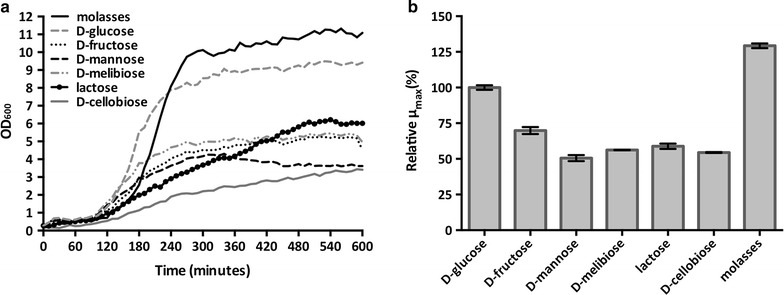
Cultivation using different lignocellulose-derived sugars. a Average growth curves in Bioscreen media containing different saccharides (Additional file 1: Table S1). b Bar plots of the maximum specific growth rates (μ max) expressed as percentage (%) relative to the μ max in presence of glucose. Error bars show the deviation between duplicate experiments
Fig. 7
Fig. 7
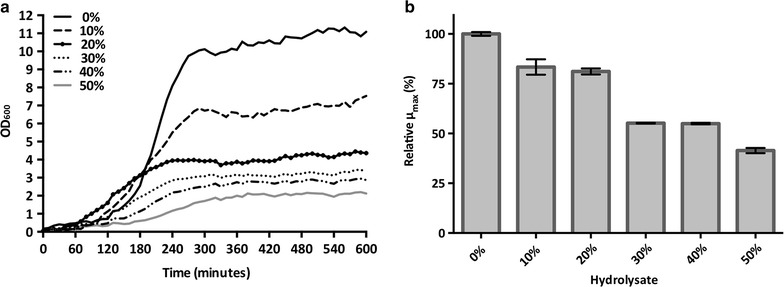
Effect of the steam-exploded wheat straw hydrolysate on the growth of B. coagulans MA-13. a Average growth curves in Bioscreen media containing different concentrations of hydrolysate (Additional file 1: Table S1). b Maximum specific growth rates (μ max) expressed as percentage (%) relative to the rate in the absence of hydrolysate (0%). Error bars show the deviation between duplicate experiments
Fig. 8
Fig. 8
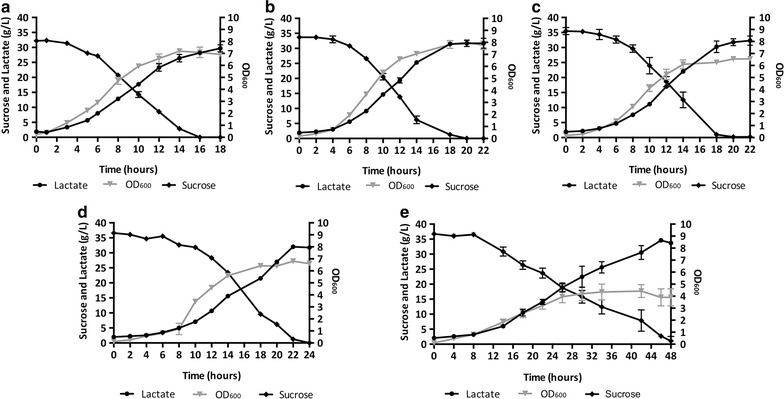
B. coagulans anaerobic batch fermentations. Growth and fermentation profiles in hydrolysate-free (a) as well as in hydrolysate-containing media: 30% (b), 50% (c), 70% (d) and 95% (e). For the composition of fermentation media see Additional file 1: Table S1. Error bars show the deviation between duplicate experiments

References

    1. Bilal M, Asgher M, Iqbal HM, Hu H, Zhang X. Biotransformation of lignocellulosic materials into value-added products—A review. Int J Biol Macromol. 2017;98:447–458. doi: 10.1016/j.ijbiomac.2017.01.133. - DOI - PubMed
    1. Arevalo-Gallegos A, Ahmad Z, Asgher M, Parra-Saldivar R, Iqbal HM. Lignocellulose: a sustainable material to produce value-added products with a zero waste approach—A review. Int J Biol Macromol. 2017;99:308–318. doi: 10.1016/j.ijbiomac.2017.02.097. - DOI - PubMed
    1. Ko C-H, Chaiprapat S, Kim L-H, Hadi P, Hsu S-C, Leu S-Y. Carbon sequestration potential via energy harvesting from agricultural biomass residues in Mekong River basin, Southeast Asia. Renew Sustain Energy Rev. 2017;68:1051–1062. doi: 10.1016/j.rser.2016.03.040. - DOI
    1. Komesu A, de Oliveira JAR, da Silva Martins LH, Maciel MRW, Maciel Filho R. Lactic acid production to purification: a review. BioResour. 2017;12:4364–4383.
    1. Abdel-Rahman MA, Tashiro Y, Sonomoto K. Lactic acid production from lignocellulose-derived sugars using lactic acid bacteria: overview and limits. J Biotechnol. 2011;156:286–301. doi: 10.1016/j.jbiotec.2011.06.017. - DOI - PubMed