Review
. 2017 Sep 8:9:98.
doi: 10.1186/s13148-017-0398-3. eCollection 2017.

Histone code and long non-coding RNAs (lncRNAs) aberrations in lung cancer: implications in the therapy response

Affiliations
Review

Histone code and long non-coding RNAs (lncRNAs) aberrations in lung cancer: implications in the therapy response

Abril Marcela Herrera-Solorio et al. Clin Epigenetics. .

Abstract

Respiratory diseases hold several genome, epigenome, and transcriptional aberrations as a cause of the accumulated damage promoted by, among others, environmental risk factors. Such aberrations can also come about as an adaptive response when faced with therapeutic oncological drugs. In epigenetic terms, aberrations in DNA methylation patterns, histone code marks balance, and/or chromatin-remodeling complexes recruitment, among Polycomb Repressive Complex-2 (PRC2) versus Trithorax (TRX) Activator Complex, have been proposed to be affected by several previously characterized functional long non-coding RNAs (lncRNAs). Such molecules are involved in modulating and/or controlling lung cancer epigenome and genome expression, as well as in malignancy and clinical progression in lung cancer. Several recent reports have described diverse epigenetic modifications in lung cancer cells and solid tumors, among others genomic DNA methylation and post-translational modifications (PTMs) on histone tails, as well as lncRNAs patterns and levels of expression. However, few systematic approaches have attempted to demonstrate a biological function and clinical association, aiming to improve therapeutic decisions in basic research and lung clinical oncology. A widely used example is the lncRNA HOTAIR and its functional histone mark H3K27me3, which is directly associated to the PRC2; however, few systematic pieces of solid evidence have been experimentally performed, conducted and/or validated to predict lung oncological therapeutic efficacy. Recent evidence suggests that chromatin-remodeling complexes accompanied by lncRNAs profiles are involved in several comprehensive lung carcinoma clinical parameters, including histopathology progression, prognosis, and/or responsiveness to unique or combined oncological therapies. The present manuscript offers a systematic revision of the current knowledge about the major epigenetic aberrations represented by changes in histone PTMs and lncRNAs expression levels and patterns in human lung carcinomas in cancer drug-based treatments, as an important comprehensive knowledge focusing on better oncological therapies. In addition, a new future direction must be refocusing on several gene target therapies, mainly on pharmaceutical EGFR-TKIs compounds, widely applied in lung cancer, currently the leading cause of death by malignant diseases.


Conflict of interest statement

Ethics approval and consent to participate

Not applicable.

Consent for publication

Not applicable.

Competing interests

The authors declare that they have no competing interests.

Publisher’s Note

Springer Nature remains neutral with regard to jurisdictional claims in published maps and institutional affiliations.

Figures
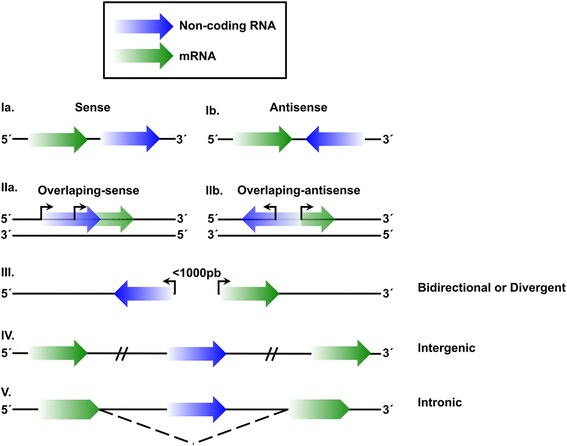
Fig. 1
Fig. 1
LncRNA classification based on their genomic location. Classification of lncRNAs (blue) based on their genomic position and in a relation to the neighboring genetic “mRNA” coding sequence (green). Ia) Sense lncRNAs. LncRNAs located in the same genetic chain with same and positive sense as the coding mRNA. Ib) Antisense lncRNAs. LncRNAs located on the opposite coding strand of the mRNA encoding sequences. IIa) Overlapping sense lncRNAs. Overlapped lncRNAs located in the same orientation sense with the mRNA encoding for protein. IIb) Overlapping antisense lncRNAs. Overlapped lncRNAs, located in opposite side with the mRNA encoding proteins. III) Bidirectional or divergent lncRNAs. LncRNAs located on the antisense strand (opposite to the neighboring lncRNA) that share or not promoter genetic sequences whose transcription start site (TSS) is close to the TSS of the coding mRNA sequences (< 1000 bp), meaning that they are transcribed in to the opposite direction with respect to the neighboring “mRNA” coding gene. IV) Intergenic lncRNA. LncRNAs which are transcribed from an intergenic region, transcribing from the sense or antisense strand. V) Intronic lncRNAs. LncRNAs located between the boundaries of the intronic and coding mRNA sequences. The arrow symbols meaning the transcription direction
Fig. 2
Fig. 2
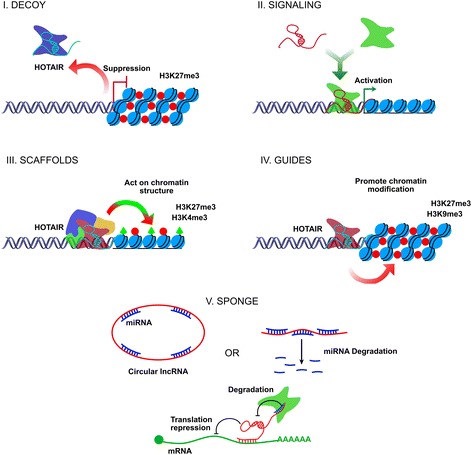
Five functional archetypes involved in the lncRNAs molecular mechanisms. I. Decoy: LncRNAs are transcribed and subsequently bound to the transcription factors, chromatin modifiers, or other regulatory factors outside from the chromatin structure, as well as moved in other nuclear subdomains preventing them from performing their biological effector function, free to perform any additional function, probably acting as a negative transcriptional regulator functionality. II. Signaling: LncRNAs are employed as molecular signals conducing to combinatorial actions of transcription factors and/or cell signaling pathways by regulating the space and time, on the stage of development and/or genetic expression patterns under certain cellular conditions by external stimuli. This archetype may act as biologically and functionally significant event markers at the cellular and/or tissue level of diseases events. III. Scaffolds: LncRNAs act as molecular platforms on which multiple proteins are assembled to form ribonucleoprotein complexes (RNPs). Each lncRNA-RNP complex may function in a structural manner by stabilizing complexes and controlling effector functions with an activating or repressive transcriptional activity or by altering post-translational modifications of the histone marks. IV. Guides: LncRNAs may recruit chromatin modifying proteins or remodeling enzymes to target specific genes, either in Cis position (near the site where lncRNA was transcribed or in neighboring regions) or in Trans position to target-distant genes into the chromatin specific sites. V. Sponge: LncRNAs that by complementarity of bases succeed in matching or sequestering sequences of small non-coding RNAs, such as miRNAs, are controlling the bioavailability of miRNAs versus lncRNAs themselves, with the functional biological repercussions at cellular level
Fig. 3
Fig. 3
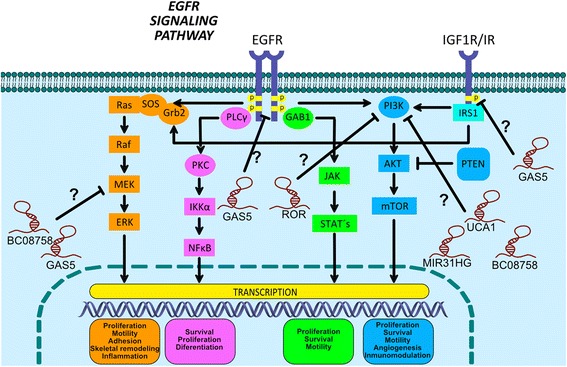
EGFR cell signaling and lncRNAs relationship in lung cancer therapy resistance. The binding of the EGF ligand to the EGFR receptor causes the autophosphorylation of the tyrosine residues located in the terminal COOH-domain, allowing the activation of multiple downstream signaling cascades through the recruitment of signaling proteins to the intracellular portion of the receptor including Ras/Raf/MEK/ERK, PI3K/Akt, JAK/STAT and PLC, which ultimately drive to proliferation, survival, and/or tumor cell invasion. Growth factor-stimulated "IGF-1R" also induces the activation of AKT and ERK signaling pathways. Likewise, the probable participation of lncRNAs along the EGFR cell signaling pathway has been indicated, as a new likely lncRNAs therapy targets in lung cancer

References

    1. WHO . World Cancer Report. 2015.
    1. Herbst RS, Heymach JV, Lippman SM. Lung cancer. N Engl J Med. 2008;359:1367–1380. doi: 10.1056/NEJMra0802714. - DOI - PMC - PubMed
    1. Travis WD. Pathology of lung cancer. Clin Chest Med. 2002;23:65–81. doi: 10.1016/S0272-5231(03)00061-3. - DOI - PubMed
    1. Yu H, Han Z, Wang Y, Xin H. The clonal evolution and therapeutic approaches of lung cancer. Cell Biochem Biophys. 2014;70:63–71. doi: 10.1007/s12013-014-9910-y. - DOI - PubMed
    1. Collins LG, Haines C, Perkel R, Enck RE. Lung cancer: diagnosis and management. Am Fam Physician. 2007;75:56–63. - PubMed

Publication types