Review
. 2017 Aug;6(4):745-752.
doi: 10.21037/tau.2017.07.07.

Microdissection testicular sperm extraction

Affiliations
Review

Microdissection testicular sperm extraction

Ryan Flannigan et al. Transl Androl Urol. 2017 Aug.

Abstract

Microdissection testicular sperm extraction (microTESE) is considered the gold standard method for surgical sperm retrieval among patients with non-obstructive azoospermia (NOA). In this review, we will discuss the optimal evaluation of NOA patients and strategies to medically optimize NOA patients prior to microTESE. In addition, we will also discuss technical principles and pearls to maximize the chances of successful sperm retrieval, sperm retrieval rates (SRR) based upon testicular histology, predictors of successful sperm retrieval, gonadal recovery following microTESE, and potential complications.

Keywords: Non-obstructive azoospermia (NOA); male infertility; microdissection testicular sperm extraction (microTESE); surgical sperm retrieval; testicular sperm extraction (TESE).


Conflict of interest statement

Conflicts of Interest: The authors have no conflicts of interest to declare.

Figures
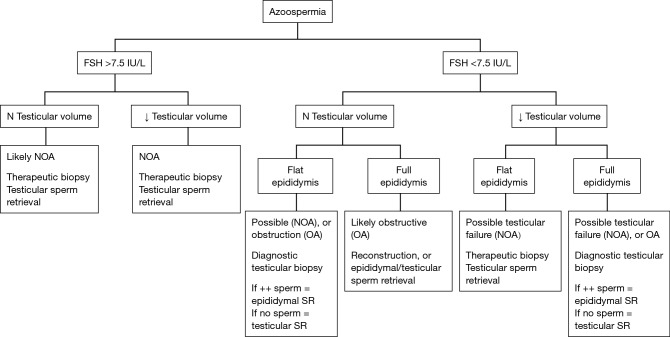
Figure 1
Figure 1
Adapted with permission from Flannigan & Schlegel 2017, AUA Update Series, Lesson 9, Volume 36. Flow chart depicting surgical management of the azoospermic patient based upon FSH and clinical examination. FSH and physical examination are two very important clinical features to determine if the etiology of azoospermia is likely NOA or OA. These findings help the surgeon to determine if a diagnostic or therapeutic testicular biopsy is required; or, if reconstruction or epididymal sperm retrieval is required. When assessing the epididymis, it may feel full & prominent indicating sperm may be present but block by obstruction, or, flat and subtle in which case it is less likely that sperm are present in the epididymal tubules; refer to Table 1 for an inclusive list of the other diagnostic tests important in initially assessing an azoospermic patient such as genetic testing, semen analysis volume & pH etc. NOA, non-obstructive azoospermia; OA, obstructive azoospermia; SR, sperm retrieval.
Figure 2
Figure 2
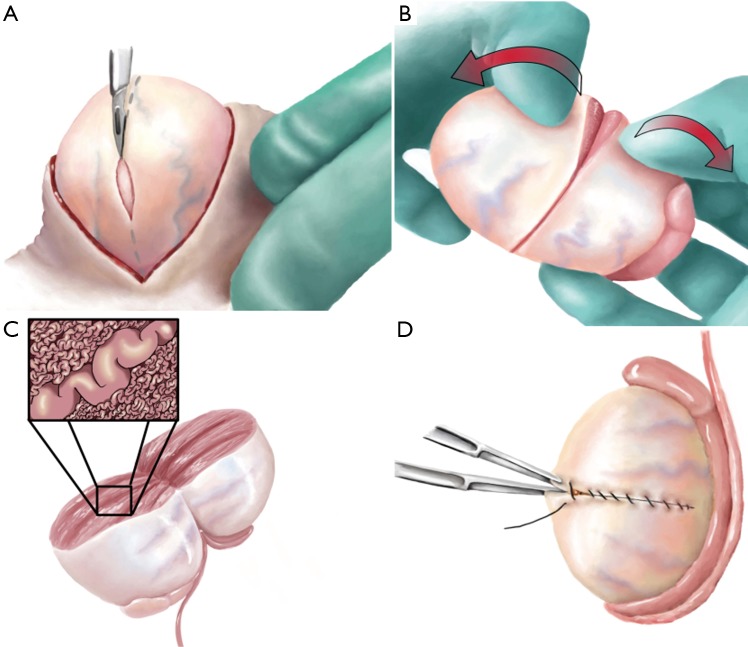
Adapted with permission from Flannigan & Schlegel 2017, AUA Update Series, Lesson 9, Volume 36. microTESE. (A) The testicle is delivered through a scrotal incision. An equatorial incision is made in the tunica albuginea; (B) the testis is bi-valved exposing the seminiferous tubules; (C) the seminiferous tubules are carefully searched under an operating microscope until a dilated tubule is identified. These dilated tubules are more likely to contain sperm and should be harvested to be processed by the embryology team and examined under a microscope; (D) once the microTESE incomplete, hemostasis is achieved with bipolar cautery and the tunical albuginea is closed with a running non-absorbable monofilament suture. The testicle is placed back in the scrotum and the tunica vaginalis, dartos, and skin layers are closed.

References

    1. Wosnitzer M, Goldstein M, Hardy MP. Review of Azoospermia. Spermatogenesis 2014;4:e28218. 10.4161/spmg.28218 - DOI - PMC - PubMed
    1. Schoor RA, Elhanbly S, Niederberger CS, et al. The role of testicular biopsy in the modern management of male infertility. J Urol 2002:167:197-200. 10.1016/S0022-5347(05)65411-0 - DOI - PubMed
    1. Bernie AM, Shah K, Halpern JA, et al. Outcomes of microdissection testicular sperm extraction in men with nonobstructive azoospermia due to maturation arrest. Fertil Steril 2015;104:569-73.e1. 10.1016/j.fertnstert.2015.05.037 - DOI - PubMed
    1. Caroppo E, Colpi EM, Gazzano G, et al. Testicular histology may predict the successful sperm retrieval in patients with non-obstructive azoospermia undergoing conventional TESE: a diagnostic accuracy study. J Assist Reprod Genet 2017;34:149-54. 10.1007/s10815-016-0812-3 - DOI - PMC - PubMed
    1. Colpi GM, Colpi EM, Piediferro G, et al. Microsurgical TESE versus conventional TESE for ICSI in non-obstructive azoospermia: a randomized controlled study. Reprod Biomed Online 2009;18:315-9. 10.1016/S1472-6483(10)60087-9 - DOI - PubMed

LinkOut - more resources