


doi: 10.1038/nature23884.
The 4D nucleome project
Affiliations
- PMID: 28905911
- PMCID: PMC5617335
- DOI: 10.1038/nature23884
Item in Clipboard
The 4D nucleome project
Nature.
.
Erratum in
-
Corrigendum: The 4D nucleome project.Nature. 2017 Dec 14;552(7684):278. doi: 10.1038/nature24667. Epub 2017 Nov 22. Nature. 2017. PMID: 29168505
Abstract
The 4D Nucleome Network aims to develop and apply approaches to map the structure and dynamics of the human and mouse genomes in space and time with the goal of gaining deeper mechanistic insights into how the nucleus is organized and functions. The project will develop and benchmark experimental and computational approaches for measuring genome conformation and nuclear organization, and investigate how these contribute to gene regulation and other genome functions. Validated experimental technologies will be combined with biophysical approaches to generate quantitative models of spatial genome organization in different biological states, both in cell populations and in single cells.
Figures
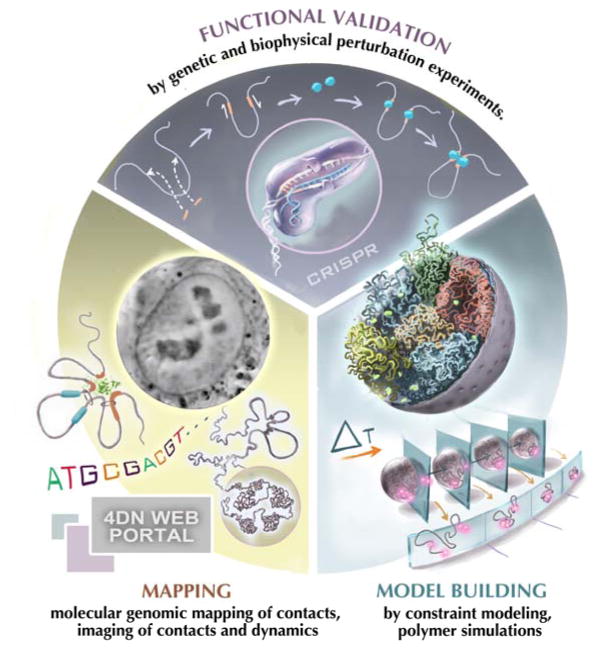
The project encompasses three components: First, experimental mapping approaches are employed to measure a range of aspects of the spatial organization of the genome including chromatin loops, domains, nuclear bodies etc. Second, computational and modeling approaches are used to interpret experimental observations and build (dynamic) spatial models of the nucleus. Third, perturbation experiments, e.g. using CRISPR/cas9-mediated genome engineering, are used for functional validation. In these studies chromatin structures are altered, e.g. removing chromatin loops, creating novel loops at defined positions or tethering regulatory components in selected regions in order to test their architectural function. These perturbation studies can be complemented with functional studies, e.g. analysis of gene expression to assess the functional implications of chromatin folding. (Picture of cell nucleus was provided by Hanhui Ma and Thoru Pederson).
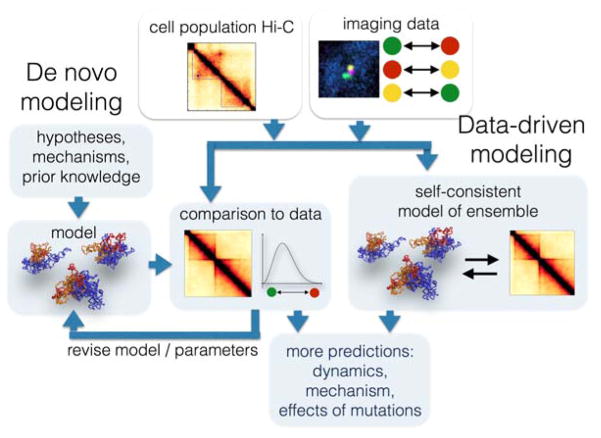
Data obtained with imaging and chromosome conformation capture based assays can be used for building spatial and dynamic models of chromosomes using two main approaches. In the data-driven approach, experimental data are used directly to generate ensembles of conformations that reproduce the experimental observations. In the de novo approach, ensembles of conformations are built according to known or hypothesized physical or biological processes. Models are then selected based on their agreement with experimental data.
References
-
- Stunnenberg H, Hirst M International Human Epigenome Consortium. The international human epigenome consortium: a blueprint for scientific collaboration and discovery. Cell. 2016;167:1145–1149. - PubMed
-
- Carninci P, et al. The transcriptional landscape of the mammalian genome. Science. 2005;309:1559–1563. - PubMed
-
- Tolhuis B, Palstra RJ, Splinter E, Grosveld F, de Laat W. Looping and Interaction between Hypersensitive Sites in the Active beta-globin Locus. Mol Cell. 2002;10:1453–1465. - PubMed
