


Triptolide induces Sertoli cell apoptosis in mice via ROS/JNK-dependent activation of the mitochondrial pathway and inhibition of Nrf2-mediated antioxidant response
- PMID: 28905938
- PMCID: PMC5800476
- DOI: 10.1038/aps.2017.95
Triptolide induces Sertoli cell apoptosis in mice via ROS/JNK-dependent activation of the mitochondrial pathway and inhibition of Nrf2-mediated antioxidant response
Abstract
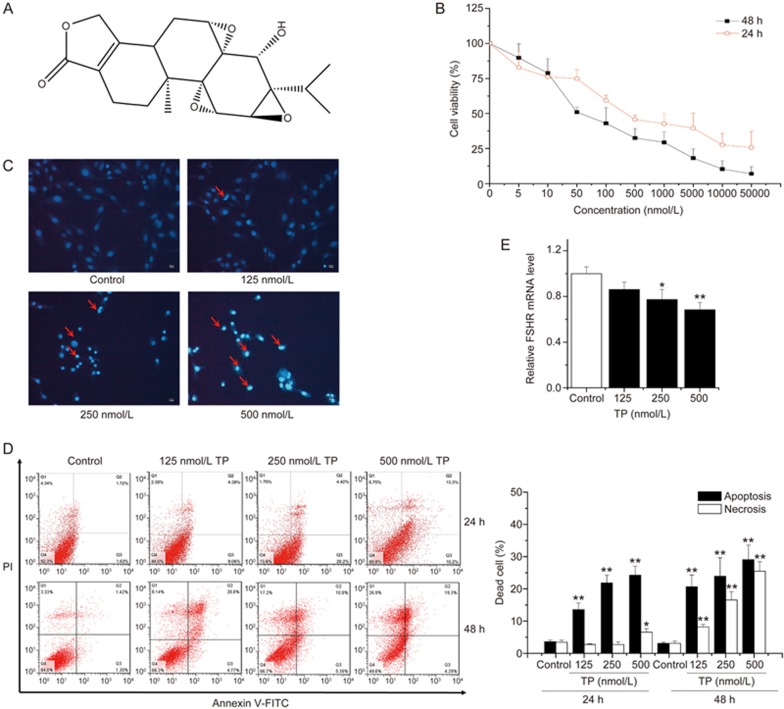
Triptolide (TP), an oxygenated diterpene, has a variety of beneficial pharmacodynamic activities but its clinical applications are restricted due to severe testicular injury. This study aimed to delineate the molecular mechanisms of TP-induced testicular injury in vitro and in vivo. TP (5-50000 nmol/L) dose-dependently decreased the viability of TM4 Sertoli cells with an IC50 value of 669.5-269.45 nmol/L at 24 h. TP (125, 250, and 500 nmol/L) dose-dependently increased the accumulation of ROS, the phosphorylation of JNK, mitochondrial dysfunction and activation of the intrinsic apoptosis pathway in TM4 cells. These processes were attenuated by co-treatment with the antioxidant N-acetyl cysteine (NAC, 1 mmol/L). Furthermore, TP treatment inhibited the translocation of Nrf2 from cytoplasm into the nucleus as well as the expression of downstream genes NAD(P)H quinone oxidoreductase1 (NQO1), catalase (CAT) and hemeoxygenase 1 (HO-1), thus abrogating Nrf2-mediated defense mechanisms against oxidative stress. Moreover, siRNA knockdown of Nrf2 significantly potentiated TP-induced apoptosis of TM4 cells. The above results from in vitro experiments were further validated in male mice after oral administration of TP (30, 60, and 120 mg·kg-1·d-1, for 14 d), as evidenced by the detected indexes, including dose-dependently decreased SDH activity, increased MDA concentration, altered testicle histomorphology, elevated caspase-3 activation, apoptosis induction, increased phosphorylation of JNK, and decreased gene expression of NQO1, CAT and HO-1 as well as nuclear protein expression of Nrf2 in testicular tissue. Our results demonstrate that TP activates apoptosis of Sertoli cells and injury of the testis via the ROS/JNK-mediated mitochondrial-dependent apoptosis pathway and down-regulates Nrf2 activation.
Figures


References
-
- Lu Y, Bao X, Sun T, Xu J, Zheng W, Shen P. Triptolide attenuate the oxidative stress induced by LPS/D-GalN in mice. J Cell Biochem 2012; 113: 1022–33. - PubMed
-
- Fu Q, Jiang ZZ, Zhang LY. Impairment of triptolide on liver mitochondria in isolated liver mitochondria and HL7702 cell line. Chin J Integr Med 2013; 19: 683–8. - PubMed
-
- Kupchan SM, Court WA, Dailey RG Jr, Gilmore CJ, Bryan RF. Triptolide and tripdiolide, novel antileukemic diterpenoid triepoxides from Tripterygium wilfordii. J Am Chem Soc 1972; 94: 7194–5. - PubMed
-
- Wang B, Ma L, Tao X, Lipsky PE. Triptolide, an active component of the Chinese herbal remedy Tripterygium wilfordii Hook F, inhibits production of nitric oxide by decreasing inducible nitric oxide synthase gene transcription. Arthritis Rheum 2004; 50: 2995–303. - PubMed
-
- Lin N, Sato T, Ito A. Triptolide, a novel diterpenoid triepoxide from Tripterygium wilfordii Hook. f., suppresses the production and gene expression of pro-matrix metalloproteinases 1 and 3 and augments those of tissue inhibitors of metalloproteinases 1 and 2 in human synovial fibroblasts. Arthritis Rheum 2001; 44: 2193–200. - PubMed
MeSH terms
Substances
LinkOut - more resources
Full Text Sources
Other Literature Sources
Research Materials
Miscellaneous
