


Vitamin D in the Parkinson Associated Risk Syndrome (PARS) study
- PMID: 28906025
- PMCID: PMC5721350
- DOI: 10.1002/mds.27127
Vitamin D in the Parkinson Associated Risk Syndrome (PARS) study
Abstract
Background: Lower vitamin D levels have been associated with manifest Parkinson's disease, prompting the hypothesis that vitamin D insufficiency or deficiency may increase risk for PD.
Objectives: To evaluate vitamin D levels in a population at risk for developing PD.
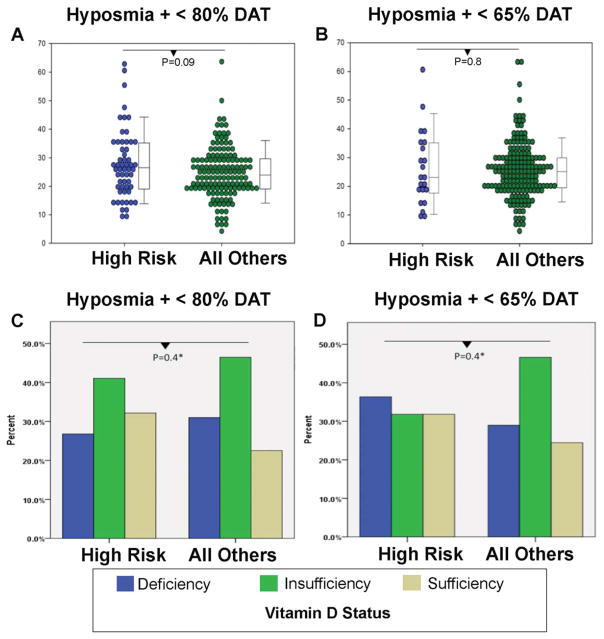
Methods: Plasma vitamin D levels were measured in the Parkinson Associated Risk Syndrome Study, a cohort of asymptomatic individuals, some of whom are at high risk for PD. Vitamin D levels were compared between subjects at high risk for PD (hyposmia and dopamine transporter scan deficit) versus all others and examined for correlations with dopaminergic system integrity.
Results: Mean vitamin D levels did not differ between groups, with a level of 27.8 ng/mL (standard deviation = 12.0) in the high-risk group versus 24.7 ng/mL (standard deviation = 9.0) in all others (P = 0.09). Vitamin D levels did not associate with putaminal dopamine transporter uptake.
Conclusions: Our data from the asymptomatic Parkinson Associated Risk Syndrome cohort do not support the hypothesis that chronic vitamin D insufficiency threatens dopaminergic system integrity, contributing to PD pathogenesis. © 2017 International Parkinson and Movement Disorder Society.
Keywords: Parkinson's disease; cognition; cohort studies; vitamin D.
© 2017 International Parkinson and Movement Disorder Society.
Conflict of interest statement
Figures
References
-
- Lee YH, Kim JH, Song GG. Vitamin D receptor polymorphisms and susceptibility to Parkinson’s disease and Alzheimer’s disease: a meta-analysis. Neurol Sci. 2014;35:1947–1953. - PubMed
-
- Sato Y, Honda Y, Iwamoto J. Risedronate and ergocalciferol prevent hip fracture in elderly men with Parkinson disease. Neurology. 2007;68:911–915. - PubMed
-
- Zhao Y, Sun Y, Ji HF, Shen L. Vitamin D levels in Alzheimer’s and Parkinson’s diseases: a meta-analysis. Nutrition. 2013;29:828–832. - PubMed
Publication types
MeSH terms
Substances
Grants and funding
LinkOut - more resources
Full Text Sources
Other Literature Sources
Medical
Miscellaneous
