


Altered default mode network configuration in posttraumatic stress disorder after earthquake: A resting-stage functional magnetic resonance imaging study
- PMID: 28906364
- PMCID: PMC5604633
- DOI: 10.1097/MD.0000000000007826
Altered default mode network configuration in posttraumatic stress disorder after earthquake: A resting-stage functional magnetic resonance imaging study
Abstract
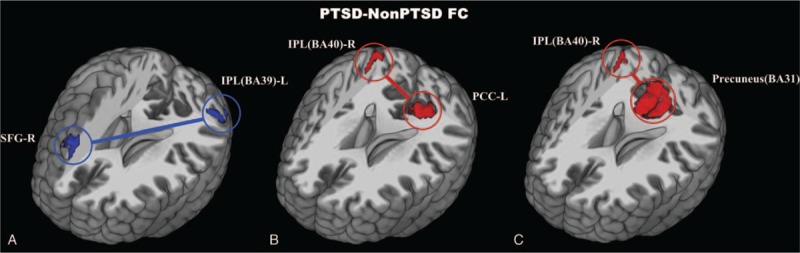
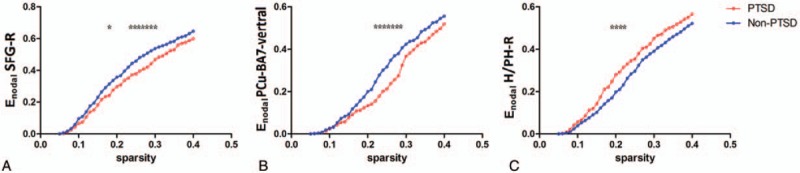
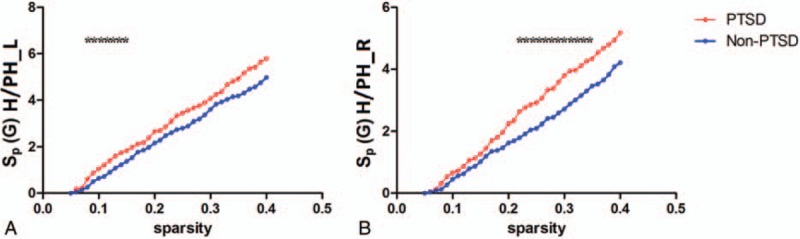
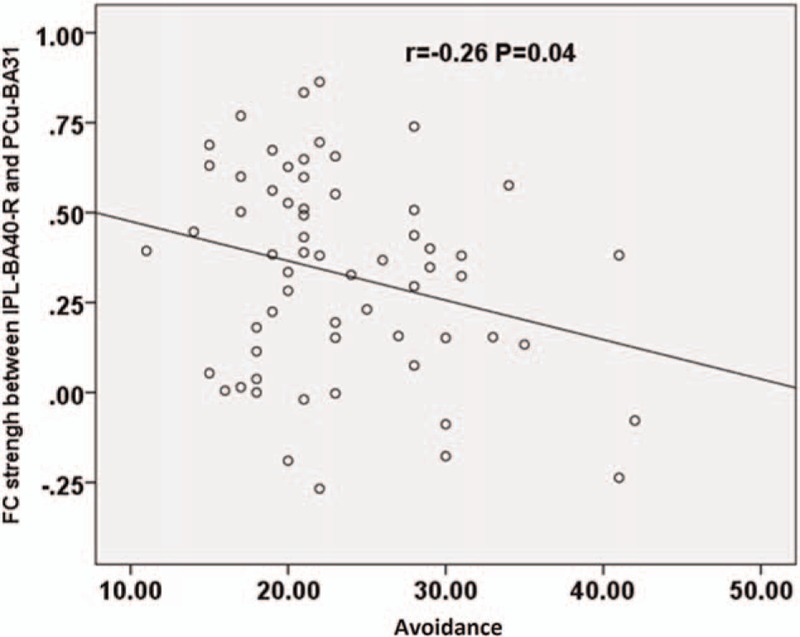
The neural substrates of posttraumatic stress disorder (PTSD) are still not fully elucidated. Hence, this study is to explore topological alterations of the default mode network (DMN) in victims with PTSD after a magnitude of 8.0 earthquake using resting-state functional magnetic resonance imaging (rs-fMRI).This study was approved by the local ethical review board, and all participants signed written informed consent. Sixty-two PTSD victims from the 2008 Sichuan earthquake and 62 matched exposed controls underwent rs-fMRI. PTSD was diagnosed by Clinician-Administered PTSD Scale, and underwent PTSD Checklist-Civilian Version for symptom scoring. The DMN was analyzed by using graph theoretical approaches. Further, Pearson correlation analysis was performed to correlate neuroimaging metrics to neuropsychological scores in victims with PTSD.Victims with PTSD showed decreased DMN functional connectivity strength between the right superior frontal gyrus and left inferior parietal lobule (IPL), and showed increased functional connectivity between the right IPL and precuneus or left posterior cingulate cortex. It was also found that victims with PTSD exhibited decreased nodal efficiency in right superior frontal gyrus and precuneus, and increased nodal efficiency in right hippocampus/parahippocampus. Apart from that, PTSD showed higher nodal degree in bilateral hippocampus/parahippocampus. In addition, the functional connectivity strength between the right IPL and precuneus correlated negatively to the avoid scores (r = -0.26, P = .04).This study implicates alteration of topological features on the DMN in PTSD victims after major earthquake, and provides new insights into DMN malfunction in PTSD based on graph theory.
Conflict of interest statement
This work was supported by the National Natural Science Foundation of China (30830046–81171286 and 91232714 to LL), the National 973 Program of China (2009CB918303 to LL), and a Chinese Key Grant to GL (BWS11J063 and 10z026). The authors declare no conflicts of interest.
Figures
References
-
- Kearney DJ, Simpson TL. Broadening the approach to posttraumatic stress disorder and the consequences of trauma. JAMA 2015;314:453–5. - PubMed
-
- Admon R, Milad MR, Hendler T. A causal model of post-traumatic stress disorder: disentangling predisposed from acquired neural abnormalities. Trends Cogn Sci 2013;17:337–47. - PubMed
-
- Raichle ME, Gusnard DA. Intrinsic brain activity sets the stage for expression of motivated behavior. J Comp Neurol 2005;493:167–76. - PubMed
MeSH terms
LinkOut - more resources
Full Text Sources
Other Literature Sources
Medical
