


Characteristics of infection and its impact on short-term outcome in patients with acute-on-chronic liver failure
- PMID: 28906399
- PMCID: PMC5604668
- DOI: 10.1097/MD.0000000000008057
Characteristics of infection and its impact on short-term outcome in patients with acute-on-chronic liver failure
Abstract
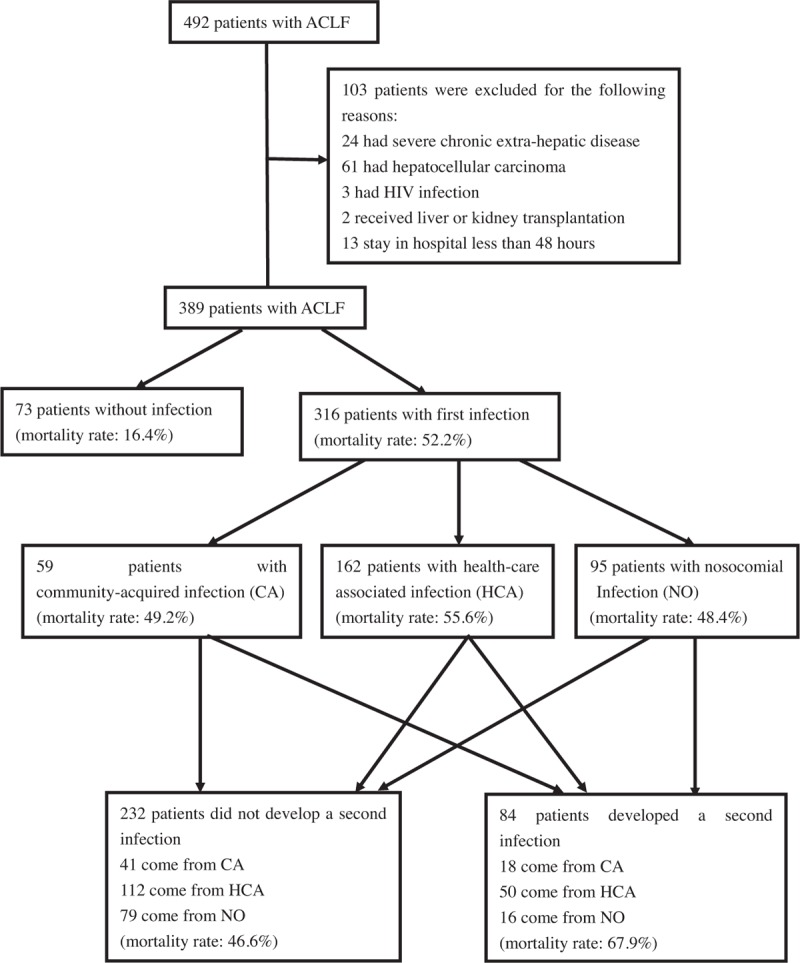
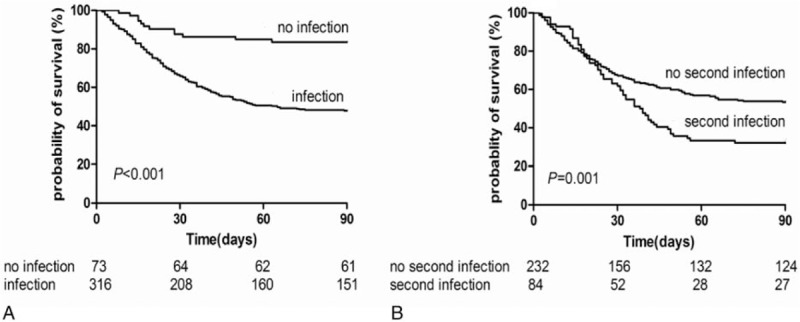
Bacterial infections are an important cause of mortality in liver failure. However, the type of infection, predictors of infection, and their impact on outcomes in patients with acute-on-chronic liver failure (ACLF) are limited.A total of 389 patients with ACLF were admitted in this retrospective, corhort study. Once admitted, clinical data including first infection site, type (community-acquired, healthcare-associated, or nosocomial), and second infection occurrence during hospitalization were collected. The outcome was mortality within 90 days. Multivariable logistic regression models were preformed to predict second infection development and 90-day mortality. Survival probability curves were calculated by the Kaplan-Meier method.Among 389 patients, 316 (81.2%) patients had infection. The 90-day mortality of patients with and without infection was 52.2% and 16.4%, respectively (P <.001). The most common first infection was healthcare associated (51.3%), followed by nosocomial (30.1%) and community-acquired infections (18.7%). Respiratory tract infection, spontaneous bacterial peritonitis, and urinary tract infection were most prevalent. Gram-positive organism was more frequently seen than gram-negative organisms. Of note, fungi accounted for 15.9% of the total infection cases. During hospitalization, 26.6% patients developed second infections. The 90-day mortality of patients developed or did not develop a second infection were 67.9% and 46.6%, respectively (P <.001). Independent predictors of 90-day mortality in infected patients with ACLF were age, white blood cell (WBC) count, model for end-stage liver disease (MELD) score, hepatic encephalopathy (HE), and second infection.Infections (regardless of first or second infection) can increase the 90-day mortality significantly in patients with ACLF. And age, WBC count, MELD score, HE, and the presence of second infection are independent risk factors affecting 90-day mortality in patients with ACLF showing infection.
Conflict of interest statement
The authors have no conflict of interest to disclose.
Figures
References
-
- Singal AK, Salameh H, Kamath PS. Prevalence and in-hospital mortality trends of infections among patients with cirrhosis: a nationwide study of hospitalized patients in the Uinted States. Aliment Pharmacol Ther 2014;40:105–12. - PubMed
-
- Sargenti K, Prytz H, Nilsson E, et al. Predictors of mortality among patients with compensated and decompensated liver cirrhosis: the role of bacterial infections and infection-related acute-on-chronic liver failure. Scand J Gastroenterol 2015;50:875–83. - PubMed
-
- Jalan R, Fernandez J, Wiest R, et al. Bacterial infections in cirrhosis: a position statement based on the EASL Special Conference 2013. J Hepatol 2014;60:1310–24. - PubMed
-
- Piano S, Fasolato S, Salinas F, et al. The empirical antibiotic treatment of nosocomial spontaneous bacterial peritonitis: results of a randomized, controlled clinical trial. Hepatology 2016;63:1299–309. - PubMed
-
- Merli M, Lucidi C, Di Gregorio V, et al. An empirical broad spectrum antibiotic therapy in health-care-associated infections improves survival in patients with cirrhosis: a randomized trial. Hepatology 2016;63:1632–9. - PubMed
MeSH terms
LinkOut - more resources
Full Text Sources
Other Literature Sources
