


Aberrant Hyperconnectivity in the Motor System at Rest Is Linked to Motor Abnormalities in Schizophrenia Spectrum Disorders
- PMID: 28911049
- PMCID: PMC5581901
- DOI: 10.1093/schbul/sbx091
Aberrant Hyperconnectivity in the Motor System at Rest Is Linked to Motor Abnormalities in Schizophrenia Spectrum Disorders
Abstract
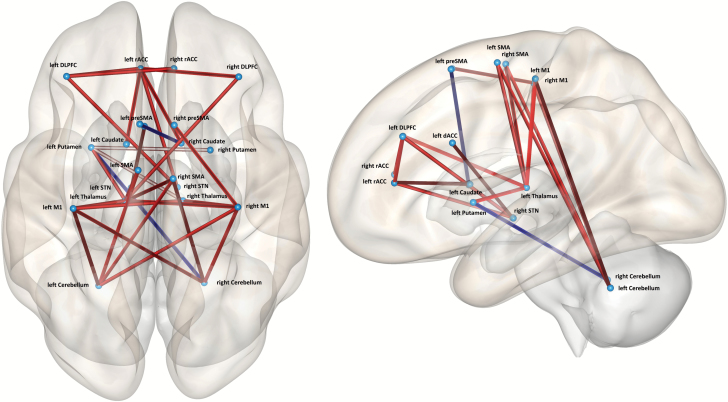
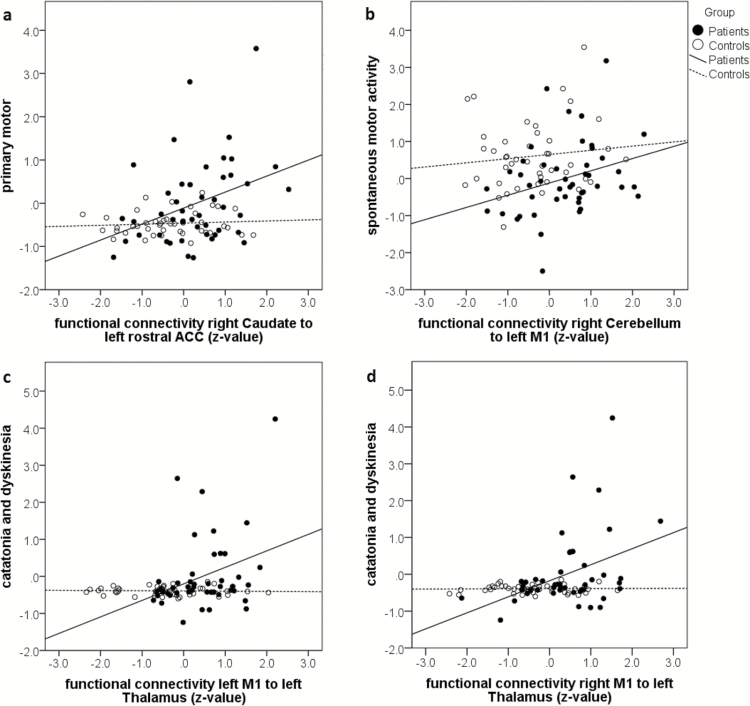
Motor abnormalities are frequently observed in schizophrenia and structural alterations of the motor system have been reported. The association of aberrant motor network function, however, has not been tested. We hypothesized that abnormal functional connectivity would be related to the degree of motor abnormalities in schizophrenia. In 90 subjects (46 patients) we obtained resting stated functional magnetic resonance imaging (fMRI) for 8 minutes 40 seconds at 3T. Participants further completed a motor battery on the scanning day. Regions of interest (ROI) were cortical motor areas, basal ganglia, thalamus and motor cerebellum. We computed ROI-to-ROI functional connectivity. Principal component analyses of motor behavioral data produced 4 factors (primary motor, catatonia and dyskinesia, coordination, and spontaneous motor activity). Motor factors were correlated with connectivity values. Schizophrenia was characterized by hyperconnectivity in 3 main areas: motor cortices to thalamus, motor cortices to cerebellum, and prefrontal cortex to the subthalamic nucleus. In patients, thalamocortical hyperconnectivity was linked to catatonia and dyskinesia, whereas aberrant connectivity between rostral anterior cingulate and caudate was linked to the primary motor factor. Likewise, connectivity between motor cortex and cerebellum correlated with spontaneous motor activity. Therefore, altered functional connectivity suggests a specific intrinsic and tonic neural abnormality in the motor system in schizophrenia. Furthermore, altered neural activity at rest was linked to motor abnormalities on the behavioral level. Thus, aberrant resting state connectivity may indicate a system out of balance, which produces characteristic behavioral alterations.
Keywords: STN; basal ganglia; cerebellum; dysconnectivity.
© The Author 2017. Published by Oxford University Press on behalf of the Maryland Psychiatric Research Center. All rights reserved. For permissions, please email: journals.permissions@oup.com.
Figures
References
-
- Walther S, Strik W. Motor symptoms and schizophrenia. Neuropsychobiology. 2012;66:77–92. - PubMed
-
- Kindler J, Schultze-Lutter F, Michel C et al. . Abnormal involuntary movements are linked to psychosis-risk in children and adolescents: results of a population-based study. Schizophr Res. 2016;174:58–64. - PubMed
-
- Bachmann S, Bottmer C, Schroder J. Neurological soft signs in first-episode schizophrenia: a follow-up study. Am J Psychiatry 2005;162:2337–2343. - PubMed
Publication types
MeSH terms
LinkOut - more resources
Full Text Sources
Other Literature Sources
Medical
Molecular Biology Databases
