


Metal release profiles of orthodontic bands, brackets, and wires: an in vitro study
- PMID: 28913542
- PMCID: PMC5682850
- DOI: 10.1007/s00056-017-0107-z
Metal release profiles of orthodontic bands, brackets, and wires: an in vitro study
Abstract
Aim: The present study evaluated the temporal release of Co Cr, Mn, and Ni from the components of a typical orthodontic appliance during simulated orthodontic treatment.
Materials and methods: Several commercially available types of bands, brackets, and wires were exposed to an artificial saliva solution for at least 44 days and the metals released were quantified in regular intervals using inductively coupled plasma quadrupole mass spectrometry (ICP-MS, Elan DRC+, Perkin Elmer, USA). Corrosion products encountered on some products were investigated by a scanning electron microscope equipped with an energy dispersive X-ray microanalyzer (EDX).
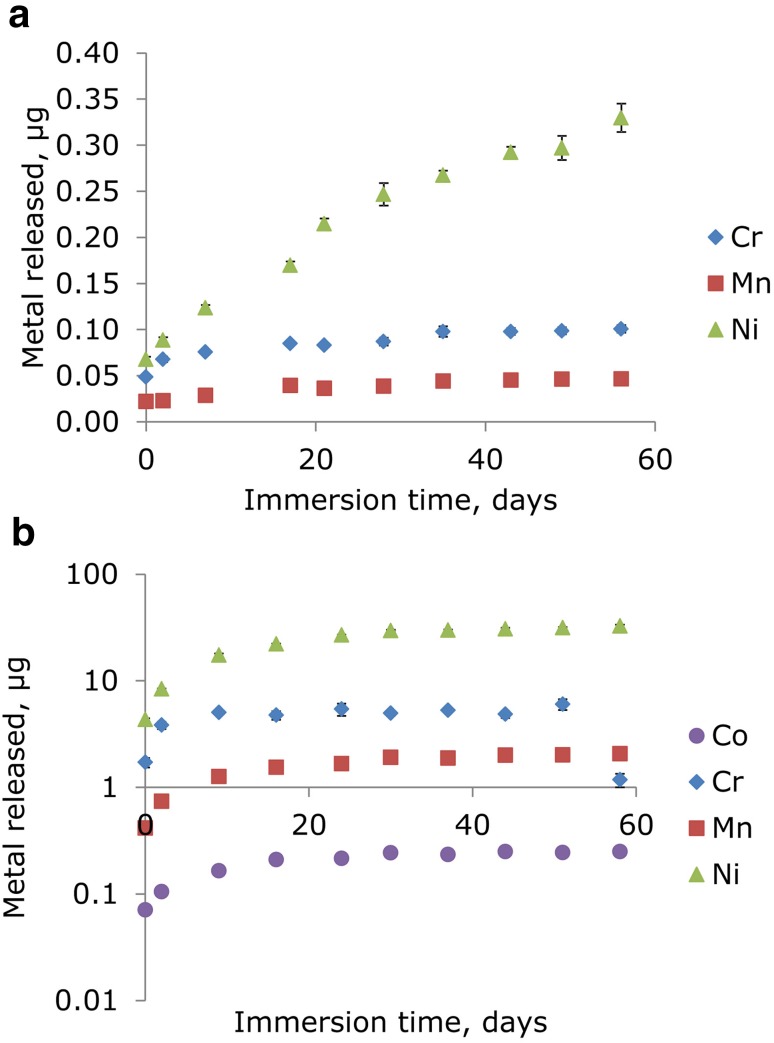
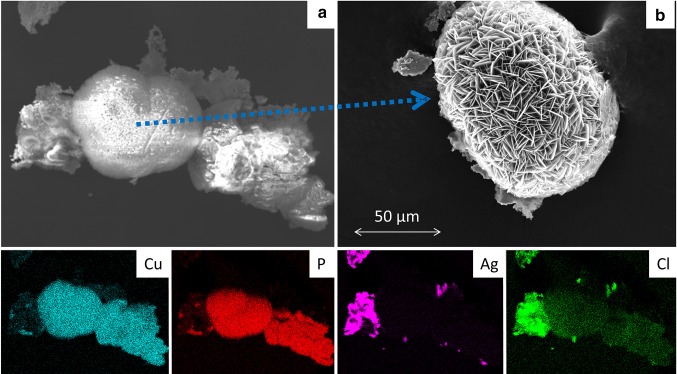
Results: Bands released the largest quantities of Co, Cr, Mn, and Ni, followed by brackets and wires. Three different temporal metal release profiles were observed: (1) constant, though not necessarily linear release, (2) saturation (metal release stopped after a certain time), and (3) an intermediate release profile that showed signs of saturation without reaching saturation. These temporal metal liberation profiles were found to be strongly dependent on the individual test pieces. The corrosion products which developed on some of the bands after a 6-month immersion in artificial saliva and the different metal release profiles of the investigated bands were traced back to different attachments welded onto the bands.
Conclusion: The use of constant release rates will clearly underestimate metal intake by the patient during the first couple of days and overestimate exposure during the remainder of the treatment which is usually several months long. While our data are consistent with heavy metal release by orthodontic materials at levels well below typical dietary intake, we nevertheless recommend the use of titanium brackets and replacement of the band with a tube in cases of severe Ni or Cr allergy.
Zielsetzung: In dieser Studie wurde die Freisetzung von Co(Kobalt)-, Cr(Chrom)-, Mn(Mangan)- und Ni(Nickel)-Metallionen aus typischen kieferorthopädischen Apparaturen in einer künstlichen Speichellösung gemessen.
Materialien und Methoden: Handelsübliche Bänder, Brackets und Drähte wurden für mindestens 44 Tage einer künstlichen Speichellösung ausgesetzt, und die freigesetzten Metalle wurden unter Verwendung eines induktiv gekoppelten Plasma-Quadrupol-Massenspektrometers (ICP-MS, Elan DRC+, PerkinElmer, USA) quantifiziert. Korrosionsprodukte wurden durch ein Rasterelektronenmikroskop mit einem Röntgenmikroanalysator (EDX) untersucht.
Ergebnisse: Bänder setzten die größten Mengen an Co, Cr, Mn und Ni frei, gefolgt von Brackets und Drähten. Drei verschiedene Metallfreisetzungsprofile ließen sich beobachten: (1) eine konstante, wenn auch nicht lineare Freisetzung, (2) eine Sättigung (Metallfreisetzung stoppt nach einer bestimmten Zeit) und (3) ein intermediäres Freisetzungsprofil mit Zeichen einer Sättigung. Diese temporären Metallfreisetzungsprofile waren stark von den einzelnen Teststücken abhängig. Die Korrosionsprodukte, die sich nach einer 6-monatigen Exposition in künstlichem Speichel auf einigen der Bänder entwickelten, und deren verschiedene Metallfreisetzungsprofile wurden auf die aufgeschweißten Attachments der Bänder zurückgeführt.
Schlussfolgerung: Bei Verwendung von konstanten Freisetzungsraten wird die Metallaufnahme durch den Patienten während der ersten paar Tage deutlich unterschätzt und die Exposition im Verlauf der sich anschließenden, i.d.R. etliche Monate dauernden Behandlung, überschätzt. Auch wenn die Konzentration der Schwermetallfreisetzung durch kieferorthopädische Materialien deutlich unterhalb der der typischen Nahrungsaufnahme liegt, empfehlen wir die Verwendung von Titan-Brackets und die Vermeidung von Bändern in Fällen von schwerer Ni oder Cr-Allergie.
Keywords: Allergy; Biocompatibility; Corrosion; Mass spectrometer; Metal release; Orthodontic materials.
Conflict of interest statement
Conflict of interest
The authors declare no potential conflicts of interest with respect to the authorship and/or publication of this article.
Funding
The authors have no financial relationship with the organization that sponsored the research.
Figures
References
-
- Arndt M, Brück A, Scully T, Jäger A, Bourauel C. Nickel ion release from orthodontic NiTi wires under simulation of realistic in situ conditions. J Mater Sci. 2005;40(14):3659–3667. doi: 10.1007/s10853-005-0448-7. - DOI
-
- Buehler WJ, Gilfrich JV, Wiley RC. Effect of low temperature phase changes on the mechanical properties of alloys near composition TiNi. J Appl Phys. 1963;34(5):1475–1477. doi: 10.1063/1.1729603. - DOI
MeSH terms
Substances
LinkOut - more resources
Full Text Sources
Other Literature Sources
