


Clinical genetics of craniosynostosis
- PMID: 28914635
- PMCID: PMC5681249
- DOI: 10.1097/MOP.0000000000000542
Clinical genetics of craniosynostosis
Abstract
Purpose of review: When providing accurate clinical diagnosis and genetic counseling in craniosynostosis, the challenge is heightened by knowledge that etiology in any individual case may be entirely genetic, entirely environmental, or anything in between. This review will scope out how recent genetic discoveries from next-generation sequencing have impacted on the clinical genetic evaluation of craniosynostosis.
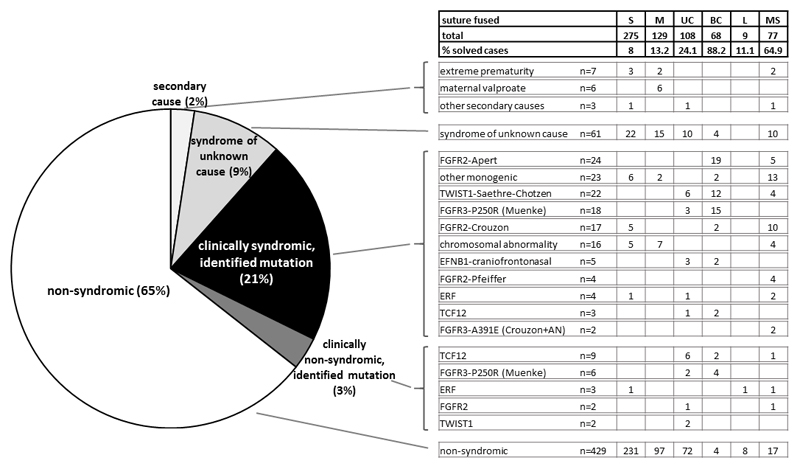
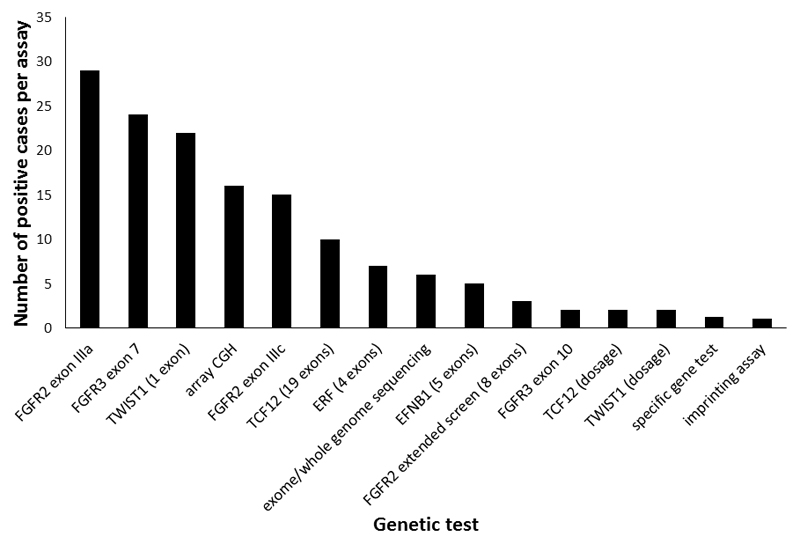
Recent findings: Survey of a 13-year birth cohort of patients treated at a single craniofacial unit demonstrates that a genetic cause of craniosynostosis can be identified in one quarter of cases. The substantial contributions of mutations in two genes, TCF12 and ERF, is confirmed. Important recent discoveries are mutations of CDC45 and SMO in specific craniosynostosis syndromes, and of SMAD6 in nonsyndromic midline synostosis. The added value of exome or whole genome sequencing in the diagnosis of difficult cases is highlighted.
Summary: Strategies to optimize clinical genetic diagnostic pathways by combining both targeted and next-generation sequencing are discussed. In addition to improved genetic counseling, recent discoveries spotlight the important roles of signaling through the bone morphogenetic protein and hedgehog pathways in cranial suture biogenesis, as well as a key requirement for adequate cell division in suture maintenance.
Conflict of interest statement
None
Figures
References
-
- Lajeunie E, Le Merrer M, Bonaïti-Pellie C, et al. Genetic study of nonsyndromic coronal craniosynostosis. Am J Med Genet. 1995;55:500–504. - PubMed
-
- Cornelissen M, den Ottelander B, Rizopoulos D, et al. Increase of prevalence of craniosynostosis. J Craniomaxillofac Surg. 2016;44:1273–1279. [This paper reported a 12.5% increase in the overall prevalence of craniosynostosis in the Netherlands between 1997 and 2013. The increase was most marked in metopic synostosis (+20.5%), as found in other studies. The proportion of cases with identified mutations (7%) was considerably lower than presented in this review.] - PubMed
-
- Forrest CR, Hopper RA. Craniofacial syndromes and surgery. Plast Reconstr Surg. 2013;131:86e–109e. - PubMed
Publication types
MeSH terms
Substances
Grants and funding
LinkOut - more resources
Full Text Sources
Other Literature Sources
Medical
Research Materials
Miscellaneous
