


"Maybe we should talk about it anyway": a qualitative study of understanding expectations and use of an established technology innovation in caring practices
- PMID: 28915809
- PMCID: PMC5602870
- DOI: 10.1186/s12913-017-2587-3
"Maybe we should talk about it anyway": a qualitative study of understanding expectations and use of an established technology innovation in caring practices
Abstract
Background: Technological innovations are strongly promoted to meet the demands posed by increased pressure on home care services and to assist ageing in place in western societies. Although heavily advocated as plug and play solutions, technologies have proven difficult and unpredictable when integrated into home care services. We need greater insight into what happens when technologies are integrated into caring practices. All technologies come with expectations as to their function. This study explores how actors who are involved with the social alarm, which is an established technology innovation, relate to, perceive and articulate these expectations of the technology in everyday living.
Methods: The article presents results from a two-case study, using a triangulation of qualitative methods in order to gain an in-depth understanding of technology in use in home care services through "thick descriptions". The study was conducted in Norway and data were analysed using a stepwise deductive-inductive analysis.
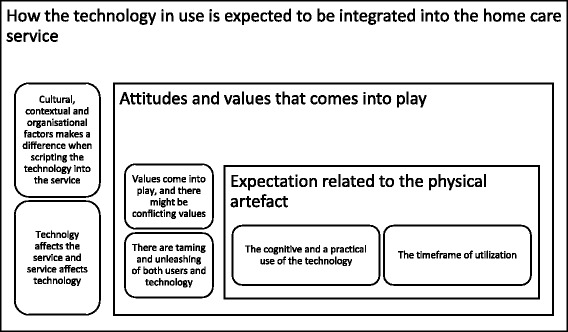
Results: The empirical findings demonstrate that expectations regarding the social alarm, even though it represents a simple and well-established technology, are complex and multidimensional. The notion of script and domestication provided relevant tools for exploring these expectations and for understanding how actors interpret and adapt their practices of using the technology. This enabled a more comprehensive understanding of how technology opens up for different interpretations and puts values in play.
Conclusions: This article suggests exploring technology in use as scripted in multidimensional script, and offers a frame for doing so. It also reveals how technology scripts and articulation prove important for understanding the complex reality when integrated into home care practices, thus identifying how using the technology leads to the taming and unleashing of both technology and actors. The study offers an increased understanding of how and why technology is unpredictable and works differently in different contexts. Moreover, it stresses the importance of avoiding expectations of plug-and-play in a reality of complex interactions between different actors.
Keywords: Domestication; Home care; Innovation; Older people; Personal Emergency Response System (PERS); Script; Social alarm; Telecare; Welfare technology.
Conflict of interest statement
Ethics approval and consent to participate
Data Protection Official for Research in Norway (NSD) granted approval for the project (Project no.: 38,605). All interview participants gave informed written consent. The municipal healthcare management gave written consent to conduct data within the home care services. All healthcare professionals got both written and verbal information about the study and the data collection, and were informed that they could decline from being observed or interviewed. Prior to the observational study, the healthcare workers informed the patients about the study and asked the patients if the researchers could observe the encounter.
Consent for publication
Not applicable.
Competing interests
The author declares that she has no competing interests.
Publisher’s Note
Springer Nature remains neutral with regard to jurisdictional claims in published maps and institutional affiliations.
Figures

References
-
- Genet N, European Observatory on Health S, Policies . Home care across Europe: current structure and future challenges. Copenhagen: World Health Organization; 2012.
-
- Blaschke CM, Freddolino PP, Mullen EE. Ageing and technology: a review of the research literature. Br J Soc Work. 2009;39(4):641–656. doi: 10.1093/bjsw/bcp025. - DOI
-
- Tarricone R, Tsouros AD. Home care in Europe: the solid facts: Copenhagen: WHO Regional Office Europe; 2008.
-
- Daatland SO, Veenstra M, Kjelvik J, Otnes B, Aksøy H. Bærekraftig omsorg? Familien, velferdsstaten og aldringen av befolkningen (In Norwegian, Sustainable care) 2012.
-
- Peine A, Neven L. Social-structural lag revisited. Gerontechnology. 2011;10(3):129–139. doi: 10.4017/gt.2011.10.3.002.00. - DOI
Publication types
MeSH terms
LinkOut - more resources
Full Text Sources
Other Literature Sources
Medical
