


MRI combined with PET-CT of different tracers to improve the accuracy of glioma diagnosis: a systematic review and meta-analysis
- PMID: 28918564
- PMCID: PMC6503074
- DOI: 10.1007/s10143-017-0906-0
MRI combined with PET-CT of different tracers to improve the accuracy of glioma diagnosis: a systematic review and meta-analysis
Abstract
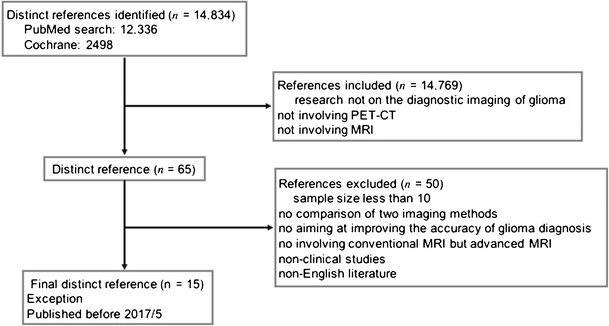
Based on studies focusing on positron emission tomography (PET)-computed tomography (CT) combined with magnetic resonance imaging (MRI) in the diagnosis of glioma, we conducted a systematic review and meta-analysis evaluating the pros and cons and the accuracy of different examinations. PubMed and Cochrane Library were searched. The search was conducted until April 2017. Two reviewers independently conducted the literature search according to the criteria set initially. Based on the exclusion criteria, 15 articles are included in this study. Of all studies that used MRI examination, there are five involving 18F-fluorodeoxyglucose-PET, five involving 11C-methionine-PET, five involving 18F-fluoro-ethyl-tyrosine-PET, and three involving 18F-fluorothymidine-PET. Due to the limitations such as lack of data, small sample size, and unrepresentative studies, we use a non-quantitative methodology. MRI examination can provide the anatomy information of glioma more clearly. PET-CT examinations based on tumor metabolism using different tracers have more advantages in determining the degree of glioma malignancy and boundaries. However, information provided by PET-CT of different tracers is not the same. With respect to the novel hybrid MRI/PET examination equipment proposed in recent years, the combination of MRI and PET-CT can definitively improve the diagnostic accuracy of glioma.
Keywords: Diagnostic accuracy; Glioma; MRI; PET-CT.
Conflict of interest statement
Conflict of interest
The authors declare that they have no conflicts of interest.
Ethical approval
Because this study is a systematic review and does not involve original data, ethical approval was not required.
Informed consent
Because this study is a systematic review and does not involve original data, informed consent is not applicable.
Figures
References
-
- Arbizu J, Tejada S, Marti-Climent JM, Diez-Valle R, Prieto E, Quincoces G, Vigil C, Idoate MA, Zubieta JL, Peñuelas I, Richter JA. Quantitative volumetric analysis of gliomas with sequential MRI and 11C-methionine PET assessment: patterns of integration in therapy planning. Eur J Nucl Med Mol Imaging. 2012;39:771–781. doi: 10.1007/s00259-011-2049-9. - DOI - PubMed
-
- Bach-Gansmo T, Nanni C, Nieh PT, Zanoni L, Bogsrud TV, Sletten H, Korsan K, Kieboom J, Tade F, Odewole O, Chau A, Ward P, Goodman MM, Fanti S, Schuster DM, Willoch F (2016) Multi-site experience of the safety, detection rate and diagnostic performance of fluciclovine (18F) PET/CT imaging in the staging of biochemically recurrent prostate cancer. J Urol. 10.1016/j.juro.2016.09.117 - PMC - PubMed
-
- Bailey DL, Barthel H, Beyer T, Boellaard R, Gückel B, Hellwig D, Herzog H, Pichler BJ, Quick HH, Sabri O, Scheffler K, Schlemmer HP, Schwenzer NF, Wehrl HF. Summary report of the first international workshop on PET/MR imaging, March 19-23, 2012, Tübingen, Germany. Mol Imaging Biol. 2013;15:361–371. doi: 10.1007/s11307-013-0623-1. - DOI - PMC - PubMed
Publication types
MeSH terms
Substances
Grants and funding
LinkOut - more resources
Full Text Sources
Other Literature Sources
Medical
Miscellaneous
