


Risk of post-traumatic epilepsy after severe head injury in patients with at least one seizure
- PMID: 28919762
- PMCID: PMC5587192
- DOI: 10.2147/NDT.S141486
Risk of post-traumatic epilepsy after severe head injury in patients with at least one seizure
Abstract
Background: To explore the incidence and risk factors, including type of seizures for post-traumatic epilepsy (PTE) after severe traumatic brain injury (TBI).
Subjects and methods: This was a retrospective follow-up study of patients discharged from Liaocheng People's Hospital between March 2011 and June 2015 with a diagnosis of post-traumatic seizures. Risk factors for PTE were evaluated in 68 inpatients by using Kaplan-Meier curves and the Cox model.
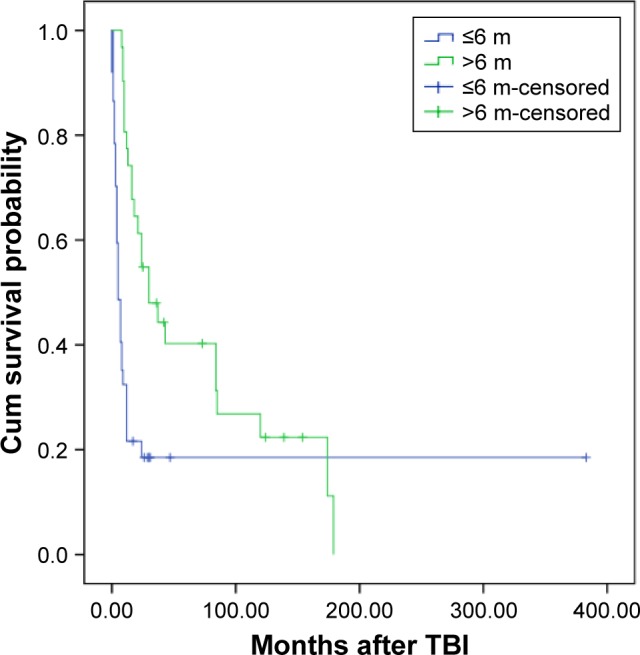
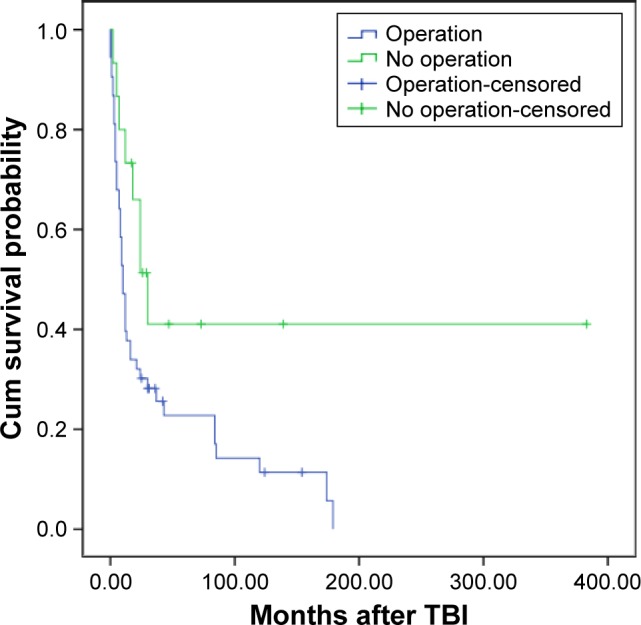
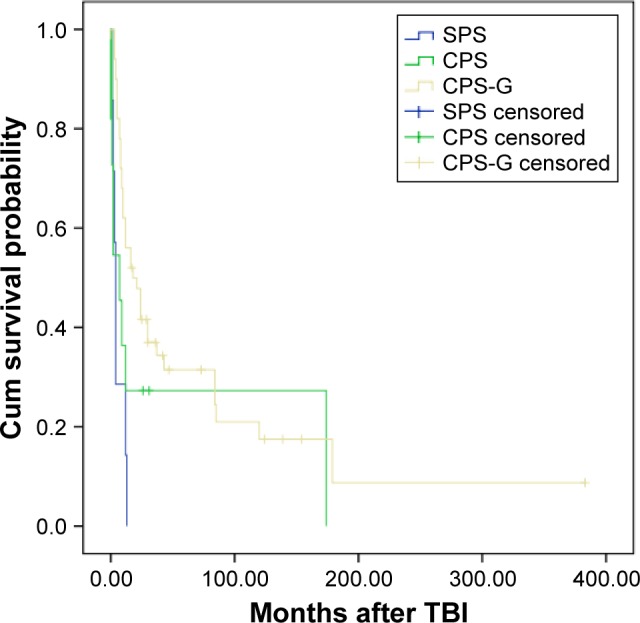
Results: Complete clinical information was available for 68 patients. A total of 54 cases (79.4%) were diagnosed as presenting with PTE, occurring from 10 days to 179 months after severe TBI. Nineteen out of 54 cases (35.2%) had been defined as PTE within the first 6 months after the trauma, 17 cases (31.5%) within 7-12 months, 8 cases (14.8%) within 13-24 months, 2 cases (3.7%) within 25-36 months, and 8 cases (14.8%) within 37-179 months after the TBI. The Kaplan-Meier curves demonstrated that simple partial seizures, surgical treatment, and onset of seizures occurring within 6 months after injury were associated with PTE.
Conclusions: The Cox model indicated that, for patients aged >34 years at the time of injury, the PTE risk was 2.55 times greater than for those aged ≤34 years. In addition, simple partial seizures, surgical treatment and onset of seizures occurring within 6 months after injury were significant risk factors for the development of PTE.
Keywords: post-traumatic epilepsy; post-traumatic seizure; risk factor.
Conflict of interest statement
Disclosure The authors report no conflicts of interest in this work.
Figures
References
-
- Frey LC. Epidemiology of posttraumatic epilepsy: a critical review. Epilepsia. 2003;44(Suppl 10):11–17. - PubMed
-
- Annegers JF, Hauser WA, Coan SP, Rocca WA. A population-based study of seizures after traumatic brain injuries. N Engl J Med. 1998;338(1):20–24. - PubMed
-
- Zhao Y, Wu H, Wang X, Li J, Zhang S. Clinical epidemiology of posttraumatic epilepsy in a group of Chinese patients. Seizure. 2012;21(5):322–326. - PubMed
-
- Englander J, Bushnik T, Duong TT, et al. Analyzing risk factors for late posttraumatic seizures: a prospective, multicenter investigation. Arch Phys Med Rehabil. 2003;84(3):365–373. - PubMed
LinkOut - more resources
Full Text Sources
Other Literature Sources
