


The P2X7 receptor forms a dye-permeable pore independent of its intracellular domain but dependent on membrane lipid composition
- PMID: 28920575
- PMCID: PMC5624784
- DOI: 10.7554/eLife.31186
The P2X7 receptor forms a dye-permeable pore independent of its intracellular domain but dependent on membrane lipid composition
Abstract
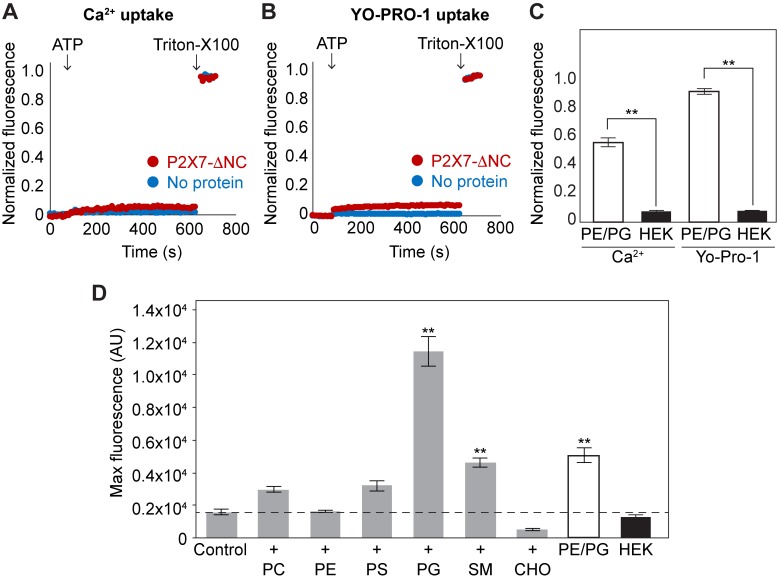
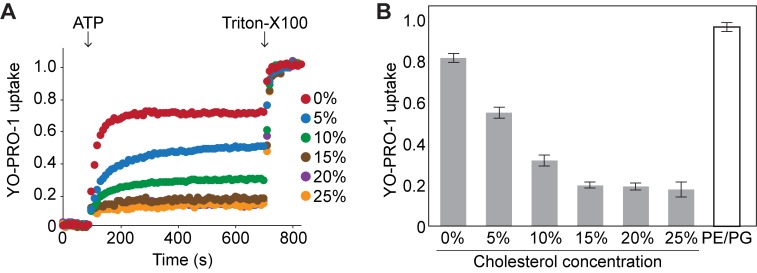
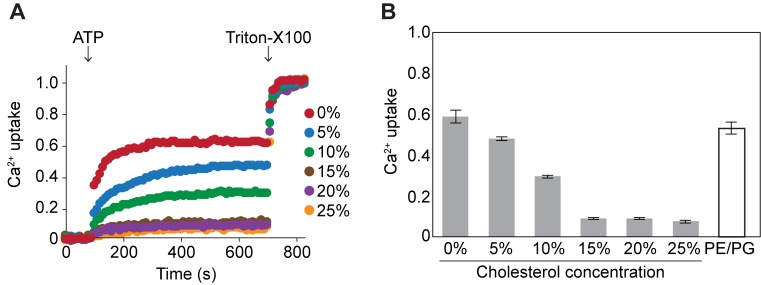
The P2X7 receptor mediates extracellular ATP signaling implicated in the development of devastating diseases such as chronic pain and cancer. Activation of the P2X7 receptor leads to opening of the characteristic dye-permeable membrane pore for molecules up to ~900 Da. However, it remains controversial what constitutes this peculiar pore and how it opens. Here we show that the panda receptor, when purified and reconstituted into liposomes, forms an intrinsic dye-permeable pore in the absence of other cellular components. Unexpectedly, we found that this pore opens independent of its unique C-terminal domain. We also found that P2X7 channel activity is facilitated by phosphatidylglycerol and sphingomyelin, but dominantly inhibited by cholesterol through direct interactions with the transmembrane domain. In combination with cell-based functional studies, our data suggest that the P2X7 receptor itself constitutes a lipid-composition dependent dye-permeable pore, whose opening is facilitated by palmitoylated cysteines near the pore-lining helix.
Keywords: biophysics; cell lines; dye uptake; functional reconstitution; giant panda; neuroscience; none; proteoliposomes; purified ion channel; structural biology.
Conflict of interest statement
No competing interests declared.
Figures
References
-
- Adinolfi E, Cirillo M, Woltersdorf R, Falzoni S, Chiozzi P, Pellegatti P, Callegari MG, Sandonà D, Markwardt F, Schmalzing G, Di Virgilio F. Trophic activity of a naturally occurring truncated isoform of the P2X7 receptor. The FASEB Journal. 2010;24:3393–3404. doi: 10.1096/fj.09-153601. - DOI - PubMed
-
- Alves LA, de Melo Reis RA, de Souza CA, de Freitas MS, Teixeira PC, Neto Moreira Ferreira D, Xavier RF. The P2X7 receptor: shifting from a low- to a high-conductance channel - an enigmatic phenomenon? Biochimica et Biophysica Acta (BBA) - Biomembranes. 2014;1838:2578–2587. doi: 10.1016/j.bbamem.2014.05.015. - DOI - PubMed
Publication types
MeSH terms
Substances
Grants and funding
LinkOut - more resources
Full Text Sources
Other Literature Sources
