. 2018 Jan 15;142(2):297-307.
doi: 10.1002/ijc.31053. Epub 2017 Oct 4.

Neuroblastoma cells undergo transcriptomic alterations upon dissemination into the bone marrow and subsequent tumor progression

Affiliations

Neuroblastoma cells undergo transcriptomic alterations upon dissemination into the bone marrow and subsequent tumor progression

Fikret Rifatbegovic et al. Int J Cancer. .

Abstract

Neuroblastoma is the most common extracranial solid tumor in childhood. The vast majority of metastatic (M) stage patients present with disseminated tumor cells (DTCs) in the bone marrow (BM) at diagnosis and relapse. Although these cells represent a major obstacle in the treatment of neuroblastoma patients, insights into their expression profile remained elusive. The present RNA-Seq study of stage 4/M primary tumors, enriched BM-derived diagnostic and relapse DTCs, as well as the corresponding BM-derived mononuclear cells (MNCs) from 53 patients revealed 322 differentially expressed genes in DTCs as compared to the tumors (q < 0.001, |log2 FC|>2). Particularly, the levels of transcripts encoded by mitochondrial DNA were elevated in DTCs, whereas, for example, genes involved in angiogenesis were downregulated. Furthermore, 224 genes were highly expressed in DTCs and only slightly, if at all, in MNCs (q < 8 × 10-75 log2 FC > 6). Interestingly, we found the transcriptome of relapse DTCs largely resembling those of diagnostic DTCs with only 113 differentially expressed genes under relaxed cut-offs (q < 0.01, |log2 FC|>0.5). Notably, relapse DTCs showed a positional enrichment of 31 downregulated genes on chromosome 19, including five tumor suppressor genes: SIRT6, BBC3/PUMA, STK11, CADM4 and GLTSCR2. This first RNA-Seq analysis of neuroblastoma DTCs revealed their unique expression profile in comparison to the tumors and MNCs, and less pronounced differences between diagnostic and relapse DTCs. The latter preferentially affected downregulation of genes encoded by chromosome 19. As these alterations might be associated with treatment failure and disease relapse, further functional studies on DTCs should be considered.

Keywords: RNA-Seq; bone marrow; disseminated tumor cells; neuroblastoma.


Figures

Figure 1
Figure 1
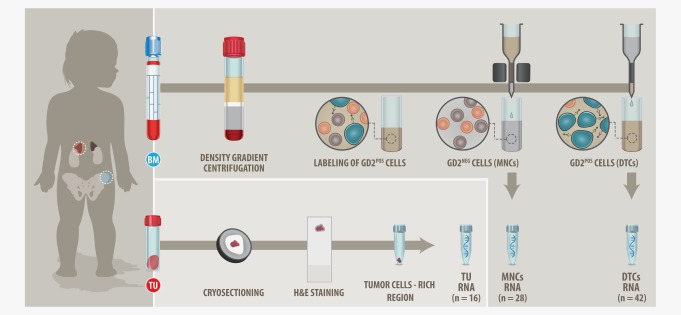
Study design. mRNA of BM cells (DTCs and MNCs) and primary tumors of stage M neuroblastoma patients was sequenced. The MNC fraction of BM aspirates was isolated by density gradient separation, DMSO frozen and stored in liquid nitrogen. Upon thawing, dead cells were removed by an additional density gradient separation and the MNCs were used for a magnetic bead‐based enrichment of DTCs. mRNA of DTCs (n = 42) was isolated and sequenced. mRNA of corresponding tumor cells‐depleted BM samples (MNCs, n = 28) was sequenced as well (MNC fractions with total RNA <30 ng or detectable DTCs were excluded from sequencing). Primary tumors were cryosectioned and H&E stained. Regions rich in tumor cells were determined by light microscopy and the corresponding regions were cut out of the frozen tumor pieces and used for RNA isolation and sequencing (n = 16). [Color figure can be viewed at wileyonlinelibrary.com]
Figure 2
Figure 2
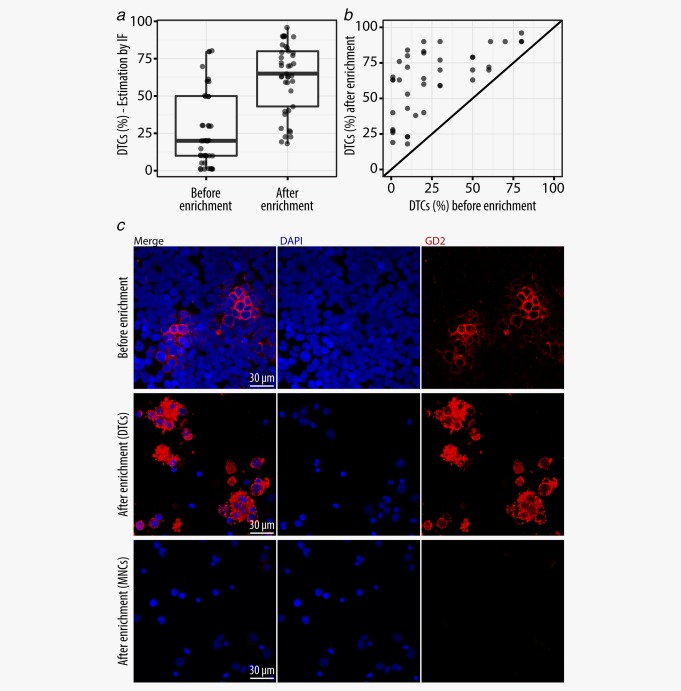
Efficiency of DTC enrichment. (a) Tumor cell content of DTC samples before and after enrichment determined by GD2‐IF. (b) Enrichment efficiency for each individual DTC sample determined by IF. (c) IF staining of BM aspirates before enrichment and corresponding positive (enriched DTCs) and negative (DTC‐depleted MNCs) fractions after enrichment. [Color figure can be viewed at wileyonlinelibrary.com]
Figure 3
Figure 3
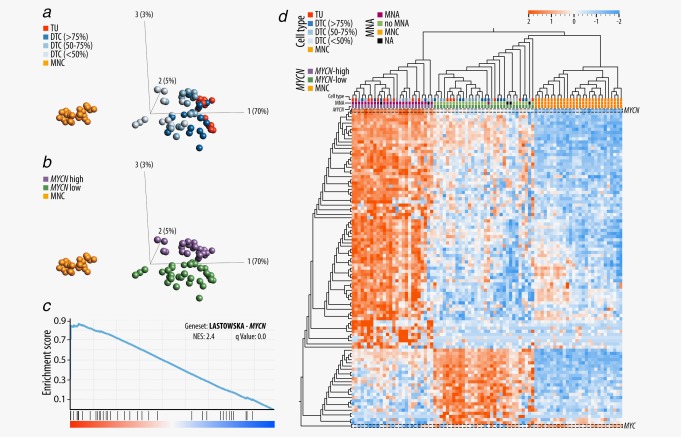
Cell type and MYCN driven expression signatures of tumor, DTC and MNC samples. (a) Principle component analysis of TU, DTC and MNC samples with cell type specific annotations. DTC samples were annotated in three different groups, according to the tumor cell content determined by IF. (b) Principle component analysis of TU, DTC and MNC samples with a MYCN expression level specific annotation. (c) A representative gene set (LASTOWSKA_COAMPLIFIED_WITH_MYCN) that was enriched in the comparison of DTC MYCN‐high and DTC MYCN‐low samples. (d) Unsupervised clustering of TU, DTC and MNC samples based on the expression of 101 genes: the top 100 differentially transcribed genes between DTC MYCN‐high and DTC MYCN‐low samples (sorted by q value, |log2FC|>1) and in addition MYC. MYCN is highlighted in the heat map as the most significantly upregulated gene in the DTC MYCN‐high samples (q = 3.7 × 10−51, log2FC = 4.9). MYC is highlighted, but is not among the top 100 differentially expressed genes (q = 0.047, Log2FC = −1). Abbreviation: NES: normalized enrichment score. [Color figure can be viewed at wileyonlinelibrary.com]
Figure 4
Figure 4
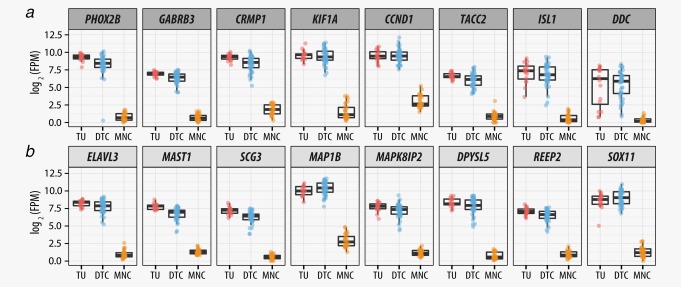
Differentially expressed genes in tumor, DTC and MNC samples. (a) Expression of MRD marker in the BM of neuroblastoma patients that are known from the literature.27 (b) The top eight upregulated genes in DTCs as compared to the corresponding MNCs. Abbreviation: FPM: fragments per million. [Color figure can be viewed at wileyonlinelibrary.com]
Figure 5
Figure 5
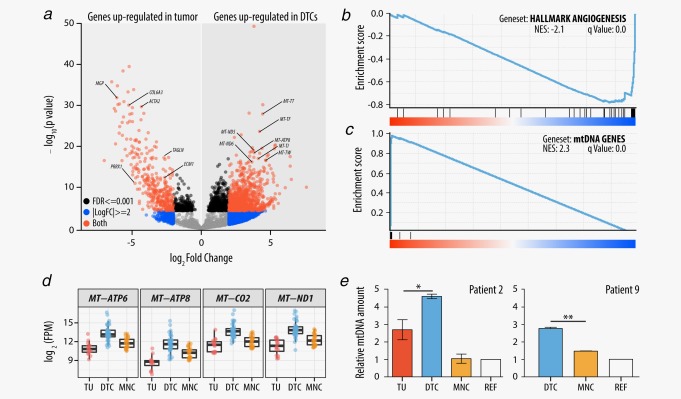
Differentially expressed genes between tumor and DTC samples. (a) Volcano plot of log2FC versus p values comparing gene expression of tumor and DTC samples. p values were capped at 1 × 10−200. Selected upregulated genes in the tumor are known drivers of metastasis initiation and or angiogenesis. A selection of genes that are encoded by the mtDNA and overexpressed in DTCs is labeled. (b) The HALLMARK_ANGIOGENESIS gene set which was enriched in the gene set enrichment analysis for tumor and DTC samples. (c) Gene set enrichment analysis for tumor and DTC samples using the complete set of genes encoded by the mitochondrial genome. (d) Expression levels of representative genes encoded by the mtDNA in tumor, DTC and MNC samples. (e) Relative amount of mtDNA in two representative patients. The mitochondrial DNA amount was determined by qPCR for each patient and with three technical replicates for each sample. Ct values were normalized with Ct values of the ALB gene (chromosome 4). All values were calibrated with the mitochondrial DNA quantity of a peripheral blood sample of a healthy individual. REF refers to BM‐derived MNCs of the particular patient at a time point when the BM was tumor cell‐free. Abbreviations: FPM: fragments per million; NES: normalized enrichment score. [Color figure can be viewed at wileyonlinelibrary.com]
Figure 6
Figure 6
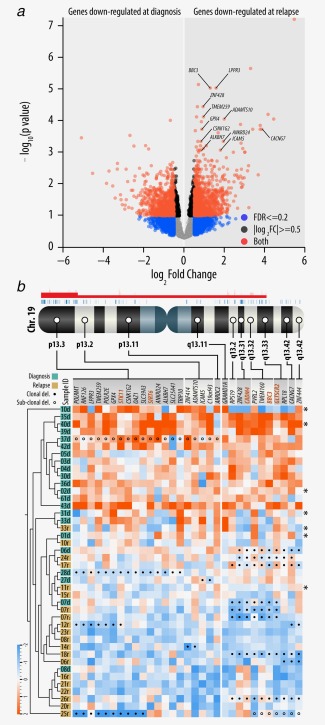
Positional enrichment of genes encoded by chromosome 19. (a) Volcano plot of log2FC versus p values comparing gene expression of diagnostic and relapse DTCs. A selection of genes which are upregulated in relapse DTCs and which are encoded by chromosome 19 is highlighted. (b) Ideogram showing the genomic location of 31 differentially expressed genes encoded by chromosome 19. Significantly enriched chromosomal regions (p < 0.01) are shown as red segments above the chromosome. Clonal deletions of particular genes are highlighted with solid circles in the heat map. Sub‐clonal deletions are labeled with non‐solid circles. Names of tumor suppressor genes are highlighted. Samples with no available SNP array data are highlighted with (*). [Color figure can be viewed at wileyonlinelibrary.com]

References

    1. Brodeur GM, Bagatell R. Mechanisms of neuroblastoma regression. Nat Rev Clin Oncol 2014;11:704–13. - PMC - PubMed
    1. Matthay KK, Maris JM, Schleiermacher G, et al. Neuroblastoma. Nat Rev Dis Primers 2016;2:16078 - PubMed
    1. Cohn SL, Pearson ADJ, London WB, et al. The International Neuroblastoma Risk Group (INRG) classification system: an INRG task force report. J Clin Oncol 2009;27:289–97. - PMC - PubMed
    1. Ambros IM, Zellner A, Roald B, et al. Role of ploidy, chromosome 1p, and Schwann cells in the maturation of neuroblastoma. N Engl J Med 1996;334:1505–11. - PubMed
    1. Molenaar JJ, Koster J, Zwijnenburg DA, et al. Sequencing of neuroblastoma identifies chromothripsis and defects in neuritogenesis genes. Nature 2012;483:589–93. - PubMed

Publication types

MeSH terms

Substances