


Longer-Term Investigation of the Value of 18F-FDG-PET and Magnetic Resonance Imaging for Predicting the Conversion of Mild Cognitive Impairment to Alzheimer's Disease: A Multicenter Study
- PMID: 28922157
- PMCID: PMC5676852
- DOI: 10.3233/JAD-170395
Longer-Term Investigation of the Value of 18F-FDG-PET and Magnetic Resonance Imaging for Predicting the Conversion of Mild Cognitive Impairment to Alzheimer's Disease: A Multicenter Study
Abstract
Background: The value of fluorine-18-fluorodeoxyglucose positron emission tomography (18F-FDG-PET) and magnetic resonance imaging (MRI) for predicting conversion of mild cognitive impairment (MCI) to Alzheimer's disease (AD) in longer-term is unclear.
Objective: To evaluate longer-term prediction of MCI to AD conversion using 18F-FDG-PET and MRI in a multicenter study.
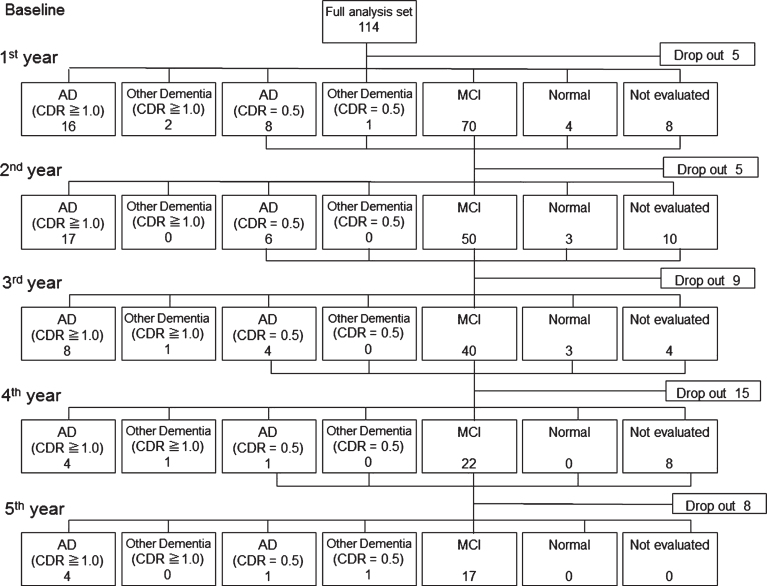
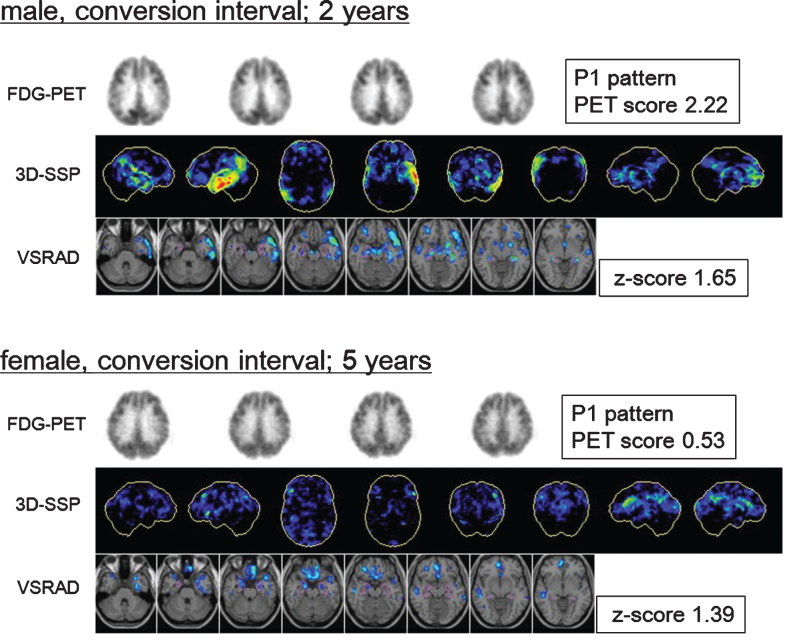
Methods: One-hundred and fourteen patients with MCI were followed for 5 years. They underwent clinical and neuropsychological examinations, 18F-FDG-PET, and MRI at baseline. PET images were visually classified into predefined dementia patterns. PET scores were calculated as a semi quantitative index. For structural MRI, z-scores in medial temporal area were calculated by automated volume-based morphometry (VBM).
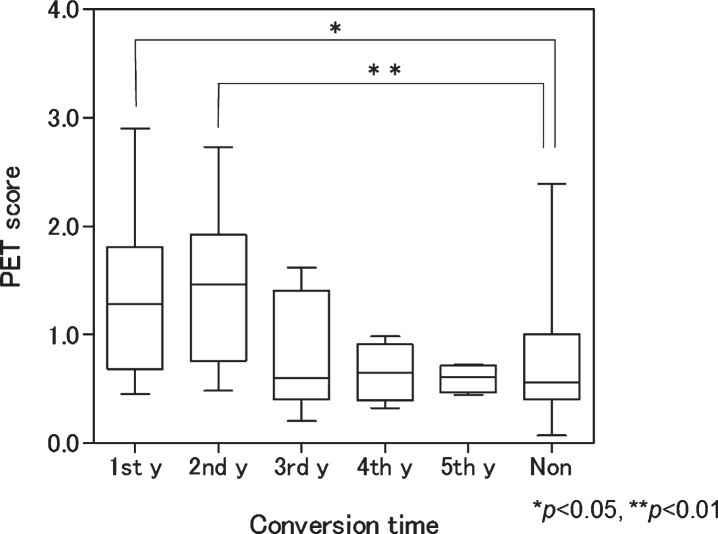
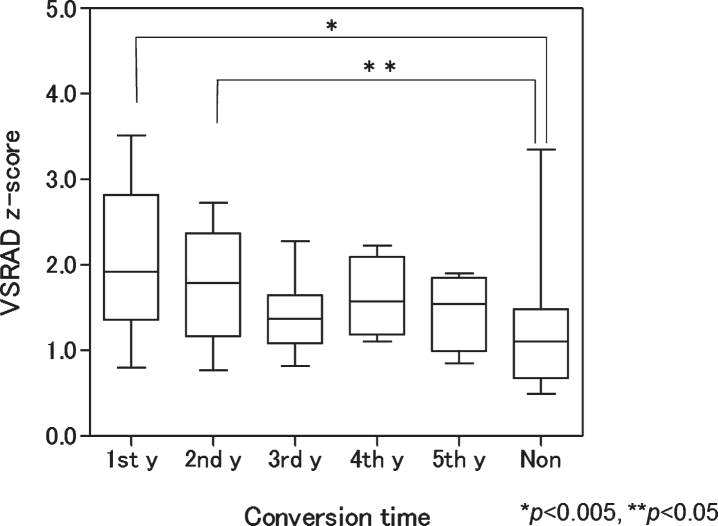
Results: Overall, 72% patients with amnestic MCI progressed to AD during the 5-year follow-up. The diagnostic accuracy of PET scores over 5 years was 60% with 53% sensitivity and 84% specificity. Visual interpretation of PET images predicted conversion to AD with an overall 82% diagnostic accuracy, 94% sensitivity, and 53% specificity. The accuracy of VBM analysis presented little fluctuation through 5 years and it was highest (73%) at the 5-year follow-up, with 79% sensitivity and 63% specificity. The best performance (87.9% diagnostic accuracy, 89.8% sensitivity, and 82.4% specificity) was with a combination identified using multivariate logistic regression analysis that included PET visual interpretation, educational level, and neuropsychological tests as predictors.
Conclusion: 18F-FDG-PET visual assessment showed high performance for predicting conversion to AD from MCI, particularly in combination with neuropsychological tests. PET scores showed high diagnostic specificity. Structural MRI focused on the medial temporal area showed stable predictive value throughout the 5-year course.
Keywords: Alzheimer’s disease; fluorodeoxyglucose F18; magnetic resonance imaging; mild cognitive impairment; multicenter studies; positron-emission tomography.
Figures
References
-
- Petersen RC (2004) Mild cognitive impairment as a diagnostic entity. J Intern Med 256, 183–194. - PubMed
-
- Dubois B, Feldman HH, Jacova C, Dekosky ST, Barberger-Gateau P, Cummings J, Delacourte A, Galasko D, Gauthier S, Jicha G, Meguro K, O’Brien J, Pasquier F, Robert P, Rossor M, Salloway S, Stern Y, Visser PJ, Scheltens P (2007) Research criteria for the diagnosis of Alzheimer’s disease: Revising the NINCDS-ADRDA criteria. Lancet Neurol 6, 734–746. - PubMed
-
- Mosconi L, Perani D, Sorbi S, Herholz K, Nacmias B, Holthoff V, Salmon E, Baron JC, De Cristofaro MT, Padovani A, Borroni B, Franceschi M, Bracco L, Pupi A (2004) MCI conversion to dementia and the APOE genotype: A prediction study with FDG-PET. Neurology 63, 2332–2340. - PubMed
-
- Drzezga A, Grimmer T, Riemenschneider M, Lautenschlager N, Siebner H, Alexopoulus P, Minoshima S, Schwaiger M, Kurz A (2005) Prediction of individual clinical outcome in MCI by means of genetic assessment and (18)F-FDG PET. J Nucl Med 46, 1625–1632. - PubMed
-
- Anchisi D, Borroni B, Franceschi M, Kerrouche N, Kalbe E, Beuthien-Beumann B, Cappa S, Lenz O, Ludecke S, Marcone A, Mielke R, Ortelli P, Padovani A, Pelati O, Pupi A, Scarpini E, Weisenbach S, Herholz K, Salmon E, Holthoff V, Sorbi S, Fazio F, Perani D (2005) Heterogeneity of brain glucose metabolism in mild cognitive impairment and clinical progression to Alzheimer disease. Arch Neurol 62, 1728–1733. - PubMed
Publication types
MeSH terms
Substances
LinkOut - more resources
Full Text Sources
Other Literature Sources
Medical
