


Evaluation of preoperative speed of progression and its association with surgical outcomes in primary congenital glaucoma patients: a retrospective study
- PMID: 28923045
- PMCID: PMC5604357
- DOI: 10.1186/s12886-017-0565-5
Evaluation of preoperative speed of progression and its association with surgical outcomes in primary congenital glaucoma patients: a retrospective study
Abstract
Background: Surgeries are inevitable for treating primary congenital glaucoma (PCG) and risk factors of surgical failure play a key role in surgical decision making. The aim of this study was to investigate the influence of delay of surgery and preoperative speed of progression (SP) on the surgical outcomes in these patients.
Methods: Medical records of 83 eyes of 51 PCG patients with trabeculotomy within 3 years were retrospectively observed. Surgical outcomes, demographic and clinical data were compared after separating the eyes into two groups based on the interval (between onset of PCG and trabeculotomy) and SP index (SPI) respectively. Student's t-test, Wilcoxon rank-sum test, Pearson's chi-square test and Kaplan-Meier survival analysis were used in the statistical analysis.
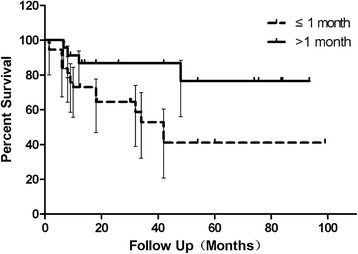
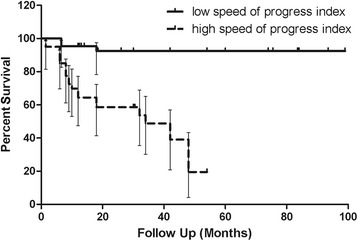
Results: Comparative analysis showed better outcomes in the group with longer interval and lower SPIs. Better intraocular pressure (IOP) control was found in patients with lower SPI at 1, 3, 6, 12 and 24 months postoperatively (19.54 ± 4.84 mmHg vs. 24.75 ± 8.87 mmHg, p = 0.004; 19.88 ± 7.78 mmHg vs. 23.19 ± 6.74 mmHg, p = 0.089; 17.45 ± 6.23 mmHg vs. 21.31 ± 7.28 mmHg, p = 0.031; 15.09 ± 6.21 mmHg vs. 19.18 ± 6.66 mmHg, p = 0.008; 14.95 ± 2.95 mmHg vs. 18.10 ± 3.96 mmHg, p = 0.004). The correlation between SPI and IOP at 1, 3, 6, 12 and 24 months postoperatively was 0.328 (CI = 0.105 to 0.529, p = 0.005), 0.192 (CI = -0.070 to 0.429, p = 0.149), 0.261 (CI = 0.010 to 0.481, p = 0.042), 0.046 (CI = -0.183 to 0.270, p = 0.70), and 0.230 (CI = -0.072 to 0.493, p = 0.134), respectively. Patients with lower SPI were less likely to fail (χ2 = 22.71, p = 0.000, OR: 0.174; 95%CI: 0.059-0.510). Kaplan-Meier analysis showed a much slower decline of success rate in patients with lower SPI (χ2 = 25.52, p = 0.000).
Conclusions: In PCG patients, lower preoperative SPI was associated with better short-term IOP control and success rate. Evaluation of preoperative SPI may help with surgical decision. However, early detection and treatment are important given the same SPI.
Keywords: Primary congenital glaucoma; Speed of progression index; Trabeculotomy.
Conflict of interest statement
Ethics approval and consent to participate
This retrospective study adhered to the Declaration of Helsinki and was approved by the Institutional Review Board of Ninth People’s Hospital.
Consent for publication
Not applicable.
Competing interests
The authors declare that they have no competing interests.
Publisher’s Note
Springer Nature remains neutral with regard to jurisdictional claims in published maps and institutional affiliations.
Figures
References
MeSH terms
LinkOut - more resources
Full Text Sources
Other Literature Sources
Medical
