


Improving the performance of community health workers in Swaziland: findings from a qualitative study
- PMID: 28923076
- PMCID: PMC5604406
- DOI: 10.1186/s12960-017-0236-x
Improving the performance of community health workers in Swaziland: findings from a qualitative study
Abstract
Background: The performance of community health workers (CHWs) in Swaziland has not yet been studied despite the existence of a large national CHW program in the country. This qualitative formative research study aimed to inform the design of future interventions intended to increase the performance of CHW programs in Swaziland. Specifically, focusing on four CHW programs, we aimed to determine what potential changes to their program CHWs and CHW program managers perceive as likely leading to improved performance of the CHW cadre.
Methods: The CHW cadres studied were the rural health motivators, mothers-to-mothers (M2M) mentors, HIV expert clients, and a community outreach team for HIV. We conducted semi-structured, face-to-face qualitative interviews with all (15) CHW program managers and a purposive sample of 54 CHWs. Interview transcripts were analyzed using conventional content analysis to identify categories of changes to the program that participants perceived would result in improved CHW performance.
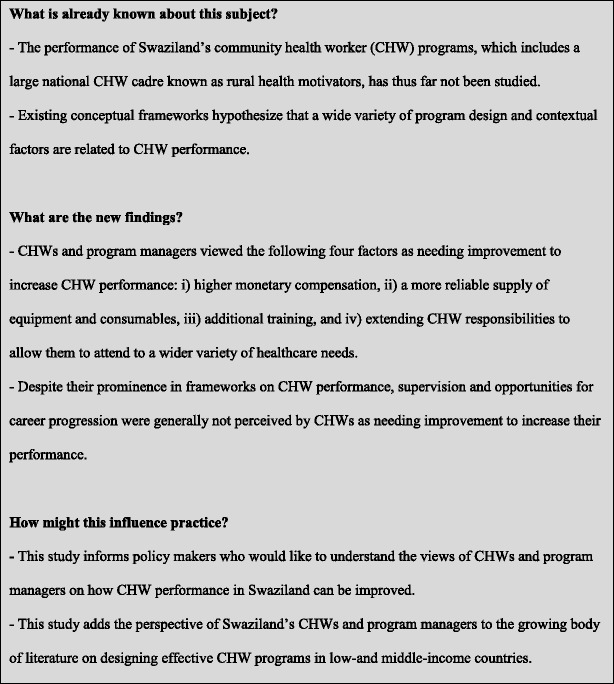
Results: Across the four cadres, participants perceived the following four changes to likely lead to improved CHW performance: (i) increased monetary compensation of CHWs, (ii) a more reliable supply of equipment and consumables, (iii) additional training, and (iv) an expansion of CHW responsibilities to cover a wider array of the community's healthcare needs. The supervision of CHWs and opportunities for career progression were rarely viewed as requiring improvement to increase CHW performance.
Conclusions: While this study is unable to provide evidence on whether the suggested changes would indeed lead to improved CHW performance, these views should nonetheless inform program reforms in Swaziland because CHWs and CHW program managers are familiar with the day-to-day operations of the program and the needs of the target population. In addition, program reforms that agree with their views would likely experience a higher degree of buy-in from these frontline health workers.
Keywords: Community health workers; Formative research; Motivation; Program design; Qualitative research; Rural health motivators; Swaziland.
Conflict of interest statement
Ethics approval and consent to participate
The research was approved by both the Swaziland Ethics Committee and the institutional review board of the Harvard T.H. Chan School of Public Health. All participants provided full written informed consent at enrolment into the study.
Consent for publication
Not applicable.
Competing interests
The authors declare that they have no competing interests.
Publisher’s Note
Springer Nature remains neutral with regard to jurisdictional claims in published maps and institutional affiliations.
References
-
- World Health Organization . World health statistics 2015. Geneva: World Health Organization; 2015.
-
- World Health Organization . The World Health Report 2006—working together for health. 2006.
-
- World Health Organization, PEPFAR, UNAIDS . Task shifting—global recommendations and guidelines. Geneva: World Health Organization; 2008.
-
- World Health Organization . Optimizing health worker roles to improve access to key maternal and newborn health interventions through task shifting. Geneva: World Health Organization; 2012. - PubMed
-
- One million community health workers. http://1millionhealthworkers.org/. Accessed 5 July 2017.
MeSH terms
LinkOut - more resources
Full Text Sources
Other Literature Sources
