


Signals that drive T-bet expression in B cells
- PMID: 28923237
- PMCID: PMC6191851
- DOI: 10.1016/j.cellimm.2017.09.004
Signals that drive T-bet expression in B cells
Abstract
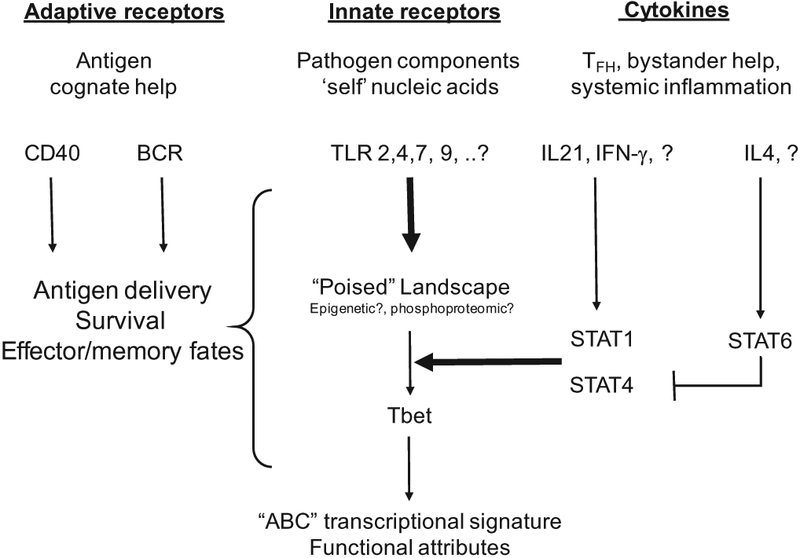
Transcription factors regulate various developmental and functional aspects of B cells. T-bet is a recently appreciated transcription factor associated with "Age-associated B cells" or ABCs, the development of autoimmunity, and viral infections. T-bet expression is favored by nucleic acid-containing antigens and immune complexes and is regulated by interplay between various cytokines, notably, the TFH cytokines IL-21, IL-4 and IFNγ. Adaptive signals by themselves cannot upregulate T-bet; however, they have a synergistic effect on induction of T-bet by innate receptors. The functional role of T-bet+ B cells is unclear, although it is known that T-bet promotes class switching to IgG2a/c. It is likely T-bet serves dichotomous roles in B cells, promoting pathogenic autoreactive antibodies on one hand but mediating microbial immunity on the other, making it a target of interest in both therapeutic and prophylactic settings.
Keywords: B cell; IFN-gamma; IL21; Signalling; T-bet; TLR.
Copyright © 2017 Elsevier Inc. All rights reserved.
Figures
Similar articles
-
Cutting Edge: IL-4, IL-21, and IFN-γ Interact To Govern T-bet and CD11c Expression in TLR-Activated B Cells.J Immunol. 2016 Aug 15;197(4):1023-8. doi: 10.4049/jimmunol.1600522. Epub 2016 Jul 18. J Immunol. 2016. PMID: 27430719 Free PMC article.
-
Know Your ABCs: Discovery, Differentiation, and Targeting of T-Bet+ B Cells.Immunol Rev. 2025 Mar;330(1):e13440. doi: 10.1111/imr.13440. Immunol Rev. 2025. PMID: 39844597 Free PMC article. Review.
-
Age-Associated B Cells: A T-bet-Dependent Effector with Roles in Protective and Pathogenic Immunity.J Immunol. 2015 Sep 1;195(5):1933-7. doi: 10.4049/jimmunol.1501209. J Immunol. 2015. PMID: 26297793 Free PMC article. Review.
-
Context-Dependent Role for T-bet in T Follicular Helper Differentiation and Germinal Center Function following Viral Infection.Cell Rep. 2019 Aug 13;28(7):1758-1772.e4. doi: 10.1016/j.celrep.2019.07.034. Cell Rep. 2019. PMID: 31412245 Free PMC article.
-
T-bet-expressing B cells during HIV and HCV infections.Cell Immunol. 2017 Nov;321:26-34. doi: 10.1016/j.cellimm.2017.04.012. Epub 2017 Jul 11. Cell Immunol. 2017. PMID: 28739077 Free PMC article. Review.
Cited by
-
Immunological memory in rheumatic inflammation - a roadblock to tolerance induction.Nat Rev Rheumatol. 2021 May;17(5):291-305. doi: 10.1038/s41584-021-00601-6. Epub 2021 Apr 6. Nat Rev Rheumatol. 2021. PMID: 33824526 Review.
-
Multiple Functions of B Cells in the Pathogenesis of Systemic Lupus Erythematosus.Int J Mol Sci. 2019 Nov 29;20(23):6021. doi: 10.3390/ijms20236021. Int J Mol Sci. 2019. PMID: 31795353 Free PMC article. Review.
-
CD11c+ T-bet+ B Cells Require IL-21 and IFN-γ from Type 1 T Follicular Helper Cells and Intrinsic Bcl-6 Expression but Develop Normally in the Absence of T-bet.J Immunol. 2020 Aug 15;205(4):1050-1058. doi: 10.4049/jimmunol.2000206. Epub 2020 Jul 17. J Immunol. 2020. PMID: 32680956 Free PMC article.
-
T-bet suppresses proliferation of malignant B cells in chronic lymphocytic leukemia.Blood. 2024 Aug 1;144(5):510-524. doi: 10.1182/blood.2023021990. Blood. 2024. PMID: 38684038 Free PMC article.
-
Alternative B Cell Differentiation During Infection and Inflammation.Front Immunol. 2022 Jun 24;13:908034. doi: 10.3389/fimmu.2022.908034. eCollection 2022. Front Immunol. 2022. PMID: 35812395 Free PMC article. Review.
References
-
- Nutt SL, Hodgkin PD, Tarlinton DM, Corcoran LM, The generation of antibody-secreting plasma cells, Nat. Rev. Immunol. 15 (2015) 160–171. - PubMed
-
- Bartholdy B, Matthias P, Transcriptional control of B cell development and function, Gene 327 (2004) 1–23. - PubMed
-
- Busslinger M, Transcriptional control of early B cell development, Annu. Rev. Immunol. 22 (2004) 55–79. - PubMed
-
- Schebesta M, Heavey B, Busslinger M, Transcriptional control of B-cell development, Curr. Opin. Immunol. 14 (2002) 216–223. - PubMed
-
- Nutt SL, Heavey B, Rolink AG, Busslinger M, Commitment to the B-lymphoid lineage depends on the transcription factor Pax5, Nature 401 (1999) 556–562. - PubMed
MeSH terms
Substances
Grants and funding
LinkOut - more resources
Full Text Sources
Other Literature Sources
