


Identification of sialic acid-binding function for the Middle East respiratory syndrome coronavirus spike glycoprotein
- PMID: 28923942
- PMCID: PMC5635925
- DOI: 10.1073/pnas.1712592114
Identification of sialic acid-binding function for the Middle East respiratory syndrome coronavirus spike glycoprotein
Abstract
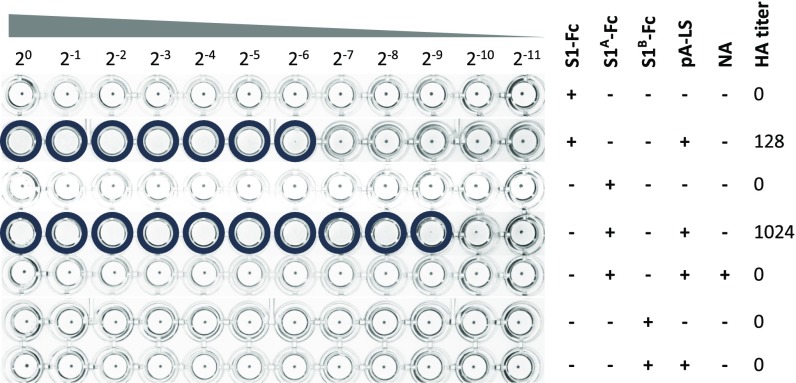
Middle East respiratory syndrome coronavirus (MERS-CoV) targets the epithelial cells of the respiratory tract both in humans and in its natural host, the dromedary camel. Virion attachment to host cells is mediated by 20-nm-long homotrimers of spike envelope protein S. The N-terminal subunit of each S protomer, called S1, folds into four distinct domains designated S1A through S1D Binding of MERS-CoV to the cell surface entry receptor dipeptidyl peptidase 4 (DPP4) occurs via S1B We now demonstrate that in addition to DPP4, MERS-CoV binds to sialic acid (Sia). Initially demonstrated by hemagglutination assay with human erythrocytes and intact virus, MERS-CoV Sia-binding activity was assigned to S subdomain S1A When multivalently displayed on nanoparticles, S1 or S1A bound to human erythrocytes and to human mucin in a strictly Sia-dependent fashion. Glycan array analysis revealed a preference for α2,3-linked Sias over α2,6-linked Sias, which correlates with the differential distribution of α2,3-linked Sias and the predominant sites of MERS-CoV replication in the upper and lower respiratory tracts of camels and humans, respectively. Binding is hampered by Sia modifications such as 5-N-glycolylation and (7,)9-O-acetylation. Depletion of cell surface Sia by neuraminidase treatment inhibited MERS-CoV entry of Calu-3 human airway cells, thus providing direct evidence that virus-Sia interactions may aid in virion attachment. The combined observations lead us to propose that high-specificity, low-affinity attachment of MERS-CoV to sialoglycans during the preattachment or early attachment phase may form another determinant governing the host range and tissue tropism of this zoonotic pathogen.
Keywords: MERS-CoV; attachment; receptor; sialic acid; spike.
Conflict of interest statement
The authors declare no conflict of interest.
Figures




References
-
- Zaki AM, van Boheemen S, Bestebroer TM, Osterhaus ADME, Fouchier RAM. Isolation of a novel coronavirus from a man with pneumonia in Saudi Arabia. N Engl J Med. 2012;367:1814–1820. - PubMed
-
- Lau SKP, et al. Genetic characterization of Betacoronavirus lineage C viruses in bats reveals marked sequence divergence in the spike protein of pipistrellus bat coronavirus HKU5 in Japanese pipistrelle: Implications for the origin of the novel Middle East respiratory syndrome coronavirus. J Virol. 2013;87:8638–8650. - PMC - PubMed
Publication types
MeSH terms
Substances
Grants and funding
LinkOut - more resources
Full Text Sources
Other Literature Sources
Miscellaneous
