Randomised trial of cord clamping and initial stabilisation at very preterm birth
- PMID: 28923985
- PMCID: PMC5750367
- DOI: 10.1136/archdischild-2016-312567
Randomised trial of cord clamping and initial stabilisation at very preterm birth
Abstract
Objectives: For very preterm births, to compare alternative policies for umbilical cord clamping and immediate neonatal care.
Design: Parallel group randomised (1:1) trial, using sealed opaque numbered envelopes.
Setting: Eight UK tertiary maternity units.
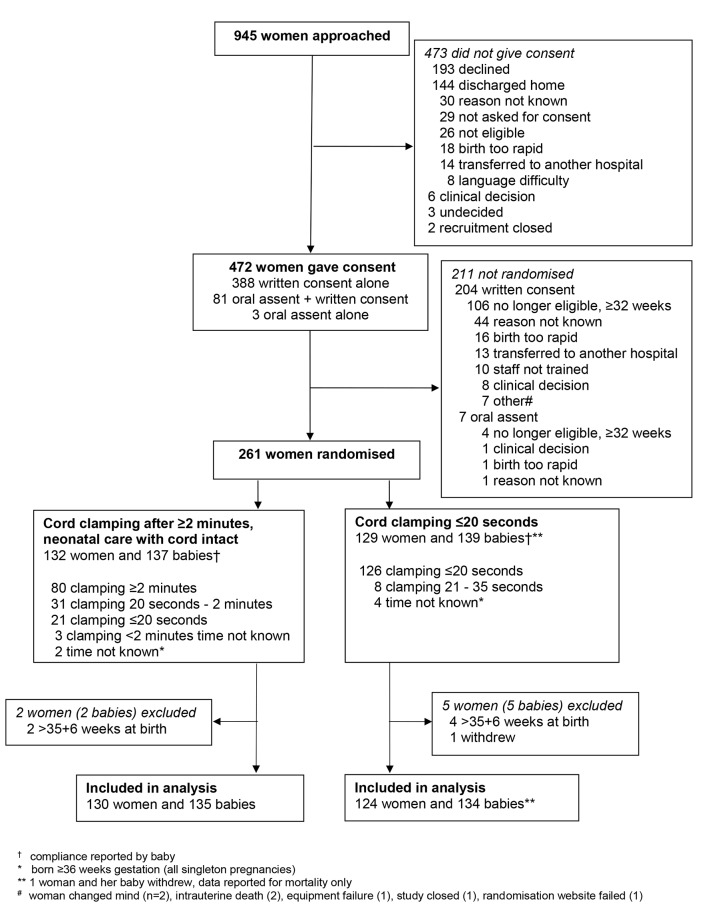
Participants: 261 women expected to have a live birth before 32 weeks, and their 276 babies.
Interventions: Cord clamping after at least 2 min and immediate neonatal care with cord intact, or clamping within 20 s and immediate neonatal care after clamping.
Main outcome measures: Intraventricular haemorrhage (IVH), death before discharge.
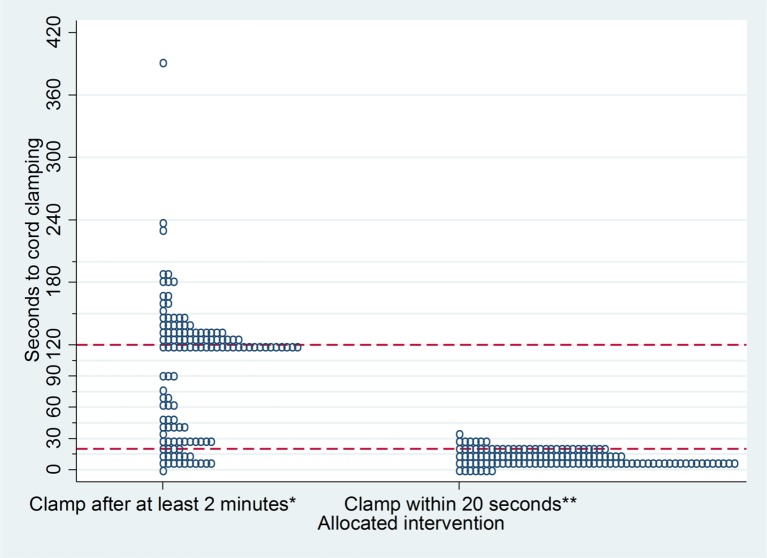
Results: 132 women (137 babies) were allocated clamping ≥2 min and neonatal care cord intact, and 129 (139) clamping ≤20 s and neonatal care after clamping; six mother-infant dyads were excluded (2, 4) as birth was after 35+6 weeks, one withdrew (death data only available) (0, 1). Median gestation was 28.9 weeks for those allocated clamping ≥2 min, and 29.2 for those allocated clamping ≤20 s. Median time to clamping was 120 and 11 s, respectively. 7 of 135 infants (5.2%) allocated clamping ≥2 min died and 15 of 135 (11.1%) allocated clamping ≤20 s; risk difference (RD) -5.9% (95% CI -12.4% to 0.6%). Of live births, 43 of 134 (32%) had IVH vs 47 of 132 (36%), respectively; RD -3.5% (-14.9% to 7.8%). There were no clear differences in other outcomes for infants or mothers.
Conclusions: This is promising evidence that clamping after at least 2 min and immediate neonatal care with cord intact at very preterm birth may improve outcome; a large trial is urgently needed.
Trial registration: ISRCTN 21456601.
Keywords: cord clamping; intraventricular haemorrhage; neonatal care with umbilical cord intact; preterm birth; randomised trial.
© Article author(s) (or their employer(s) unless otherwise stated in the text of the article) 2018. All rights reserved. No commercial use is permitted unless otherwise expressly granted.
Conflict of interest statement
Competing interests: All authors declare no support from any organisation for the submitted work other than the NIHR programme grant; no financial relationships with any organisations that might have an interest in the submitted work in the previous three years; the grant funded research included development of a neonatal resuscitation trolley now marketed as ‘LifeStart’ and purchased by two sites for use in this trial, several authors were involved in development of the trolley but have no further relationship with the manufacturer; no other relationships or activities that could appear to have influenced the submitted work.
Figures
References
-
- Dawes GS. Foetal and neonatal physiology; a comparative study of the changes at birth [by] Geoffrey S Dawes. Chicago: Year Book Medical Publishers, 1968. Chapter 13.
-
- Gunther M. The transfer of blood between baby and placenta in the minutes after birth. Lancet 1957;272:1277–80. - PubMed
Publication types
MeSH terms
Grants and funding
LinkOut - more resources
Full Text Sources
Other Literature Sources
Medical
Miscellaneous