. 2017 Nov 10;292(45):18689-18698.
doi: 10.1074/jbc.M117.796912. Epub 2017 Sep 18.

IRAK4 kinase activity controls Toll-like receptor-induced inflammation through the transcription factor IRF5 in primary human monocytes

Affiliations

IRAK4 kinase activity controls Toll-like receptor-induced inflammation through the transcription factor IRF5 in primary human monocytes

Leah Cushing et al. J Biol Chem. .

Abstract

Interleukin-1 receptor-associated kinase 4 (IRAK4) plays a critical role in innate immune signaling by Toll-like receptors (TLRs), and loss of IRAK4 activity in mice and humans increases susceptibility to bacterial infections and causes defects in TLR and IL1 ligand sensing. However, the mechanism by which IRAK4 activity regulates the production of downstream inflammatory cytokines is unclear. Using transcriptomic and biochemical analyses of human monocytes treated with a highly potent and selective inhibitor of IRAK4, we show that IRAK4 kinase activity controls the activation of interferon regulatory factor 5 (IRF5), a transcription factor implicated in the pathogenesis of multiple autoimmune diseases. Following TLR7/8 stimulation by its agonist R848, chemical inhibition of IRAK4 abolished IRF5 translocation to the nucleus and thus prevented IRF5 binding to and activation of the promoters of inflammatory cytokines in human monocytes. We also found that IKKβ, an upstream IRF5 activator, is phosphorylated in response to the agonist-induced TLR signaling. Of note, IRAK4 inhibition blocked IKKβ phosphorylation but did not block the nuclear translocation of NFκB, which was surprising, given the canonical role of IKKβ in phosphorylating IκB to allow NFκB activation. Moreover, pharmacological inhibition of either IKKβ or the serine/threonine protein kinase TAK1 in monocytes blocked TLR-induced cytokine production and IRF5 translocation to the nucleus, but not nuclear translocation of NFκB. Taken together, our data suggest a mechanism by which IRAK4 activity regulates TAK1 and IKKβ activation, leading to the nuclear translocation of IRF5 and induction of inflammatory cytokines in human monocytes.

Keywords: IKKβ; IRAK4; IRF5; NFκB; TAK1; TLR; Toll-like receptor; cytokine; inflammation; interferon regulatory factor.


Conflict of interest statement

W. K. and R. H. were employees of Nodality, contracted by Pfizer to perform SCNP studies with the IRAK4 inhibitor. All other authors were Pfizer employees

Figures
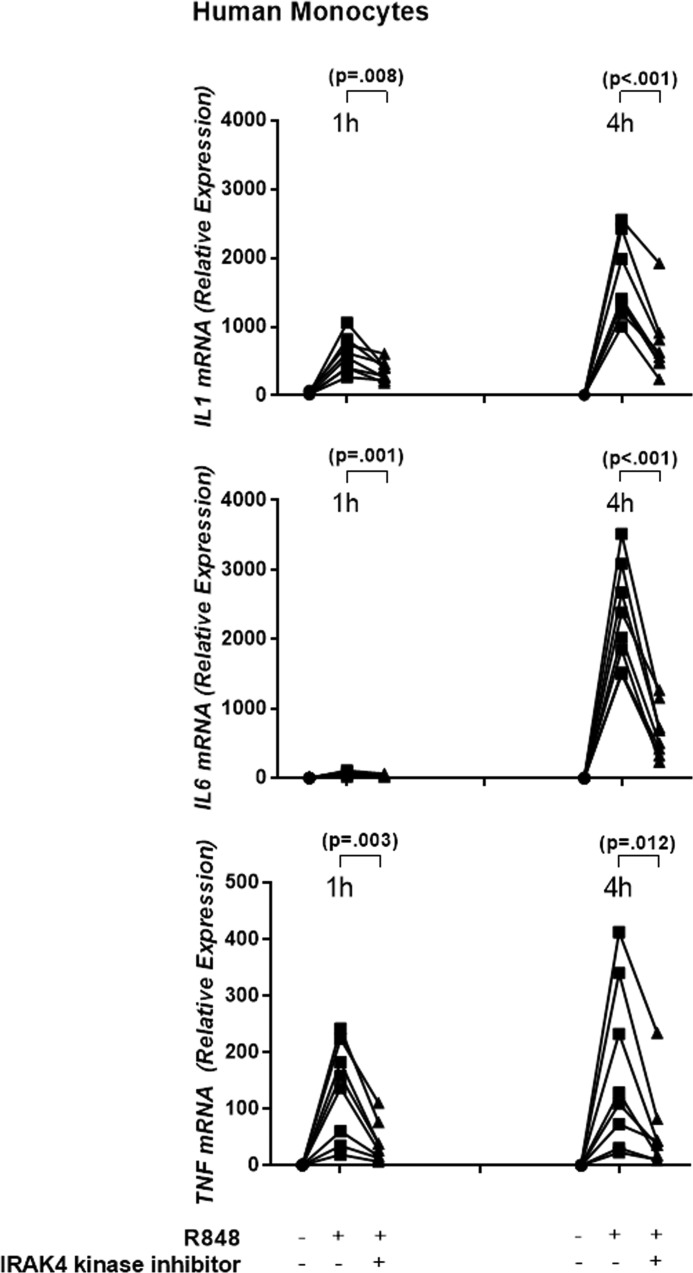
Figure 1.
Figure 1.
IRAK4 kinase is essential for inflammatory cytokine mRNA expression. Primary human monocytes were stimulated with R848 in the presence and/or absence of the IRAK4 kinase inhibitor. IL1, IL6, and TNF mRNA expression was measured 1 and 4 h after R848 stimulation (n = 8 donors).
Figure 2.
Figure 2.
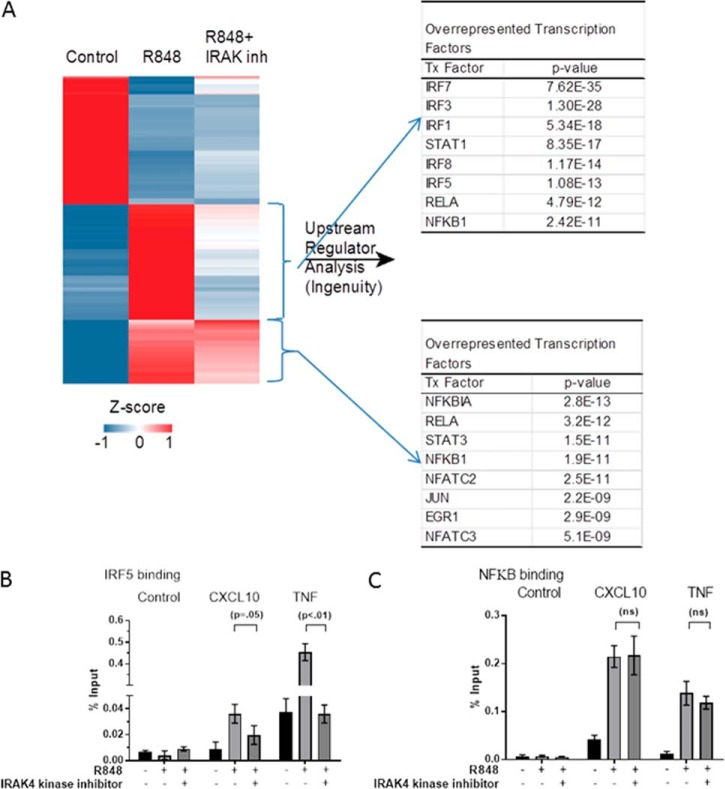
IRAK4 kinase inhibition results in differential regulation of genes in monocytes. A, 860 probes that showed a significant difference in expression (n = 8 donors, Welch's p value <0.01, -fold difference >4.0) following treatment with R848 for 1 h were visualized in TIBCO Spotfire 3.3.2. Each row was z-score normalized and then subjected to hierarchical clustering. The middle bracketed cluster represents 203 genes that were down-regulated following treatment with IRAK4, the lower bracketed cluster represents 185 genes that remained elevated despite IRAK4 inhibitor treatment. Ingenuity Pathway Analysis was used to identify the transcriptional regulators significantly associated with these two clusters of genes and the top are presented here. B and C, ChIP-qPCR demonstrates that IRAK4 kinase controls IRF5 binding to promoters of target genes but not NFκB. Human monocytes were pretreated with DMSO or IRAK4 kinase inhibitor for 30 min followed by treatment with 1 μg/ml R848 or untreated for 30 min. Increased binding of both IRF5 (B) and NFκB (C) were seen upon R848 treatment as compared with untreated conditions. Binding of IRF5 to promoters of target genes CXCL10 and TNFa was reduced with IRAK4 kinase inhibition (B), whereas no reduction of NFκB binding was observed with IRAK4 kinase inhibition (C). Error bars are standard deviation from the mean.
Figure 3.
Figure 3.
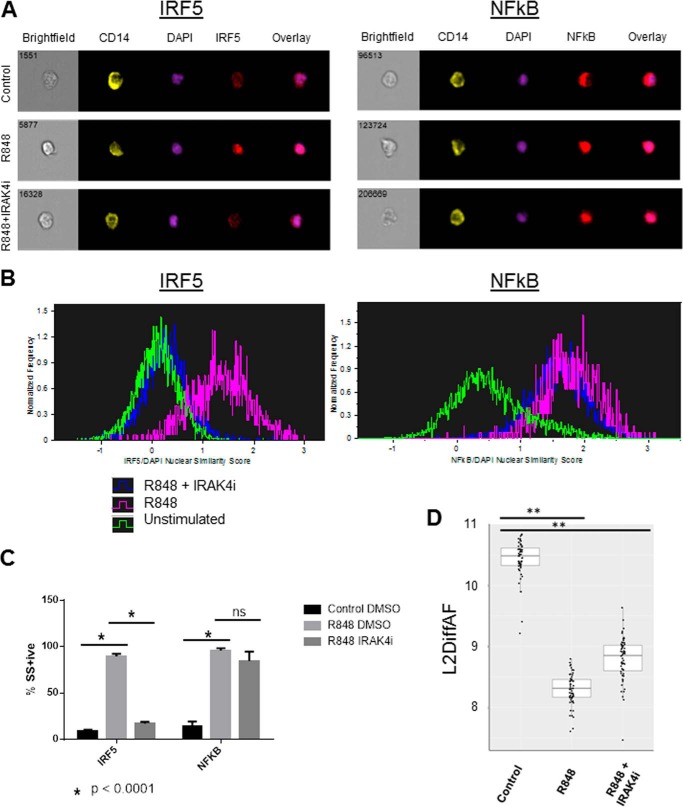
IRAK4 kinase controls IRF5 but not NFKβ activation and translocation to the nucleus. ImageStream files of human PBMC were gated for single, focused cells and CD14+ monocytes, then analyzed for nuclear translocation using similarity score (SS). A, Brightfield, CD14, DAPI, IRF5, and NFκB images and overlays from samples with and without R848 stimulation, with and without IRAK4 inhibitor treatment. B, single parameter histogram overlays depicting the distribution of monocyte nuclear similarity scores with and without R848 stimulation, with and without IRAK4 inhibitor treatment. C, quantification of IRF5 and NFκB nuclear translocation by similarity score percent positive events. n = 4 human PBMC samples (mean ± S.E.; *, p < 0.0001). D, analysis of IRAK4 kinase inhibitor–mediated inhibition of IκB degradation by SCNP flow cytometry analysis in PBMC from n = 59 healthy human volunteer blood donors. L2DiffAF = log2(MFI-MFI AF), where MFI = mean fluorescence intensity and AF = autofluorescence (**, p < 2.2 × 10(−16)).
Figure 4.
Figure 4.
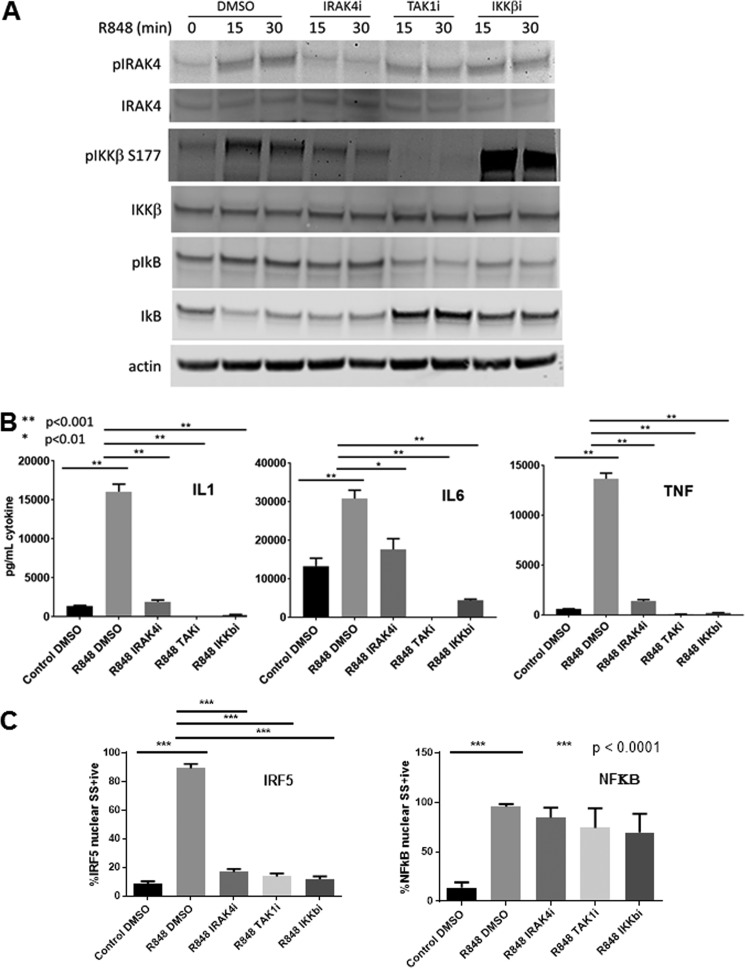
IRAK4 kinase acts through IKKβ to activate IRF5. A and B, 10 million monocytes from healthy human blood donors were reconstituted in 2 ml of RPMI with PenStepGln/HEPES/0.5% heat-inactivated fetal bovine serum (Thermo Fisher) and incubated with 1 μm IRAK4i (IRAK4 inhibitor), 1 μm TAK1i (TAK1 inhibitor 5Z-7 oxozeaenol, Tocris), 1 μm IKKβi (IKKβ inhibitor TPCA, Sigma), or 0.1% DMSO for 30 min prior to stimulation with 0.5 μg/ml R848 for 15 or 30 min prior to analysis of cell lysates by Western blot (A) or 20 h prior to analysis of supernatant cytokines by ELISA (B). A, Western blot image representative of one of three donors. Quantitation by LI-COR image analysis software shown in supplemental Fig. S2. B, cytokines represent mean ± S.E. for n = 3 donors, comparison by one-way analysis of variance (ANOVA). C, 2-ml cultures of freshly isolated human PBMC were stimulated 30 min with 1 μg/ml R848 after incubation with or without inhibitors for 30 min and then subjected to Amnis ImageStream analysis of IRF5 and NFκB nuclear localization (mean ± S.E.; n = 4 donors).
Figure 5.
Figure 5.
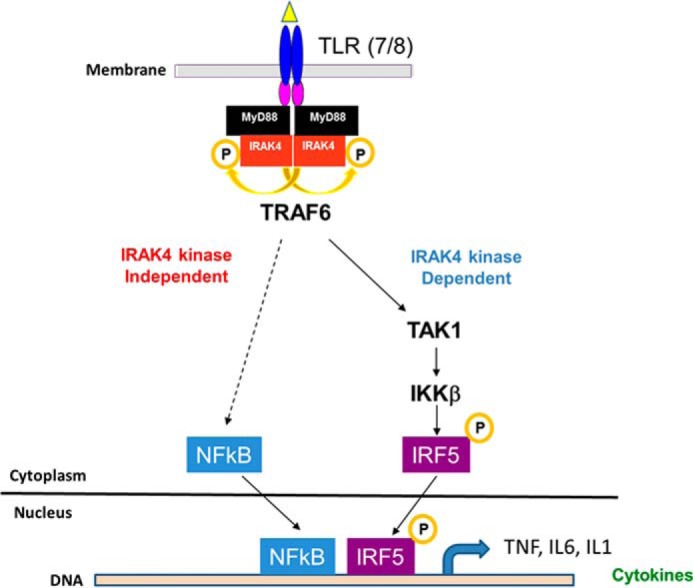
A proposed model of IRAK4 regulation of TLR7/8 signaling pathway in human monocytes is shown. Ligation of endosomal TLR7 and/or TLR8 by R848 leads to cytoplasmic assembly of the myddosome and autophosphorylation of IRAK4. Inflammatory cytokine production is induced by a signaling cascade including TAK1 and IKKβ that results in phosphorylation, nuclear translocation, and transcription mediated by IRF5 (right). At the same time, an as yet unidentified signaling cascade (left, dashed line) that requires IRAK4 scaffolding activity but not IRAK4 kinase activity but is independent of TAK1 and IKKβ, induces translocation of NFκB to the nucleus. Binding of both NFκB and IRF5 to the promoters of inflammatory cytokines is required for transcription.

References

    1. Picard C., Puel A., Bonnet M., Ku C. L., Bustamante J., Yang K., Soudais C., Dupuis S., Feinberg J., Fieschi C., Elbim C., Hitchcock R., Lammas D., Davies G., Al-Ghonaium A., et al. (2003) Pyogenic bacterial infections in humans with IRAK-4 deficiency. Science 299, 2076–2079 - PubMed
    1. Suzuki N., Suzuki S., Duncan G. S., Millar D. G., Wada T., Mirtsos C., Takada H., Wakeham A., Itie A., Li S., Penninger J. M., Wesche H., Ohashi P. S., Mak T. W., and Yeh W.-C. (2002) Severe impairment of interleukin-1 and Toll-like receptor signalling in mice lacking IRAK-4. Nature 416, 750–756 - PubMed
    1. Seganish W. M. (2016) Inhibitors of interleukin-1 receptor-associated kinase 4 (IRAK4): A patent review. (2012–2015). Expert Opin. Ther. Pat. 26, 917–932 - PubMed
    1. Flannery S., and Bowie A. G. (2010) The interleukin-1 receptor-associated kinases: Critical regulators of innate immune signalling. Biochem. Pharmacol. 80, 1981–1991 - PubMed
    1. Cushing L., Stochaj W., Siegel M., Czerwinski R., Dower K., Wright Q., Hirschfield M., Casanova J. L., Picard C., Puel A., Lin L. L., and Rao V. R. (2014) Interleukin 1/Toll-like receptor-induced autophosphorylation activates interleukin 1 receptor-associated kinase 4 and controls cytokine induction in a cell type-specific manner. J. Biol. Chem. 289, 10865–10875 - PMC - PubMed

MeSH terms