. 2017 Sep 18;8(1):568.
doi: 10.1038/s41467-017-00611-7.

Low carbon renewable natural gas production from coalbeds and implications for carbon capture and storage

Affiliations

Low carbon renewable natural gas production from coalbeds and implications for carbon capture and storage

Zaixing Huang et al. Nat Commun. .

Abstract

Isotopic studies have shown that many of the world's coalbed natural gas plays are secondary biogenic in origin, suggesting a potential for gas regeneration through enhanced microbial activities. The generation of biogas through biostimulation and bioaugmentation is limited to the bioavailability of coal-derived compounds and is considered carbon positive. Here we show that plant-derived carbohydrates can be used as alternative substrates for gas generation by the indigenous coal seam microorganisms. The results suggest that coalbeds can act as natural geobioreactors to produce low carbon renewable natural gas, which can be considered carbon neutral, or perhaps even carbon negative depending on the amount of carbon sequestered within the coal. In addition, coal bioavailability is no longer a limiting factor. This approach has the potential of bridging the gap between fossil fuels and renewable energy by utilizing existing coalbed natural gas infrastructure to produce low carbon renewable natural gas and reducing global warming.Coalbeds produce natural gas, which has been observed to be enhanced by in situ microbes. Here, the authors add plant-derived carbohydrates (monosaccharides) to coal seams to be converted by indigenous microbes into natural gas, thus demonstrating a potential low carbon renewable natural gas resource.


Conflict of interest statement

The authors declare no competing financial interests.

Figures
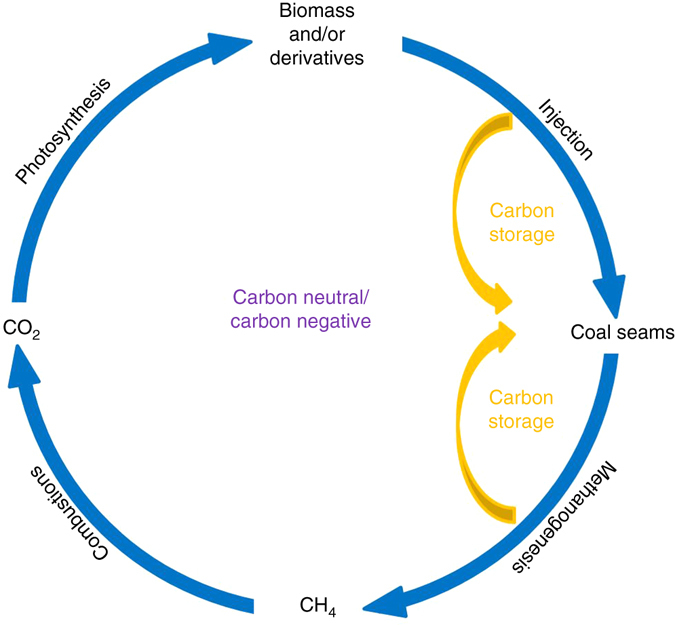
Fig. 1
Fig. 1
Schematic depicting the concept of low carbon renewable natural gas produced using coalbeds as geobioreactors and as sinks for carbon capture and storage. The concenpt is intended to take advantage of the coal seams as natural geobioreactors that use biomass derived simple sugars as the carbon source for natural gas production. Coal seams also serve as a sink for sequestering microbial biomass and carbon dioxide, further lowering the carbon intensity of the gas
Fig. 2
Fig. 2
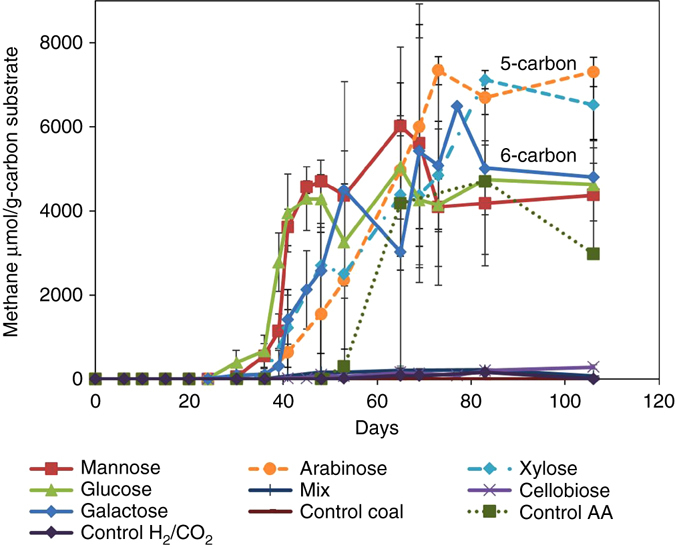
Profile of methane yeilds in all microcosms. The highest yeilds were from galactose, mannose, glucose, xylose, arabinose, and acetic acid-fed systems. The lowest yeilds were from the mix, cellobiose, H2/CO2, and controls with only coal. Data points represent the means ± s.d., n = 3 per group
Fig. 3
Fig. 3
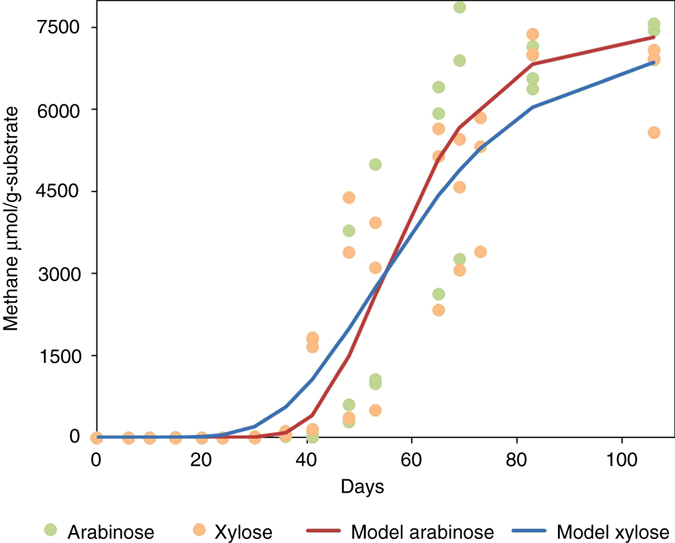
Gompertz model and raw data points for the five-carbon carbohydrates. The five-carbon carbohydrates include arabinose and xylose. The values of the asymptote for methane Arabinose A = 7339 and xylose A = 7124, the parameters µ m, and λ are displayed in Table 1
Fig. 4
Fig. 4
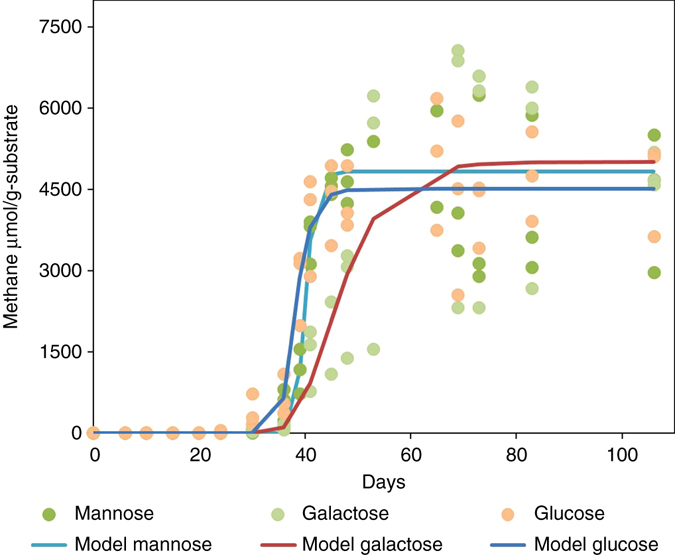
Gompertz model and raw data points of the six-carbon carbohydrates. The six-carbon carbohydrates include mannose, galactose, glucose. The values of the peak methane galactose A = 6488, mannose A = 6019 and glucose A = 5041, the parameters µ m, and λ are displayed in Table 1
Fig. 5
Fig. 5
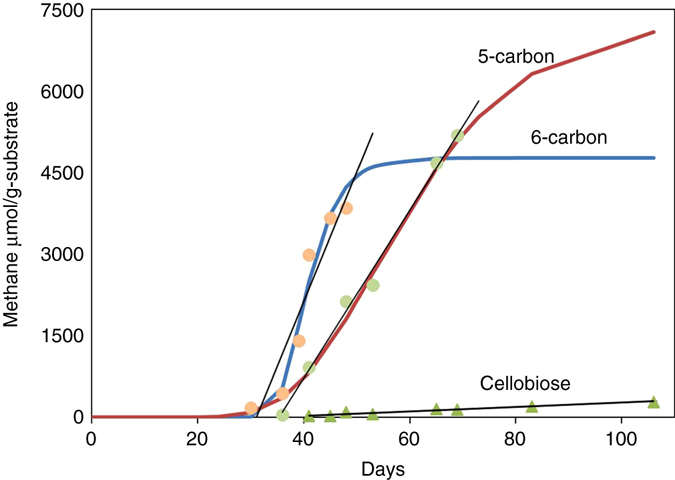
Linear methane rates and Gompertz model production curves of monosaccharides and disaccharides. The blue curve is the averaged six-carbon carbohydrates and the red curve is the averaged five-carbon carbohydrate treatments. The black line with green triangle data points represents the cellobiose treatments
Fig. 6
Fig. 6
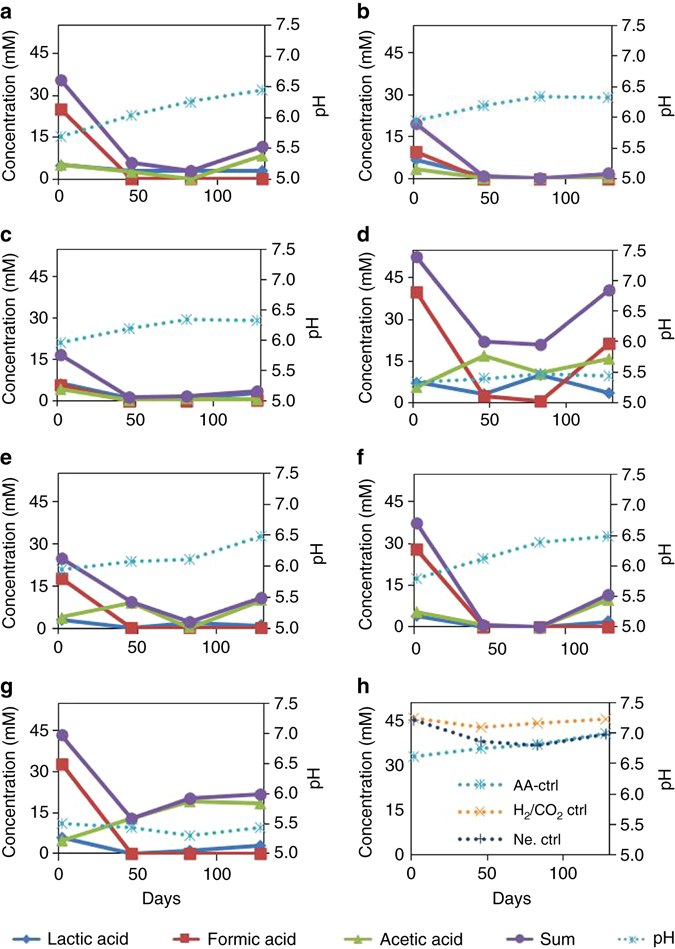
Intermediate organic acids and pHs at sampling intervals. The sampling intervals are day 2, 46, 83 and 128. Each data point represents an average value of three replicates. a Galactose; b mannose; c glucose; d cellobiose; e xylose; f arabinose; g mix; h controls (pH only)
Fig. 7
Fig. 7
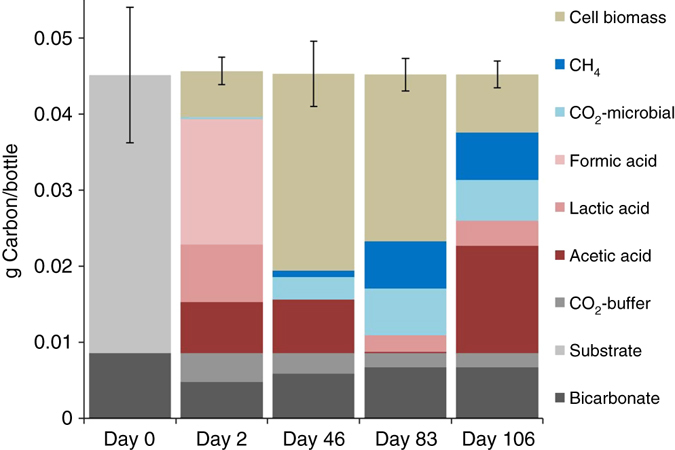
Carbon balance of five-carbon microcosms at sampling intervals. The sampling intervals are day 2, 46, 83 and 128. The columns represent the cumulative carbon levels of various compounds. Day 0 represents the total carbon (g per bottle) initially added to the system. Data points represent the means ± s.d., n = 3 per group
Fig. 8
Fig. 8
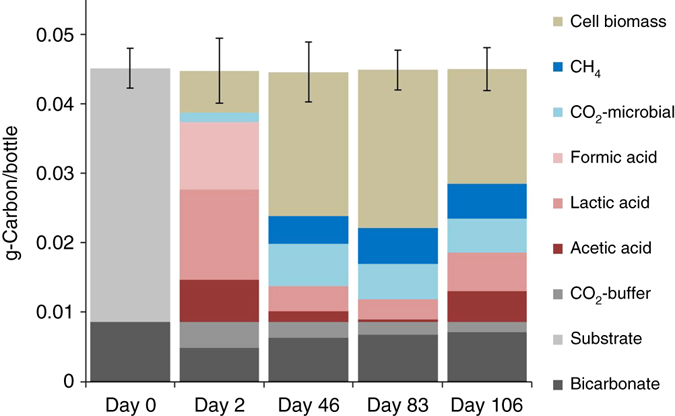
Carbon balance of six-carbon microcosms at sampling intervals. The sampling intervals are day 2, 46, 83 and 128. The columns represent the cumulative carbon levels of various compounds. Day 0 represents the total carbon (g per bottle) initially added to the system. Data points represent the means ± s.d., n = 3 per group
Fig. 9
Fig. 9
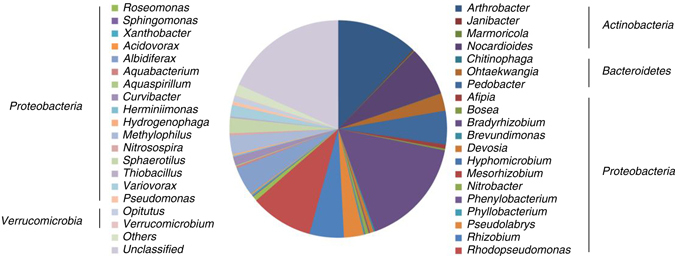
The composition of bacterial communities at genetic level. The genera contained <0.1% of sequence reads were summarized in group “others”

References

    1. Luppens, J. A., Scott, D. C., Osmonson, L. M., Haacke, J. E. & Pierce, P. E. Assessment of Coal Geology, Resources, and Reserve Base in the Powder River Basin, Wyoming and Montana (2013).
    1. EIA U.S. Energy Information Administration Monthly Energy Review. Available at: https://www.eia.gov/totalenergy/data/monthly/ (2016).
    1. Ayers WB., Jr Coalbed gas systems, resources, and production and a review of contrasting cases from the San Juan and Powder River basins. AAPG Bull. 2002;86:1853–1890.
    1. Jones, N. R., Quillinan, S. A. & McClurg, J. E. Wyoming Coal (Wyoming State Geological Survey, 2009).
    1. Swindell, G. S. Powder River Basin coalbed methane wells-reserves and rates. Rocky Mountain Oil & Gas Technology Symposium (Society of Petroleum Engineers, 2007).

Publication types

LinkOut - more resources