Review
. 2018 Jan 11;37(2):148-159.
doi: 10.1038/onc.2017.313. Epub 2017 Sep 18.

Functional significance and therapeutic implication of ring-type E3 ligases in colorectal cancer

Affiliations
Review

Functional significance and therapeutic implication of ring-type E3 ligases in colorectal cancer

L Liu et al. Oncogene. .

Abstract

Accumulative studies revealed that E3 ubiquitin ligases have important roles in colorectal carcinogenesis. The pathogenic mechanisms of colorectal cancer (CRC) initiation and progression are complex and heterogeneous, involving somatic mutations, abnormal gene fusion, deletion or amplification and epigenetic alteration, which may cause aberrant expression or altered function of E3 ligases in CRC. Defects of E3 ligases have been reported to be involved in the molecular etiology and pathogenesis of CRC. The aberrant expressed E3 ligases can function as either oncogenes or tumor suppressors depending on ubiquiting target substrates in CRC. Recently, considerable progress has been made in our understanding of the potential roles of E3 ligase-mediated ubiquitylation in colorectal carcinogenesis. There are mainly two subtypes of E3 ubiquitin ligases in humans, as defined by the presence of either a HECT domain or a RING finger domain on the basis of structural similitude. Most cancer-associated E3 ligases participate in regulating the cell cycle, apoptosis, gene transcription, cell signaling and DNA repair, the critical parts of CRC tumorigenesis. In this review, we have provided a comprehensive summary of abnormally expressed E3 ligases and their related pivotal mechanistic effects in CRC. In particular, we have highlighted the function of RING-type E3 ubiquitin enzymes in modulating cancer signaling pathways, immunity and tumor microenvironment in CRC development and progression; their mechanism(s) of action in CRC involving both ubiquitylation-dependent and ubiquitylation-independent effects; and the potential of RING E3 ligases as molecular biomarkers for predicting patient prognosis and as therapeutic targets in CRC. A better understanding of E3 ligase-mediated substrates' ubiquitylation involved in the development of CRC will provide new insights into the pathophysiology mechanisms of CRC, and unravel novel prognostic markers and therapeutic strategies for CRC.


Conflict of interest statement

The authors declare no conflict of interest.

Figures
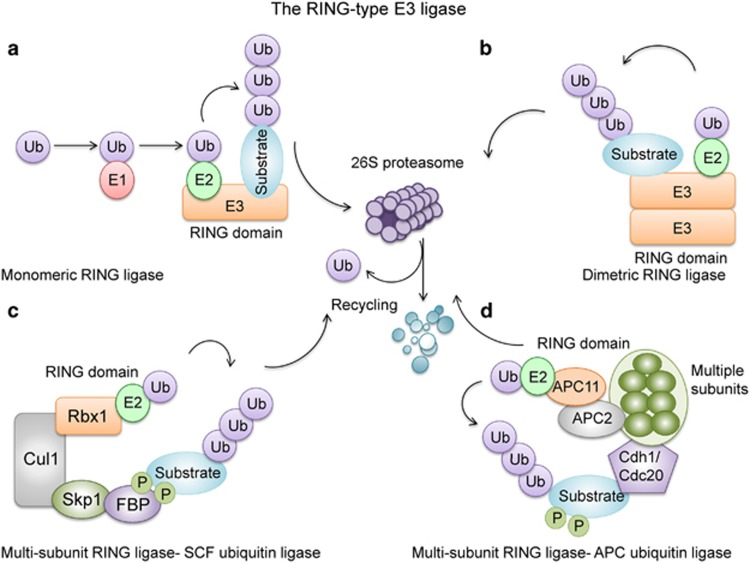
Figure 1
Figure 1
The ubiquitin–proteasome system and the structures of RING-type E3 ligases. RING-type E3 ligases are classified into monomeric RING ligases (a), dimeric RING ligases (b) and multisubunit RING ligases, which includes SCF (c) and anaphase-promoting complex/cyclosome (APC/C) type ubiquitin ligases (d). Ubiquitylation of proteins is achieved through an enzymatic cascade involving ubiquitin-activating enzyme (E1), ubiquitin-conjugating enzyme (E2) and ubiquitin-ligating enzyme (E3). E3 enzymes provide platforms for binding E2 enzymes and specific substrates, thereby coordinating ubiquitylation of the selected substrate (a, b). Substrates of SCF and APC/C ubiquitin ligases must be modified by phosphorylation before they can bind to E3 and be subjected to ubiquitination (c, d).
Figure 2
Figure 2
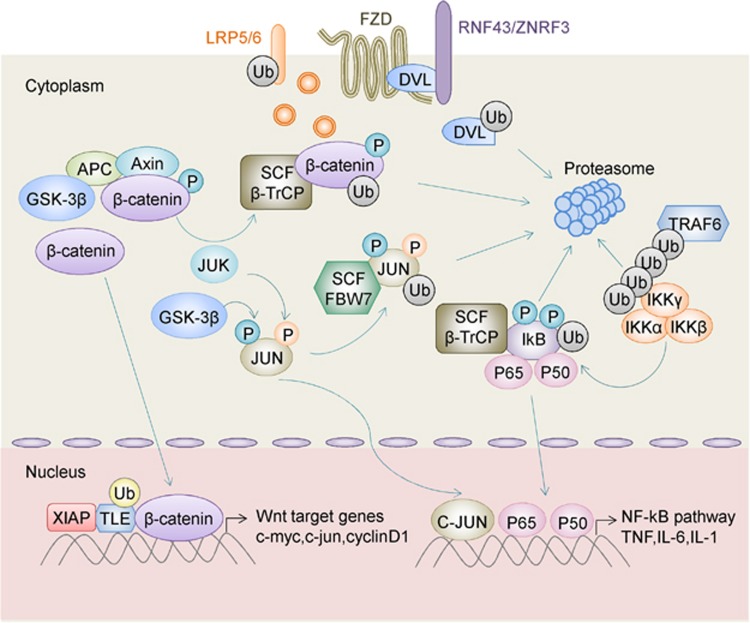
Regulation of Wnt/β-catenin signaling and oncogenic NF-κB pathway by ubiquitylating enzymes in CRC. Transmembrane E3 ligases RNF43 and ZNRF3 utilize disheveled segment polarity protein (DVL) as an adaptor to induce the endocytosis of Frizzled–LRP5/6 complex and abrogation of Wnt signaling. Binding of Wnt proteins to Wnt receptors results in the inactivation of GSK3β. β-catenin remains unphosphorylated, and it translocates to the nucleus where it binds to the LEF/TCF transcription complex, activating Wnt/β-catenin downstream target gene transcription. In the absence of Wnt, the scaffolding protein AXIN assembles a multiprotein destruction complex that consists of β-catenin, APC and GSK3β. β-catenin is phosphorylated by GSK3β and recognized by SCF-β-TrCP, leading to ubiquitylation and degradation of β-catenin. XIAP induces monoubiquitylation of TLE and releases TLE from the TCF/LEF complex, thereby initiating a canonical Wnt transcriptional program in CRC. K63-linked ubiquitylation of TRAF6 leads to the recruitment of the IKK (IκB kinase) complex (α, β, γ) and activation of IKK through TRAF6-mediated polyubiquitination. Activation of IKK kinase complex results in SCF-β-TrCP-mediated ubiquitination and proteasomal degradation of IκB (inhibitor of NF-κB kinase), thereby enabling the translocation of p50 and p65 to the nucleus and induction of NF-κB target genes, leading to positive regulation of NF-κB signaling. FBW7 preferentially targets phosphorylated JUN both by GSK3β or JNK and promotes JUN degradation in the proteasome. Accordingly, FBW7 depletion results in accumulation of phosphorylated JUN and stimulation of AP-1 activity. AP-1, activator protein 1; AXIN, axis inhibition protein; DVL, disheveled segment polarity protein; FBW7, F-box and WD repeat domain-containing 7; GSK3β, glycogen synthase kinase-3 beta; JUN, AP-1 transcription factor subunit; LEF/TCF, lymphoid enhancer factor/T-cell factor; LRP5/6, low-density lipoprotein receptor-related protein 5/6; TRAF6, tumor necrosis factor receptor-associated factor; XIAP, X-chromosome-linked inhibitor of apoptotic proteins.
Figure 3
Figure 3
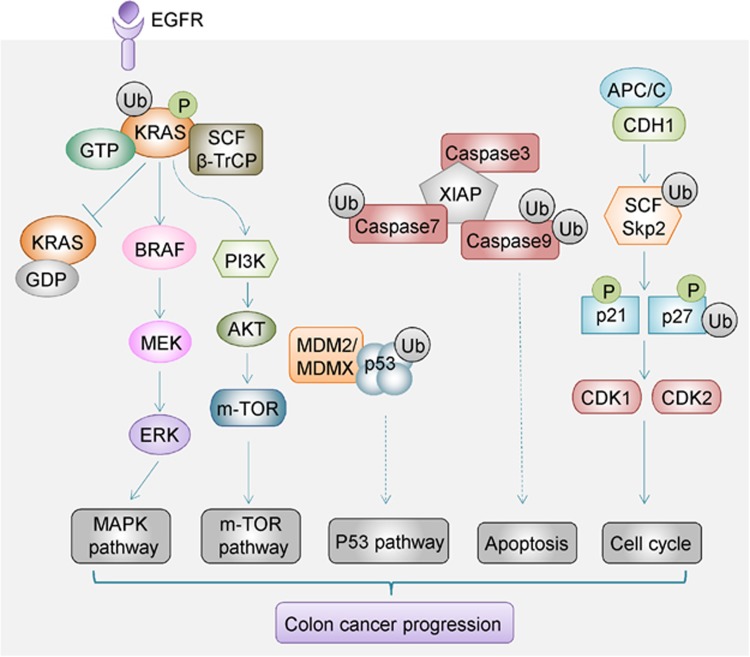
Regulation of important signaling pathways by E3 ubiquitin ligases in CRC. β-TrCP mediates polyubiquitination and degradation of phosphorylated KRAS. Loss of β-TrCP causes accumulation of active KRAS and the activation of downstream MAPK and m-TOR signaling to promote CRC progression. MDM2/MDMX directly binds to p53, and it mediates p53 degradation in the ubiquitin–proteasome system to inhibit the p53 pathway in CRC. XIAP promotes ubiquitylation and degradation of a number of caspase proteins to inhibit the caspase-dependent apoptosis pathway in CRC development. APC-type E3 ligase CDH1 cooperates with SCF-type E3 ligase SKP2 in governing cell cycle progression in CRC. β-TrCP, β-transducin repeat-containing protein; CDH1, Cadherin 1; MAPK, mitogen-activated protein kinase; m-TOR, the mechanistic target of rapamycin; SKP2, S phase kinase-associated protein 2; XIAP, X-chromosome-linked IAP.

References

    1. Torre LA, Bray F, Siegel RL, Ferlay J, Lortet‐Tieulent J, Jemal A. Global cancer statistics, 2012. CA Cancer J Clin 2015; 65: 87–108. - PubMed
    1. Watson IR, Takahashi K, Futreal PA, Chin L. Emerging patterns of somatic mutations in cancer. Nat Rev Genet 2013; 14: 703–718. - PMC - PubMed
    1. Lao VV, Grady WM. Epigenetics and colorectal cancer. Nat Rev Gastroenterol Hepatol 2011; 8: 686–700. - PMC - PubMed
    1. Fearon ER. Molecular genetics of colorectal cancer. Annu Rev Pathol 2011; 6: 479–507. - PubMed
    1. Hershko A, Ciechanover A. The ubiquitin system. Annu Rev Biochem 1998; 67: 425–479. - PubMed

Publication types

MeSH terms