


Nutrition, hygiene, and stimulation education to improve growth, cognitive, language, and motor development among infants in Uganda: A cluster-randomized trial
- PMID: 28925580
- PMCID: PMC6866193
- DOI: 10.1111/mcn.12527
Nutrition, hygiene, and stimulation education to improve growth, cognitive, language, and motor development among infants in Uganda: A cluster-randomized trial
Abstract
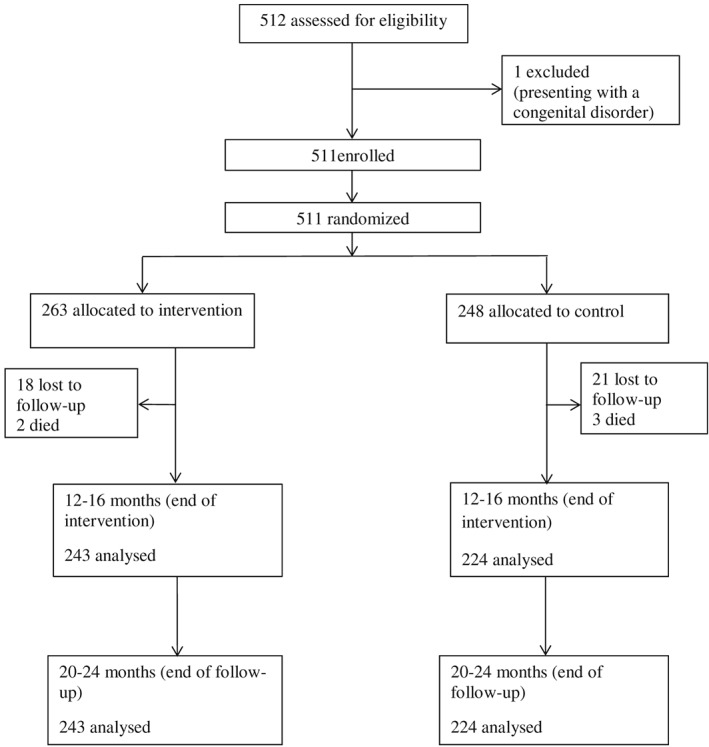
Stunting is associated with impaired cognitive and motor function. The effect of an education intervention including nutrition, stimulation, sanitation, and hygiene on child growth and cognitive/language/motor development, delivered to impoverished mothers in Uganda, was assessed. In a community-based, open cluster-randomized trial, 511 mother/children dyads aged 6-8 months were enrolled to an intervention (n = 263) or control (n = 248) group. The primary outcome was change in length-for-age z-score at age 20-24 months. Secondary outcomes included anthropometry and scores on the 2 developmental scales: Bayley Scales of Infant and Toddler Development-III and the Ages and Stages Questionnaire. There was no evidence of a difference in mean length-for-age z-score at 20-24 months between the 2 study groups: 0.10, 95% CI [-0.17, 0.36], p = .49. The intervention group had higher mean composite development scores than the controls on Bayley Scales of Infant and Toddler Development-III, the mean difference being 15.6, 95% CI [10.9, 20.2], p = .0001; 9.9, 95% CI [6.4, 13.2], p = .0001; and 14.6, 95% CI [10.9, 18.2], p = .0001, for cognitive, language, and motor composite scores, respectively. The mean difference in scores from the Ages and Stages Questionnaire were 7.0, 95% CI [2.9, 11.3], p = .001; 5.9, 95% CI [1.2, 10.3], p = .01; 4.2, 95% CI [1.7, 6.7], p = .001; 8.9, 95% CI [5.3, 12.3], p = .0001; and 4.4, 95% CI [0.0, 8.8], p = .05, for communication, gross motor, fine motor, problem solving, and personal-social development, respectively. The intervention education delivered to mothers promoted early development domains in cognitive, language, and motor development but not linear growth of small children in impoverished rural communities in Uganda. Our study showed that child development may be improved with a relatively low cost intervention strategy. This trial was registered at ClinicalTrials.gov as NCT02098031.
Keywords: Uganda; cognitive development; growth; hygiene; infant; nutrition education.
© 2017 John Wiley & Sons Ltd.
Conflict of interest statement
The authors declare that they have no conflicts of interest.
References
-
- Abu‐Saad, K. , & Fraser, D. (2010). Maternal nutrition and birth outcomes. Epidemiologic Reviews, 32, 5–25. - PubMed
-
- Amugsi, D. A. , Dimbuene, Z. T. , Kimani‐Murage, E. W. , Mberu, B. , & Ezeh, A. C. (2017). Differential effects of dietary diversity and maternal characteristics on linear growth of children aged 6–59 months in sub‐Saharan Africa: A multi‐country analysis. Public Health Nutrition, 20, 1029–1045. - PMC - PubMed
-
- Ayhan, H. , Suskan, E. , & Yildirim, S. (1996). The effect of nursing or rampant caries on height, body weight and head circumference. Journal of Clinical Pediatric Dentistry, 20, 209–212. - PubMed
-
- Bandura, A. (2001). Social cognitive theory: An agentic perspective. Annual Review of Psychology, 52, 1–26. - PubMed
-
- Bhandari, N. , Bahl, R. , Nayyar, B. , Khokhar, P. , Rohde, J. E. , & Bhan, M. K. (2001). Food supplementation with encouragement to feed it to infants from 4 to 12 months of age has a small impact on weight gain. Journal of Nutrition, 131, 1946–1951. - PubMed
Publication types
MeSH terms
Associated data
LinkOut - more resources
Full Text Sources
Other Literature Sources
Medical
