. 2017 Sep;14(3):2611-2620.
doi: 10.3892/ol.2017.6497. Epub 2017 Jun 30.

Cancer associated fibroblasts: An essential role in the tumor microenvironment

Affiliations

Cancer associated fibroblasts: An essential role in the tumor microenvironment

Leilei Tao et al. Oncol Lett. 2017 Sep.

Abstract

Fibroblasts in the tumor stroma are well recognized as having an indispensable role in carcinogenesis, including in the initiation of epithelial tumor formation. The association between cancer cells and fibroblasts has been highlighted in several previous studies. Regulation factors released from cancer-associated fibroblasts (CAFs) into the tumor microenvironment have essential roles, including the support of tumor growth, angiogenesis, metastasis and therapy resistance. A mutual interaction between tumor-induced fibroblast activation, and fibroblast-induced tumor proliferation and metastasis occurs, thus CAFs act as tumor supporters. Previous studies have reported that by developing fibroblast-targeting drugs, it may be possible to interrupt the interaction between fibroblasts and the tumor, thus resulting in the suppression of tumor growth, and metastasis. The present review focused on the reciprocal feedback loop between fibroblasts and cancer cells, and evaluated the potential application of anti-CAF agents in the treatment of cancer.

Keywords: cancer; cancer associated fibroblasts; interaction; loop; therapy.


Figures
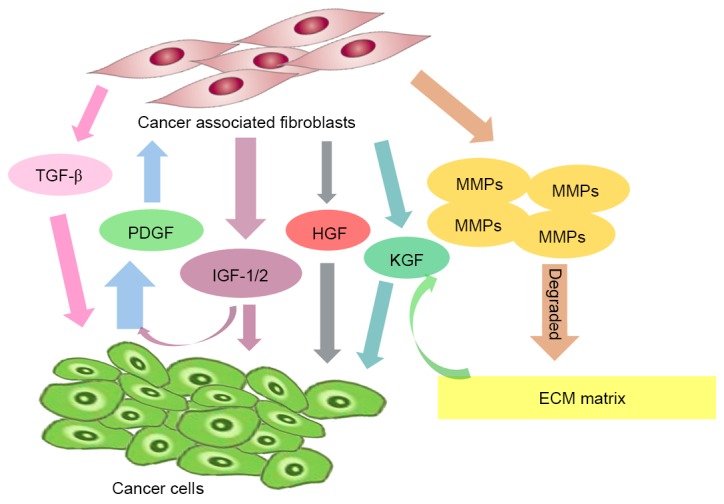
Figure 1.
Figure 1.
Cancer-induced fibroblast activation and cytokine release followed by cancer associated fibroblast-induced tumor growth, and metastasis resulting in a feedback loop. TGF-β, transforming growth factor β; PDGF, platelet-derived growth factor; IGF, IGF like family member; HGF, hepatocyte growth factor; KGF, keratinocyte growth factor; MMPs, matrix metalloproteinases; ECM, extracellular matrix.
Figure 2.
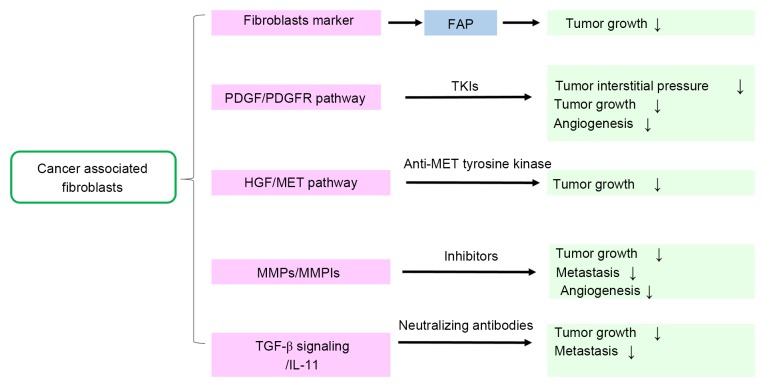
Figure 2.
Therapeutic target markers and pathways of CAFs. This fig presents the potential strategies of inhibiting the feedback loop and targeting CAFs during malignant cancer treatment. CAFs, cancer-associated fibroblasts; TGF-β, transforming growth factor β; PDGF, platelet-derived growth factor; PDGFR, PDGF receptor; HGF, hepatocyte growth factor; MET, hepatocyte growth factor receptor; MMPs, matrix metalloproteinases; MMPIs, MMP inhibitors; TKIs, tyrosine kinase inhibitors; IL-11, interleukin-11; FAP, fibroblast activation protein.

References

    1. Balkwill FR, Capasso M, Hagemann T. The tumor microenvironment at a glance. J Cell Sci. 2012;125:5591–5596. doi: 10.1242/jcs.116392. - DOI - PubMed
    1. Hanahan D, Weinberg RA. The hallmarks of cancer. Cell. 2000;100:57–70. doi: 10.1016/S0092-8674(00)81683-9. - DOI - PubMed
    1. Spano D, Zollo M. Tumor microenvironment: A main actor in the metastasis process. Clin Exp Metastasis. 2012;29:381–395. doi: 10.1007/s10585-012-9457-5. - DOI - PubMed
    1. Swartz MA, Iida N, Roberts EW, Sangaletti S, Wong MH, Yull FE, Coussens LM, DeClerck YA. Tumor microenvironment complexity: Emerging roles in cancer therapy. Cancer Res. 2012;72:2473–2480. doi: 10.1158/0008-5472.CAN-12-0122. - DOI - PMC - PubMed
    1. Quail DF, Joyce JA. Microenvironmental regulation of tumor progression and metastasis. Nat Med. 2013;19:1423–1437. doi: 10.1038/nm.3394. - DOI - PMC - PubMed