


Current status of insecticide resistance among malaria vectors in Kenya
- PMID: 28927428
- PMCID: PMC5606043
- DOI: 10.1186/s13071-017-2361-8
Current status of insecticide resistance among malaria vectors in Kenya
Abstract
Background: Insecticide resistance has emerged as one of the major challenges facing National Malaria Control Programmes in Africa. A well-coordinated national database on insecticide resistance (IRBase) can facilitate the development of effective strategies for managing insecticide resistance and sustaining the effectiveness of chemical-based vector control measures. The aim of this study was to assemble a database on the current status of insecticide resistance among malaria vectors in Kenya.
Methods: Data was obtained from published literature through PubMed, HINARI and Google Scholar searches and unpublished literature from government reports, research institutions reports and malaria control programme reports. Each data source was assigned a unique identification code and entered into Microsoft Excel 2010 datasheets. Base maps on the distribution of insecticide resistance and resistance mechanisms among malaria vectors in Kenya were generated using ArcGIS Desktop 10.1 (ESRI, Redlands, CA, USA).
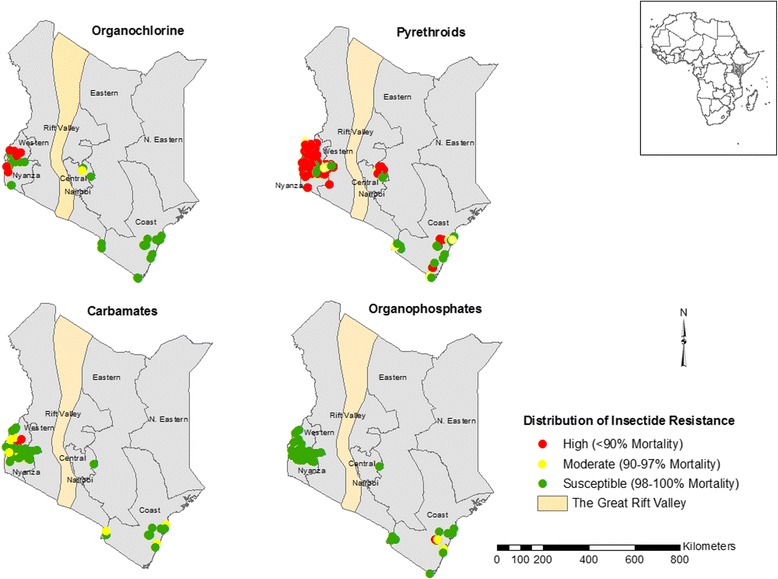
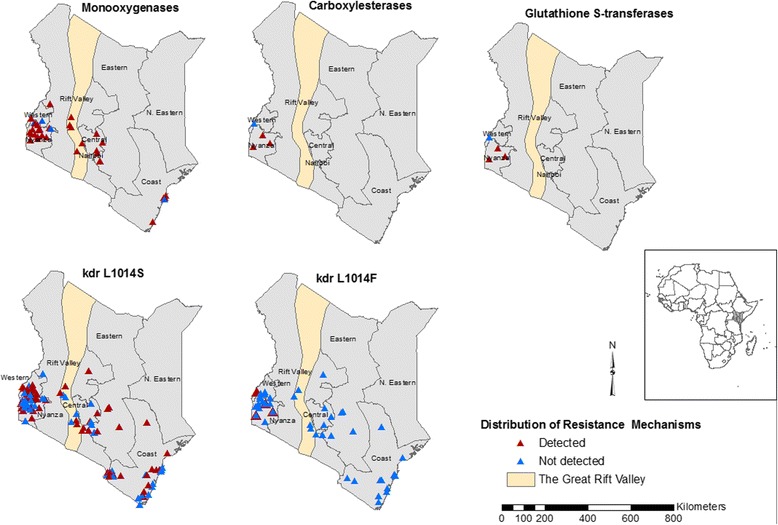
Results: Insecticide resistance status among the major malaria vectors in Kenya was reported in all the four classes of insecticides including pyrethroids, carbamates, organochlorines and organophosphates. Resistance to pyrethroids has been detected in Anopheles gambiae (s.s.), An. arabiensis and An. funestus (s.s.) while resistance to carbamates was limited to An. gambiae (s.s.) and An. arabiensis. Resistance to the organochlorine was reported in An. gambiae (s.s.) and An. funestus (s.s.) while resistance to organophosphates was reported in An. gambiae (s.l.) only. The mechanisms of insecticide resistance among malaria vectors reported include the kdr mutations (L 1014S and L 1014F) and elevated activity in carboxylesterase, glutathione S-transferases (GST) and monooxygenases. The kdr mutations L 1014S and L 1014F were detected in An. gambiae (s.s.) and An. arabiensis populations. Elevated activity of monooxygenases has been detected in both An. arabiensis and An. gambiae (s.s.) populations while the elevated activity of carboxylesterase and GST has been detected only in An. arabiensis populations.
Conclusions: The geographical maps show the distribution of insecticide resistance and resistance mechanisms among malaria vectors in Kenya. The database generated will provide a guide to intervention policies and programmes in the fight against malaria.
Keywords: Anopheles; Insecticide resistance; Kenya; Malaria; Mechanism of resistance.
Conflict of interest statement
Ethics approval and consent to participate
Not applicable.
Consent for publication
Not applicable.
Competing interests
The authors declare they have no competing interests.
Publisher’s Note
Springer Nature remains neutral with regard to jurisdictional claims in published maps and institutional affiliations.
Figures
References
-
- WHO. World Malaria Report 2016. Geneva: World Health Organization; 2016. http://www.who.int/malaria/publications/world-malaria-report-2016/report....
MeSH terms
Substances
LinkOut - more resources
Full Text Sources
Other Literature Sources
Research Materials
