


Genetic predisposition in children with cancer - affected families' acceptance of Trio-WES
- PMID: 28929227
- PMCID: PMC5748429
- DOI: 10.1007/s00431-017-2997-6
Genetic predisposition in children with cancer - affected families' acceptance of Trio-WES
Erratum in
-
Correction to: Genetic predisposition in children with cancer - affected families' acceptance of Trio-WES.Eur J Pediatr. 2018 Jan;177(1):61. doi: 10.1007/s00431-017-3033-6. Eur J Pediatr. 2018. PMID: 29105029 Free PMC article.
Abstract
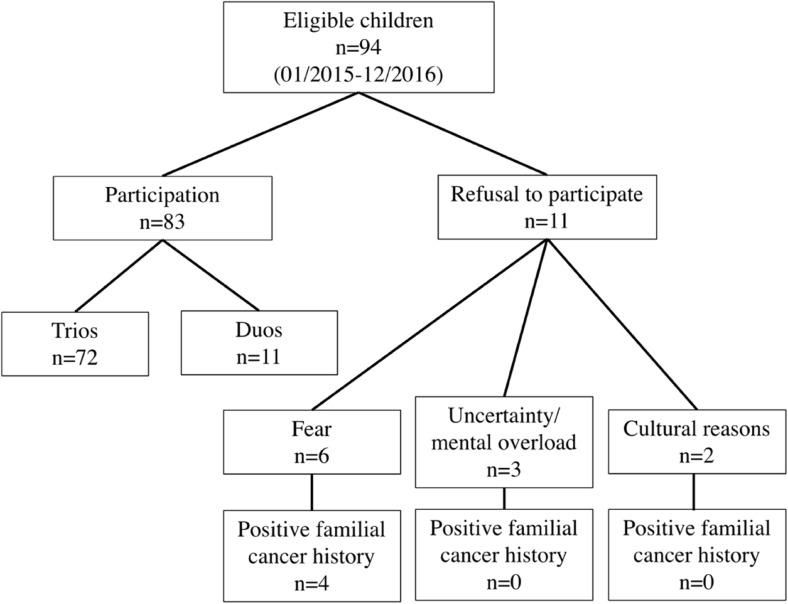
A considerable percentage of childhood cancers are due to cancer predisposition syndromes (CPS). The ratio of CPSs caused by inherited versus de novo germline mutations and the risk of recurrence in other children are unknown. We initiated a prospective study performing whole-exome sequencing (WES) of parent-child trios in children newly diagnosed with cancer. We initially aimed to determine the interest in and acceptance of trio WES among affected families and to systematically collect demographic, medical, and family history data to analyze whether these point to an underlying CPS. Between January 2015 and December 2016, 83 (88.3%) of 94 families participated; only 11 (11.7%) refused to participate. Five (6.0%) children presented with congenital malignancies and three (3.6%) with tumors with a high likelihood of an underlying CPS. Two (2.5%) families showed malignancies in family members < 18 years, 11 (13.8%) showed relatives < 45 years with cancer, 37 (46.3%) had a positive cancer history, and 14 (17.5%) families had > 1 relative with cancer.
Conclusions: Genetic testing in pediatric oncology is of great interest to the families, and the vast majority opts for investigation into potentially underlying CPSs. Trio sequencing provides unique insights into CPS in pediatric cancers and is increasingly becoming a common approach in modern oncology, and thus, trio sequencing needs also to be integrated routinely into the practice of pediatric oncology. What is Known: • A considerable percentage of childhood cancers are due to cancer predisposition syndromes (CPS). What is New: • Knowing about an underlying CPS and, thus, the risk of recurrence in other children is of great interest to affected families.
Keywords: Cancer predisposition syndrome; Children; Trio; Whole-exome sequencing.
Conflict of interest statement
Conflict of interest
The authors declare that they have no conflict of interest.
Informed consent
Informed consent was obtained from the parents and legal guardians respectively.
Figures
References
-
- Chompret A, Brugieres L, Ronsin M, Gardes M, Dessarps-Freichey F, Abel A, Hua D, Ligot L, Dondon MG, Bressac-de Paillerets B, Frebourg T, Lemerle J, Bonaiti-Pellie C, Feunteun J (2000) P53 germline mutations in childhood cancers and cancer risk for carrier individuals. Br J Cancer 82:1932–1937 - PMC - PubMed
-
- Fremerey J, Balzer S, Brozou T, Schaper J, Borkhardt A, Kuhlen M (2016) Embryonal rhabdomyosarcoma in a patient with a heterozygous frameshift variant in the DICER1 gene and additional manifestations of the DICER1 syndrome. Fam Cancer 16:401–405 - PubMed
-
- Ghosh S, Honscheid A, Duckers G, Ginzel S, Gohlke H, Gombert M, Kempkes B, Klapper W, Kuhlen M, Laws HJ, Linka RM, Meisel R, Mielke C, Niehues T, Schindler D, Schneider D, Schuster FR, Speckmann C, Borkhardt A (2016) Human RAD52: a novel player in DNA repair in cancer and immunodeficiency. Haematologica 102:e69–e72 - PMC - PubMed
Publication types
MeSH terms
LinkOut - more resources
Full Text Sources
Other Literature Sources
Medical
