. 2017 Sep 20;8(3):101.
doi: 10.3390/insects8030101.

Getting More Power from Your Flowers: Multi-Functional Flower Strips Enhance Pollinators and Pest Control Agents in Apple Orchards

Affiliations

Getting More Power from Your Flowers: Multi-Functional Flower Strips Enhance Pollinators and Pest Control Agents in Apple Orchards

Alistair John Campbell et al. Insects. .

Abstract

Flower strips are commonly recommended to boost biodiversity and multiple ecosystem services (e.g., pollination and pest control) on farmland. However, significant knowledge gaps remain regards the extent to which they deliver on these aims. Here, we tested the efficacy of flower strips that targeted different subsets of beneficial arthropods (pollinators and natural enemies) and their ecosystem services in cider apple orchards. Treatments included mixes that specifically targeted: (1) pollinators ('concealed-nectar plants'); (2) natural enemies ('open-nectar plants'); or (3) both groups concurrently (i.e., 'multi-functional' mix). Flower strips were established in alleyways of four orchards and compared to control alleyways (no flowers). Pollinator (e.g., bees) and natural enemy (e.g., parasitoid wasps, predatory flies and beetles) visitation to flower strips, alongside measures of pest control (aphid colony densities, sentinel prey predation), and fruit production, were monitored in orchards over two consecutive growing seasons. Targeted flower strips attracted either pollinators or natural enemies, whereas mixed flower strips attracted both groups in similar abundance to targeted mixes. Natural enemy densities on apple trees were higher in plots containing open-nectar plants compared to other treatments, but effects were stronger for non-aphidophagous taxa. Predation of sentinel prey was enhanced in all flowering plots compared to controls but pest aphid densities and fruit yield were unaffected by flower strips. We conclude that 'multi-functional' flower strips that contain flowering plant species with opposing floral traits can provide nectar and pollen for both pollinators and natural enemies, but further work is required to understand their potential for improving pest control services and yield in cider apple orchards.

Keywords: agri-environment schemes; agroecology; beneficial arthropods; conservation biological control; ecological intensification; ecosystem services; floral traits.


Conflict of interest statement

The authors declare no conflict of interest.

Figures
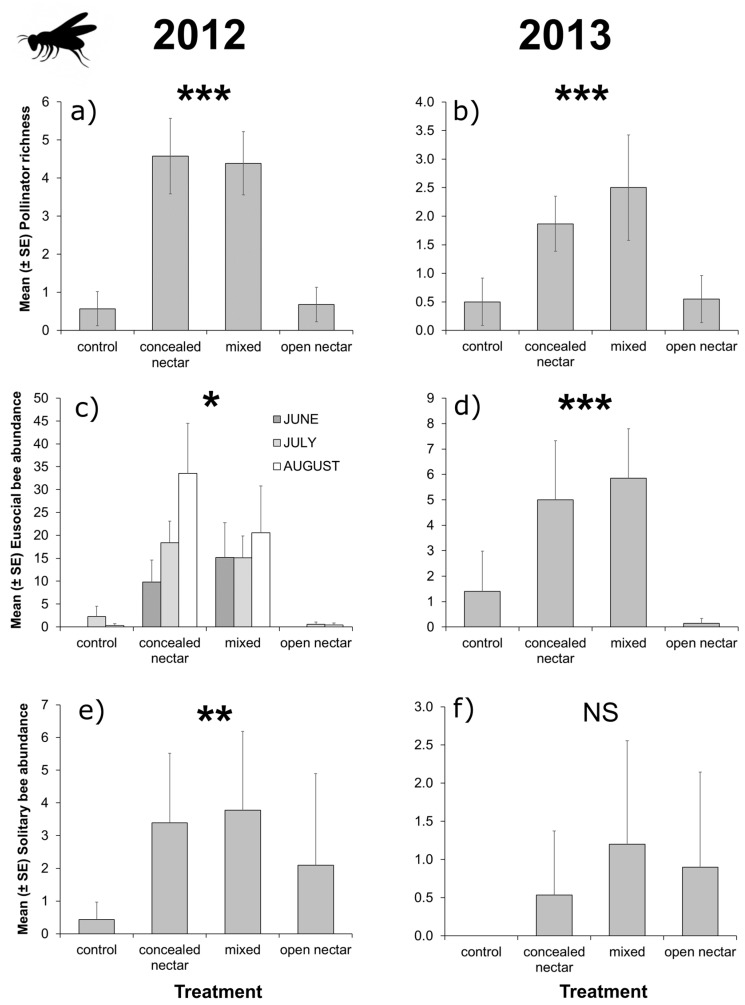
Figure 1
Figure 1
Effects of flower strips on flower-visiting pollinators in orchard alleyways. We detected significant effects of treatment (control, concealed-nectar, mixed, and open-nectar) on pollinator richness in either study year (a,b); an effect of the interaction between treatment and sampling month (June, July, and August) on eusocial bee abundance in 2012 (c); an effect of treatment on eusocial bee abundance in 2013 (d); and an effect of treatment on solitary bees in 2012 (e); but not 2013 (f). Error bars show standard errors and asterisks show level of significance (NS = p > 0.05, * = p < 0.05, ** = p < 0.01, *** = p < 0.001) reported in LRTs (see Table 1 and main text for details).
Figure 2
Figure 2
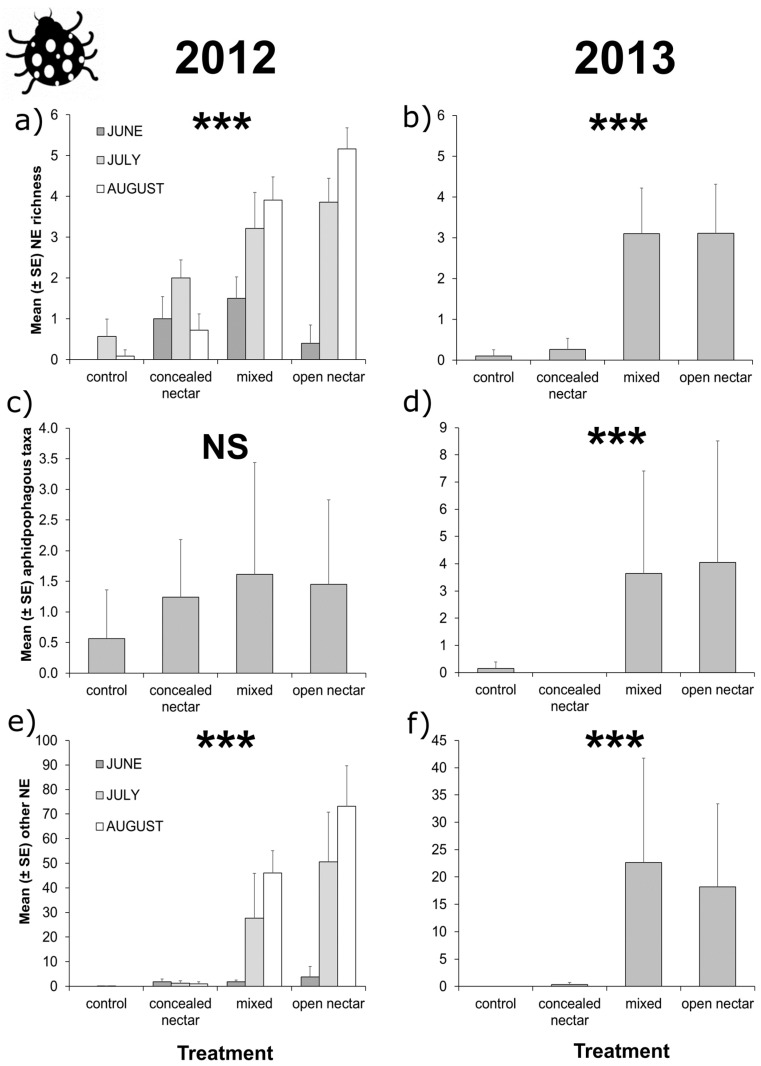
Effects of flower strips on flower-visiting natural enemies in orchard alleyways. We detected a significant effect of treatment on aphidophagous taxa in 2013 but not in 2012 (c,d); Other natural enemies and overall natural enemy richness were affected by the interaction between treatment (control, concealed-nectar, mixed, and open-nectar) and sampling month (June, July, and August) in 2012 (a,e); but by treatment only in 2013 (b,f). Error bars show standard errors and asterisks show level of significance (NS = p > 0.05, * = p < 0.05, ** = p < 0.01, *** = p < 0.001) reported in LRTs (see Table 1 and main text for details).
Figure 3
Figure 3
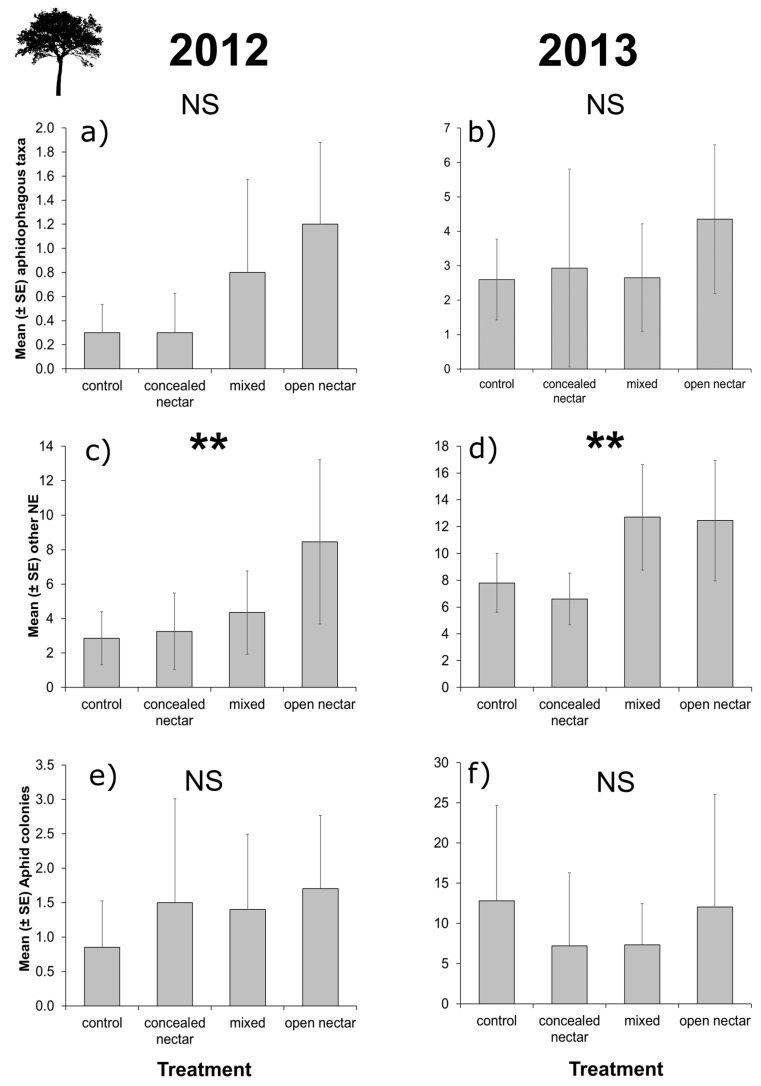
Effects of flower strips on natural enemies and aphid pests in apple trees (number of individuals/colonies per fifty branches). We detected no effect of treatment (control, concealed-nectar, mixed, and open-nectar) on aphidophagous natural enemies (hoverflies, lacewings, earwigs and ladybirds; (a,b)) or pest aphid densities in either year (e,f); but significant effects of treatment on other natural enemy abundance (non-syrphid flies, parasitoid wasps, bugs and non-coccinellid beetles; (c,d)). Error bars show standard errors and asterisks show level of significance (NS = p > 0.05, * = p < 0.05, ** = p < 0.01, *** = p < 0.001) reported in LRTs (see Table 2 and main text for details).
Figure 4
Figure 4
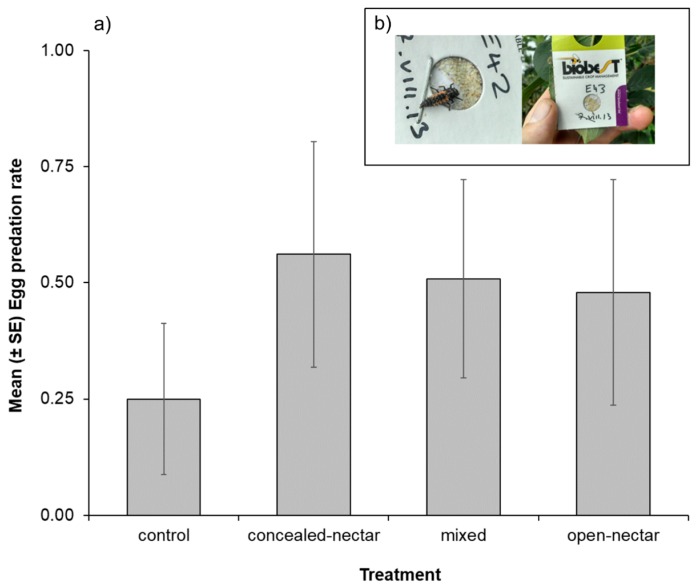
Mean (±SE) predation rate (0 = no predation and 1 = complete removal) of sentinel moth eggs in apple trees adjacent to different flower mixtures and control plots in 2013. (a). Inset photographs (b) show coccinellid larva feeding on eggs and example of card in apple foliage.
Figure 5
Figure 5
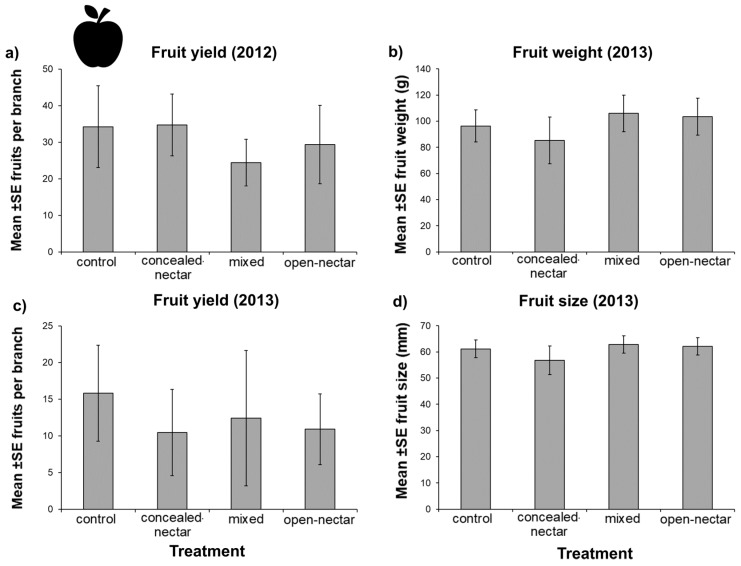
Effects of flower strips on fruit yield and fruit quality (size and weight) in orchards. We detected no effect of treatment (control, concealed-nectar, mixed, and open-nectar) on fruit yield in either study year (a,c); or on fruit size (b) and weight (d) in 2013. Error bars show standard errors.

References

    1. Godfray H.C.J. Food and biodiversity. Science. 2011;333:1231–1232. doi: 10.1126/science.1211815. - DOI - PubMed
    1. Biesmeijer J.C., Roberts S.P.M., Reemer M., Ohlemüller R., Edwards M., Peeters T., Schaffers A.P., Potts S.G., Kleukers R., Thomas C.D., et al. Parallel Declines in pollinators and insect-pollinated plants in Britain and the Netherlands. Science. 2006;313:351–354. doi: 10.1126/science.1127863. - DOI - PubMed
    1. Evenson R.E., Gollin D. Assessing the impact of the green revolution, 1960 to 2000. Science. 2003;300:758–762. doi: 10.1126/science.1078710. - DOI - PubMed
    1. Phalan B., Onial M., Balmford A., Green R.E., Godfray H.C.J., Tilman D., Green R.E., Cornell S.J., Scharlemann J.P.W., Balmford A., et al. Reconciling food production and biodiversity conservation: Land sharing and land sparing compared. Science. 2011;333:1289–1291. doi: 10.1126/science.1208742. - DOI - PubMed
    1. Kremen C., Williams N.M., Thorp R.W. Crop pollination from native bees at risk from agricultural intensification. Proc. Natl. Acad. Sci. USA. 2002;99:16812–16816. doi: 10.1073/pnas.262413599. - DOI - PMC - PubMed

LinkOut - more resources