Review
. 2017 Sep 20;9(9):127.
doi: 10.3390/cancers9090127.

Liver Cancer: Molecular Characterization, Clonal Evolution and Cancer Stem Cells

Affiliations
Review

Liver Cancer: Molecular Characterization, Clonal Evolution and Cancer Stem Cells

Germana Castelli et al. Cancers (Basel). .

Abstract

Liver cancer is the second most common cause of cancer-related death. The major forms of primary liver cancer are hepatocellular carcinoma (HCC) and intrahepatic cholangiocarcinoma (iCCA). Both these tumors develop against a background of cirrhotic liver, non-alcoholic fatty liver disease, chronic liver damage and fibrosis. HCC is a heterogeneous disease which usually develops within liver cirrhosis related to various etiologies: hepatitis B virus (HBV) infection (frequent in Asia and Africa), hepatitis C virus (HCV), chronic alcohol abuse, or metabolic syndrome (frequent in Western countries). In cirrhosis, hepatocarcinogenesis is a multi-step process where pre-cancerous dysplastic macronodules transform progressively into HCC. The patterns of genomic alterations observed in these tumors were recently identified and were instrumental for the identification of potential targeted therapies that could improve patient care. Liver cancer stem cells are a small subset of undifferentiated liver tumor cells, responsible for cancer initiation, metastasis, relapse and chemoresistance, enriched and isolated according to immunophenotypic and functional properties: cell surface proteins (CD133, CD90, CD44, EpCAM, OV-6, CD13, CD24, DLK1, α2δ1, ICAM-1 and CD47); the functional markers corresponding to side population, high aldehyde dehydrogenase (ALDH) activity and autofluorescence. The identification and definition of liver cancer stem cells requires both immunophenotypic and functional properties.

Keywords: cancer stem cells; cholangiocarcinoma; cirrhosis; gene sequencing; hepatic adenoma; hepatic dysplastic nodules; hepatitis; hepatocellular carcinoma; tumor xenotrasplantation assay.


Conflict of interest statement

The authors have no any conflict of interest to declare.

Figures
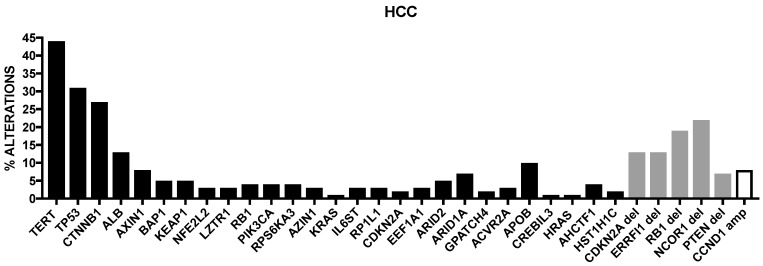
Figure 1
Figure 1
Main genetic alterations (gene mutations, gene deletions and amplifications) observed in HCC patients of multiethnic origin. The data are reprinted from a recent study of the cancer Genome Atlas Network [5] and are derived from a study based on the analysis of 363 patients.
Figure 2
Figure 2
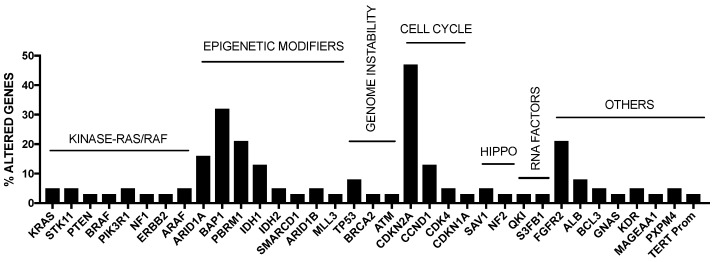
Frequent somatic alterations observed in cholangiocarcinoma (CCA). The data were reported by the TCGA in 38 CCA patients [29]. The altered genes were subdivided into different groups according to their function.
Figure 3
Figure 3
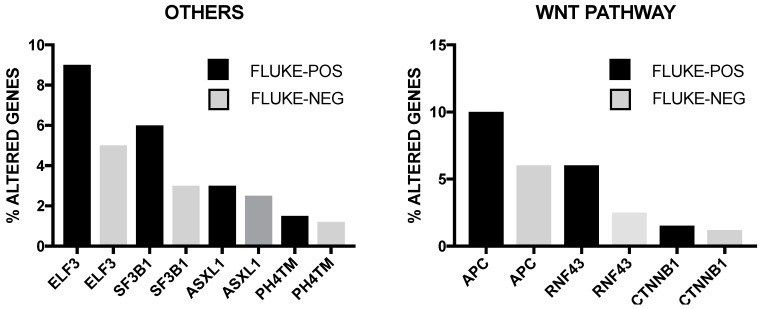
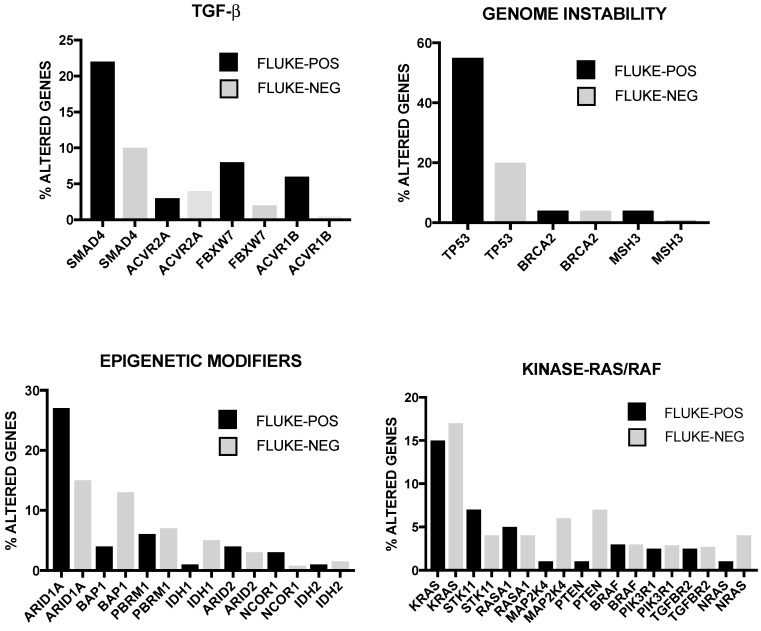
Frequently mutated genes in CCAs, subdivided into fluke-positive and fluke-negative patients. The data were based on the analysis of 489 CCAs and were reprinted from Jusakul et al. [34].
Figure 3
Figure 3
Frequently mutated genes in CCAs, subdivided into fluke-positive and fluke-negative patients. The data were based on the analysis of 489 CCAs and were reprinted from Jusakul et al. [34].
Figure 4
Figure 4
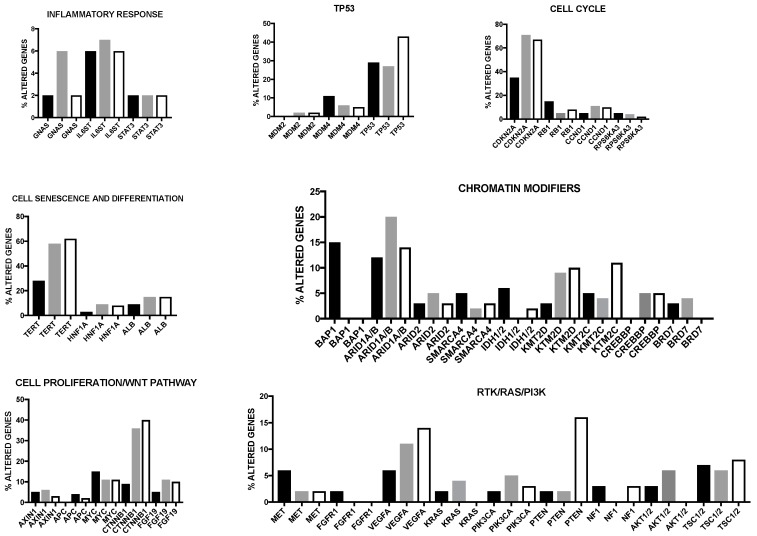
Integrated molecular analysis of somatic alterations in signaling pathways in HCC patients subdivided into three different clusters (cluster 1, black bars; cluster 2, gray bars; cluster 3, white bars). The data are reprinted from a recent study of the Cancer Genome Atlas Network [5]. Somatic alterations include mutations, copy number alterations and epigenetic silencing of CDKN2A.

References

    1. Ghouri Y.A., Misn I., Rowe J.H. Review of hepatocellular carcinoma: Epidemiology, etiology, and carcinogenesis. J. Carcinog. 2017;16:1. - PMC - PubMed
    1. Llovet J.M., Zucman-Rossi J., Pikarsky E., Sangro B., Schwartz M., Sherman M., Gores G. Hepatocellular carcinoma. Nat. Rev. Dis. Primers. 2016;2:16018. doi: 10.1038/nrdp.2016.18. - DOI - PubMed
    1. Sia D., Villanueva A., Friedman S.L., Llovet J.M. Liver cancer cell of origin, molecular class, and effects on patient prognosis. Gastroenterology. 2017;152:745–761. doi: 10.1053/j.gastro.2016.11.048. - DOI - PMC - PubMed
    1. Shibata T., Aburatani H. Exploration of liver cancer genomes. Nat. Rev Gastroenterol. Pathol. 2014;11:340–349. doi: 10.1038/nrgastro.2014.6. - DOI - PubMed
    1. Marquardt J.U., Andersen J.B., Torgeirsson S.S. Functional and genetic deconstruction of the cellular origin in liver cancer. Nat. Rev. Cancer. 2015;15:653–667. doi: 10.1038/nrc4017. - DOI - PubMed

LinkOut - more resources